The Journey of Diwali from the West Indies to North America
Our past may shape us, but it does not have to define the future we create. In my article, I explore how acknowledging our experiences, finding our voice, and intentionally rewriting our story can transform pain into purpose and open the door to healing, strength, and a new chapter. Sometimes that chapter begins with a simple act of courage: saying out loud what we’ve carried in silence.

How generations of Caribbean families of Indian descent carried their faith, traditions, and cultural identity across oceans and why preserving that legacy matters today. Drawing on childhood memories of glowing diyas, family prayers, and neighbours sharing parsad in Guyana, Sandy Shobha Maeck reflects on how Diwali has evolved since her move to Canada and what it means to pass these traditions on to younger generations.
More than a festival of lights
Every year, as Diwali approaches, I find myself travelling back in time, not by plane but through memories of my childhood in Guyana. I remember the excitement, the preparations, the beautiful glow of hundreds of diyas, and the unmistakable feeling of community that filled our neighbourhood.
Today, living in Canada, I often reflect on how far our traditions have travelled. What began centuries ago in India found a home in the Caribbean through the journeys of our ancestors and eventually crossed another ocean with families like mine.
Diwali, also known as Deepavali, is one of Hinduism’s most significant festivals. Its spiritual meaning is rooted in the triumph of light over darkness, knowledge over ignorance, and good over evil. Different Hindu traditions associate the festival with different sacred stories, including the return of Lord Rama to Ayodhya and the worship of Goddess Lakshmi.
But for Caribbean families of Indian descent, Diwali carries another layer of significance. It is a connection to our history, our ancestors, and the cultural identity that generations struggled to preserve.
The journey from India to the Caribbean
To understand what Diwali means to communities of Indian descent in the Caribbean today, we must first understand how our ancestors arrived in the region. In 1838, the first Indian indentured labourers arrived in British Guiana, now Guyana. Trinidad followed in 1845, and Suriname in 1873. Under European colonial systems, Indian men and women were recruited to work on plantations following the abolition of slavery. Many endured difficult working conditions, separation from their families, and profound cultural displacement.
They left behind familiar villages, languages, religious institutions, and ways of life. Yet they carried with them their faith, beliefs, customs, and memories, things that could not be packed into a suitcase. Through prayers, storytelling, religious observances, music, food, and family traditions, they preserved elements of their Indian heritage while adapting to life in the Caribbean.
Diwali became one of those enduring traditions. Imagine what it must have meant for our ancestors to light a simple clay diya in an unfamiliar land, thousands of miles from the homes they once knew. Perhaps that small flame offered comfort, continuity, and a reminder of who they were. Over generations, these traditions became woven into Caribbean life, shaping the distinctive cultural identity of Caribbean communities of Indian descent that we recognize today.
Diwali through my childhood eyes: Memories of Guyana
Some of my most cherished memories of growing up in Guyana are of Diwali. The celebration began long before the first diya was lit. In the days leading up to Diwali, our homes and yards were thoroughly cleaned. New clothes were purchased, diyas were brought home, and there was an unmistakable sense of excitement in the air.
On Diwali day, preparations began early. We spent hours carefully filling the clay diyas with oil and placing the cotton wicks inside. Every diya had its place, and every preparation was part of something meaningful. As evening approached, our parents performed prayers at our home mandir, the sacred altar where our family gathered in devotion.
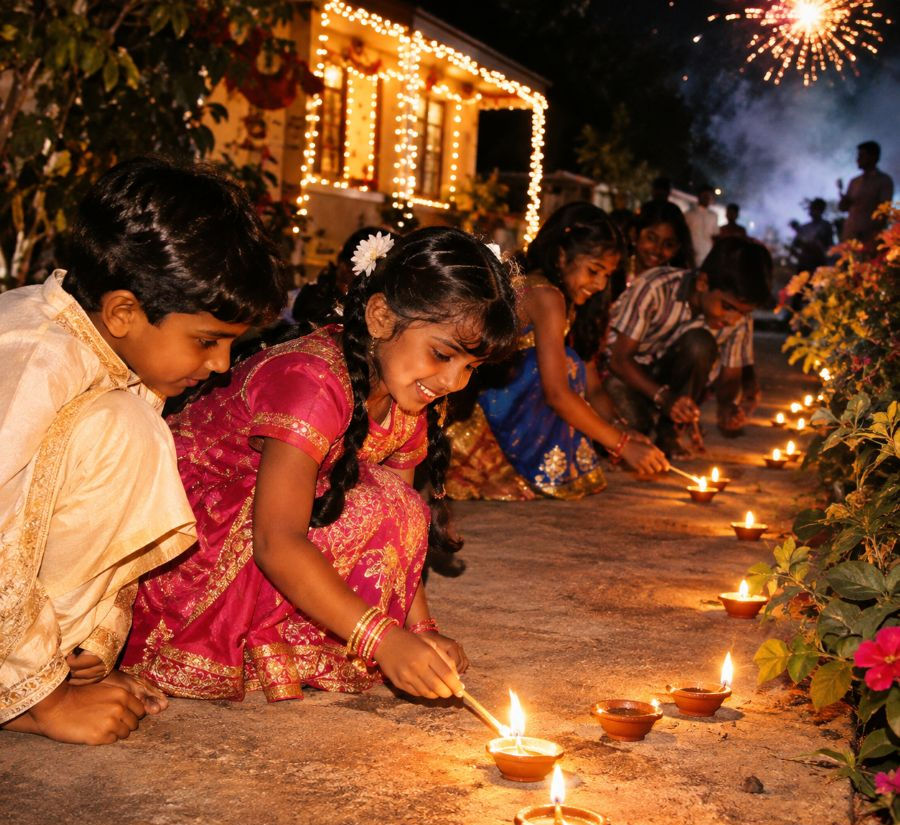
Then came the moment we had all been waiting for. One by one, the diyas were lit and placed around our homes, along the stairs, throughout the yard, and even on the concrete fences. As darkness settled, the entire neighbourhood began to glow. I can still picture the beauty of those evenings.
Children and adults gathered outside, admiring the illuminated homes. The boys in the neighbourhood would create their own little fireworks using steel wool attached to long wires or wire hangers, sending sparks spinning through the night. There was laughter, excitement, and a wonderful feeling of togetherness. Yes, sometimes there was the smell of burnt hair, but it was all part of the fun.
After the prayers and the lighting of the diyas, we enjoyed a delicious vegetarian meal, often a simple but satisfying plate of aloo curry and roti. But the evening was far from over. We would visit homes throughout the neighbourhood, sharing parsad, exchanging greetings, and admiring the beautiful displays of light. What made those celebrations so special was the sense of community. Diwali was not confined to the walls of our home. The entire neighbourhood seemed to participate in its beauty.
Looking back, I realize that those evenings taught me something far greater than the rituals themselves. They taught me about belonging, generosity, faith, and the importance of preserving traditions that connect us to our ancestors.
Now that I live in Canada, those memories carry an even deeper meaning. The lights may shine in different surroundings, the weather may be colder, and our celebrations may have evolved, but the significance of Diwali remains rooted in the same values. Perhaps that is the greatest gift our ancestors left us: the traditions we practise and the stories, memories, and sense of identity that we carry wherever life takes us.
From Caribbean villages to North American cities
As generations of Caribbean families of Indian descent migrated to Canada and the United States, they brought their traditions with them. In cities across North America, including Toronto and New York, Diwali continues to be celebrated in homes, in temples, and at community gatherings. However, the experience is not always the same.
In the Caribbean, Diwali often feels like a celebration that brings the whole community together. In North America, families may find themselves balancing religious traditions with work schedules, school commitments, colder weather, and the demands of modern life.
Traditional clay diyas may share space with electric lights. Celebrations may take place on weekends rather than on the day of the festival itself. Families may gather in temples, banquet halls, or community centres instead of neighbourhood streets. These changes do not necessarily diminish the significance of Diwali.
Culture has always evolved as people migrate, adapt, and establish new lives. But evolution also raises an important question. How do we preserve the meaning behind our traditions while embracing the realities of a new generation?
Are we preserving our traditions or simply celebrating them?
As an author, mother, grandmother, and cultural advocate, I often think about what younger generations understand about the traditions they inherit. Do our children know why we light diyas? Do they understand the significance of prayers, vegetarian meals, and sharing parsad? Do they know how our ancestors preserved these customs despite the hardships of indentureship?
Or are we gradually allowing the deeper meaning of our celebrations to disappear beneath the decorations, elaborate outfits, photographs, and social gatherings? There is nothing wrong with celebrating beautifully. Cultural festivals should bring joy, creativity, and togetherness. But traditions become more meaningful when we understand their origins.
We must move beyond simply teaching our children what to do and begin explaining why we do it. Talking with a grandparent, preparing a family recipe, attending temple, or sharing childhood memories can become an opportunity to preserve cultural knowledge.
Our children do not need to celebrate exactly as we did. They do, however, deserve the opportunity to understand where their traditions came from.
The light we carry within
Beyond its religious and cultural significance, Diwali also offers an opportunity for personal reflection. Light is often associated with hope, clarity, renewal, and spiritual awakening.
Yet darkness is not always something visible. It may appear as grief, loneliness, uncertainty, emotional exhaustion, or the quiet struggles people carry behind closed doors. As someone whose work focuses on mental health, healing, and empowerment, I find the symbolism of Diwali especially meaningful.
We cannot always remove the challenges that others face, but we can offer compassion, understanding, and support. Sometimes being a light in someone’s life means listening without judgment, offering encouragement, or reminding them that they do not have to navigate difficult moments alone.
Our mission of Strength, Healing, and Empowerment at S.H.E. West Indian reflects this belief in the importance of community, cultural connection, and meaningful support. The values of kindness, generosity, and togetherness that I experienced during childhood Diwali celebrations remain relevant far beyond the festival itself.
Keeping the flame alive for future generations
Our ancestors carried their traditions across oceans without knowing what the future would hold. Today, we have access to education, technology, cultural organizations, and global communities that give us opportunities to preserve and share our heritage in ways our ancestors could scarcely have imagined. Yet preservation requires intention.
We must continue telling our stories, honouring our elders, supporting cultural education, and creating spaces where younger generations take pride in their Caribbean roots and Indian ancestry.
We must also recognize that cultural identity is not diminished by belonging to more than one place. We can be proudly Canadian or American while remaining deeply connected to our heritage. Our heritage is not something we must leave behind to move forward. It is part of what makes our journeys meaningful.
When I think of Diwali today, I still picture those glowing diyas on the concrete fences in Guyana, the excitement of children gathering outside, the aroma of aloo curry and roti, and the warmth of neighbours sharing parsad. Those memories remind me that the most meaningful celebrations are not necessarily the grandest. They are the ones that connect us to something greater than ourselves.
Our ancestors carried the light of Diwali from India to the Caribbean. Our generation carried it to North America. The responsibility now rests with us to ensure that future generations understand not only how to light a diya but also why its flame matters. Because the true beauty of Diwali is not simply the light that illuminates our homes. It is the light we preserve in our traditions, share within our communities, and pass from one generation to the next.
Read more from Sandy Shobha Maeck
Sandy Shobha Maeck, President of S.H.E. West Indian & Empower You
Sandy Shobha Maeck is a number one best-selling author, certified life and health coach, mental health practitioner, speaker, and community advocate whose work is rooted in healing, resilience, and empowerment. Drawing from both lived experience and professional training, she uses writing, coaching, storytelling, and community engagement to help others find their voice and move forward with purpose. She is the founder and president of S.H.E. West Indian, an organization dedicated to strength, healing, and empowerment through culturally connected programs, education, mental health awareness, and community initiatives. Sandy is passionate about breaking the silence surrounding domestic and sexual violence and creating spaces for survivors.