Will The World Become A Better Place With Gender-Quoted Company Boards?
Updated: May 12, 2022
Written by: Eva Vati, Executive Contributor
Executive Contributors at Brainz Magazine are handpicked and invited to contribute because of their knowledge and valuable insight within their area of expertise.

There was this tech company with a turnover of 45 million euros which had been in the technology market for 15 years. The company's management team consisted of 8 male managers, all with an ownership interest in the company. The men were around 40-50 years old and they were all Westerners.
The company had had a very good development during the first 10 years, but in the last 2-3 years the company had started to stagnate and fall behind in terms of innovation and ability to recruit the best talents.

One autumn day ‒ during a strategy meeting, one of the managers in the management team declared that he wanted to leave his managerial position available to a woman.
This of course raised a question with the CEO and the other board members as to why he wanted to put his position to someone else?
The manager then replied that he considered that the company needed to increase the diversity in the management team and ensure that they also had female managers in leading positions. His argument and consideration were that the company's management team was too homogeneous and given that several studies have shown that groups with high diversity and gender equality perform better and have a higher ability to innovate, the company should follow suit. He also pointed out that as an owner he wanted to increase his return on the company. He therefore suggested that he mentor this new board member (a woman) and continue working in the company by supporting this new person.
Do you think this story is true or a fictional story?
Last week (14 March 2022) the majority of EU states welcomed the draft on women’s quota on corporate boards and adopting a general approach on the directive.
The initiative was also supported by Germany and the Netherlands, preferring a national approach to increase female representation in corporate leadership.
However,
Of the 27 EU countries, 23 said yes, while two abstained and two said no: Poland and Sweden.
Sweden continue to argue that gender inequality on company boards should be addressed at the national rather than EU level.
Poland, on the other hand, opposed the binding nature of the directive, which sets specific targets and deadlines.
Women’s quota
The proposal requires companies to put in place measures to achieve either a 40% target of non-executive directors held by members of the under-represented sex or 33% for all board members by 2027.
The rules shall apply to listed companies with at least 250 employees and EUR 50 million in turnover.
Moreover, member states will also need to make sure that companies give priority to the least represented sex when choosing between equally qualified candidates.
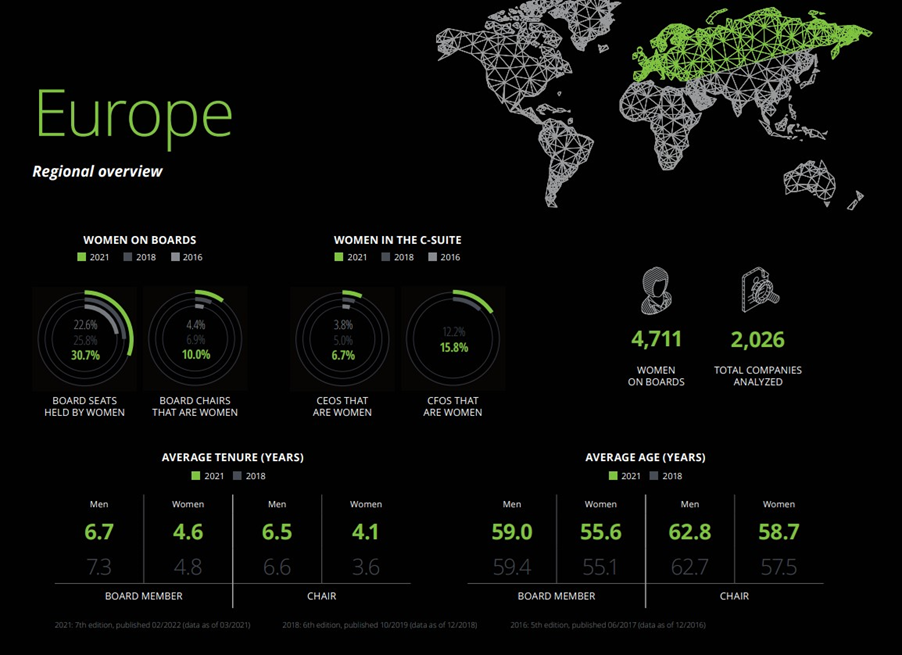
The proportion varies greatly among the member countries and the average is just under 31 percent. More and more women are taking seats on company boards around Europe.
Although the proportion has almost tripled over a ten-year period, the majority of EU board members are still men.
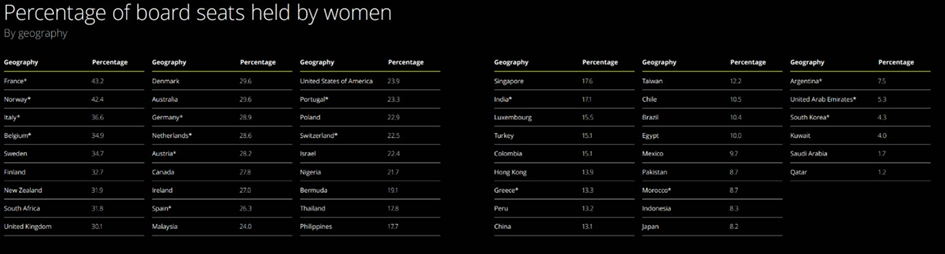
The European Institute for Gender Equality (EIGE) recently found that only 30.6% of board members and 8.5% of board chairs in the EU are women. However, the spread between member states is large. The highest proportion is in France, where women make up almost 45 per cent of the members, while the corresponding figure in Cyprus, the country with the lowest proportion, is just under 9 per cent.
So far, only Norway and France have reached the target of 40%, according to the Gender Diversity Index by European Women on Boards (EWOB), which ranks Greece, Luxembourg, Switzerland, and Poland as the worst-performing countries in Europe.
National laws
Most European countries already have a framework to address gender inequality in leadership roles, either through gender quota laws or recommendations within their corporate governance codes. These countries will have to ensure their system is in line with the EU directive’s objectives.
A 2021 study by the European Parliament found that nine member states – Bulgaria, Croatia, Cyprus, Czech Republic, Estonia, Hungary, Lithuania, Malta, and Slovakia – have no rules or recommendations.
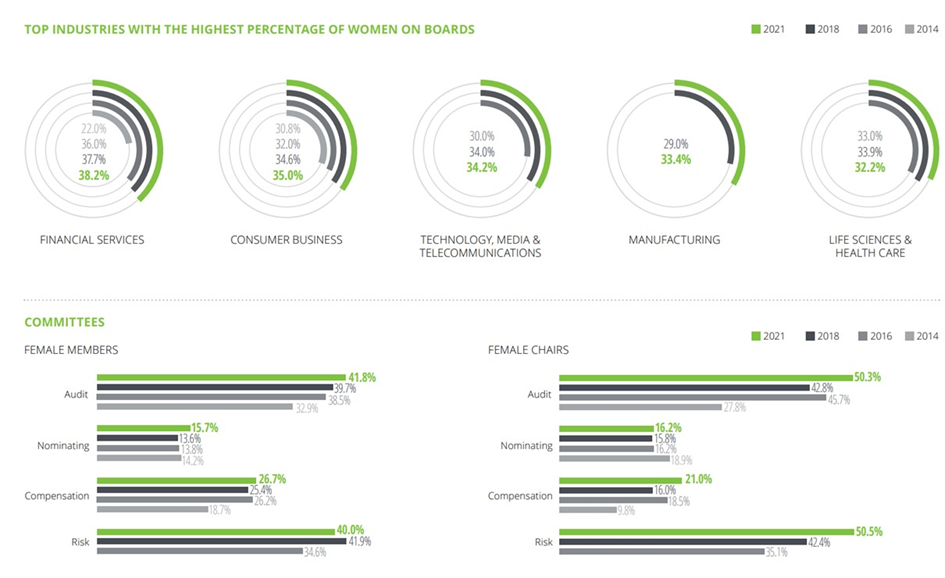
For more insight, take look at the chart below.
Quota laws ‒ does it work?
To increase the proportion of women on boards, some countries have introduced quotas laws. Norway was the first to introduce a quota law in 2006 where the larger listed company boards would consist of at least 40 percent of each gender. However, the effect was not quite as expected when ex-post studies showed that the number of women did not necessarily increase despite the quota being reached. There are many indications that the women who already sat on the boards were instead given more assignments, a phenomenon that was later named "golden skirts". There were also companies that tried to achieve the quota by reducing the board group while others moved from the country.
The following year, Spain became the first country in the EU to introduce a law on quotas in 2007. Unlike Norway's system, the design here was somewhat softer and without penalties. How efficient the system was, however, is disputed. There are also examples of other schemes and countries that have introduced quota laws for parts of the business community, for example for larger companies or state-owned companies. One such is Greece, where the goal is to achieve 33 percent of women in companies that are partly or wholly owned by the state.
Quotas as a system have been debated and several countries today have other types of objectives to even out the distribution of women and men in boardrooms. However, many agree that a more even distribution and diversification has several positive effects for companies and society as a whole.
The proposal will now need to be negotiated by the Council and the Parliament.
Sweden at the top of the gender equality ranking in company boards ‒ despite no quotas
The proportion of women on the largest Swedish company boards has more than doubled since the beginning of the 2000s and is currently 38 percent. This places Sweden among the countries in the EU that have the highest proportion of women on the boards of listed companies.
Sweden is the fifth best country in the world in terms of the proportion of women on company boards, according to a ranking conducted by the auditing and consulting company Deloitte ‒ Women in the Boardroom: A Global Perspective.
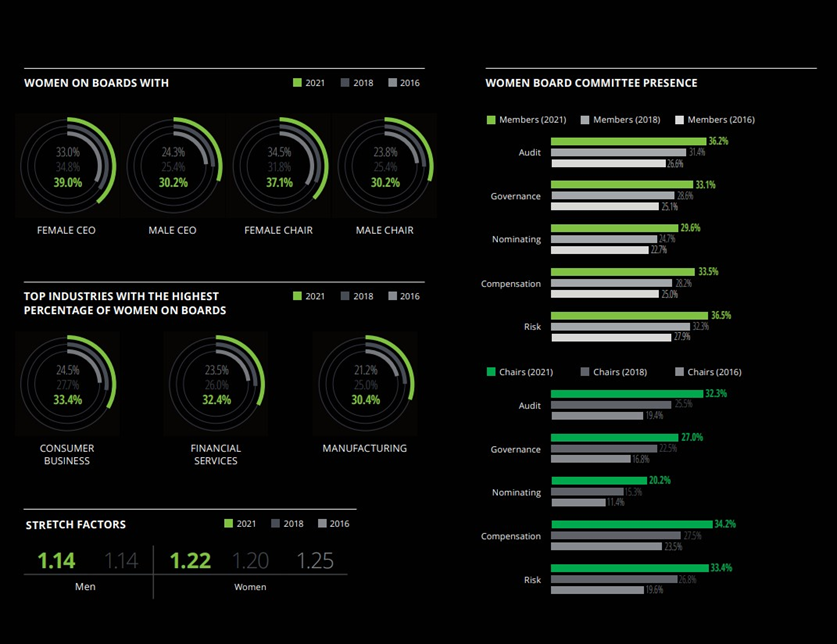
According to the report, women hold 34.7 percent of the seats on Sweden's public company boards, which is an increase of 1.4 percentage points since 2019. Sweden has the highest proportion of female board members in the financial sector (38.2 percent), followed by consumer business ( 35 percent) and TMT (34.2 percent).
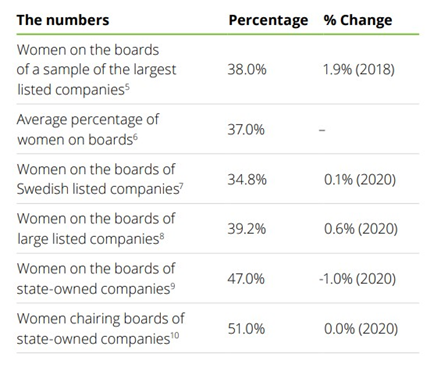
Among state-owned companies, women hold 47 percent of the board seats and the majority of the chairmanships (51 percent). The report compares the proportion of female board members in 72 countries and looks at the causes and trends behind the figures.
Are Gender Equal Boards Achieved with a Female CEO?
The report also shows a positive connection between female CEO leadership and gender equality on the board. At the global level, companies with female CEOs have significantly more women on their boards than those run by men ‒ 33.5 percent and 19.4 percent, respectively. The trend is the same in companies with female chairmen ‒ 30.8 percent and 19.4 percent, respectively. It also emerges that more equal boards are more likely to appoint female CEOs and chairmen.
Research from The 30% Club shows that companies with more diversified boards and management teams perform better. A group consisting of different genders, ages and backgrounds also gets angles from several different perspectives, which is a huge asset when it comes to solving problems and equipping the company for the future,
Self -regulation in Sweden
There is no quota legislation in place for women serving on boards in Sweden, but achieving an equal gender balance is high on the agenda for Swedish companies, the government, and regulators. Thus far, the issue has been addressed through self-regulation. Although progress has been made, government initiatives, including binding legislation, have been considered as a means of accelerating change. Recent government statistics show that among state-owned companies, women hold 47% of board seats and the majority of chair positions, at 51%.
Other initiatives
The Swedish Corporate Governance Code requires listed companies to strive for gender balance on their boards on a comply-or-explain basis. The Swedish Corporate Governance Board oversees the code and publishes boardroom gender balance statistics for Swedish listed companies each year. As of June 2021, the proportion of women elected to the boards of these companies was 34.8%, an increase of just 0.1% from the previous year.
Measures to address components of diversity beyond gender The Swedish Corporate Governance Code requires board composition to be appropriate for the company’s operations, phase of development, and other relevant areas. Board members elected at the shareholders’ meeting should exhibit diversity and breadth of qualifications, experience, and background.
So, back to the story...
Do you thing the story was fictional or true?
Until men look around the table and say, 'You know what's weird? There's only two women here and there's eight men.' When that feels weird to a man, we will have achieved something" ‒ Meryl Streep
Eva Vati, Executive Contributor Brainz Magazine
Eva Vati is an Entrepreneur & Business Strategist who helps executives, businesses, and entrepreneurs future-proof their companies.
She is the CEO & founder of several companies of which VATI of Sweden, is one of the first consultancies in the world giving certification on integrating sustainability into business strategy. She has a loyal community of over 25,000 people who are committed to creating a better world by running businesses that promote sustainability, equality, and diversity.
Eva spent over a decade working alongside the United Nations, is an official Ambassador and Advocate for TeachSDGs, and serves as a business mentor and advisory board for several of the United Nations Agencies.
Eva is Board Member for several listed companies and is on the Fairforce 100 Green Board Members-list and Chamber of Commerce of Southern Sweden Top 100 Board Member-list
She recently won a prize for Innovative Startups 2020 by Vinnova – Sweden’s Innovation Agency.
Eva believes in an equal future and she's on a mission to spread the message of “Dare to Lead” on a global scale.