

Why Music is the Last Language Left When Words Run Out
Rose Sexton is an end-of-life doula, nurse, mother, performer, mover of mountains, and author based in Victoria, Australia. Throughout a nursing career spanning more than four decades, she has been drawn to those facing life's biggest transitions, supporting people in this sacred space. She has recently published her dual-voice memoir "The Bird and the Bee" (Balboa Press, October 2026).

Before love, there was music. Before grief, there was music, and when there was nothing left to say, there was still music. A nurse, a death doula, and a singer reflect on what music does that nothing else can.
The thing about music
I've sat with a lot of dying people, and I've noticed something. When language fails, when the throat is too tired or the words feel inadequate, music gets in anyway. It slips past the door that grief has locked. It goes straight to wherever we store the things that matter most.
I'm a nurse and an end-of-life doula. I've been in those rooms more than most. But I'm also a singer, someone who has been performing since before I was old enough to be self-conscious about it. So when music and death became entwined in my own life, I understood it differently than I might have otherwise. I understood it from the inside.
We met through music
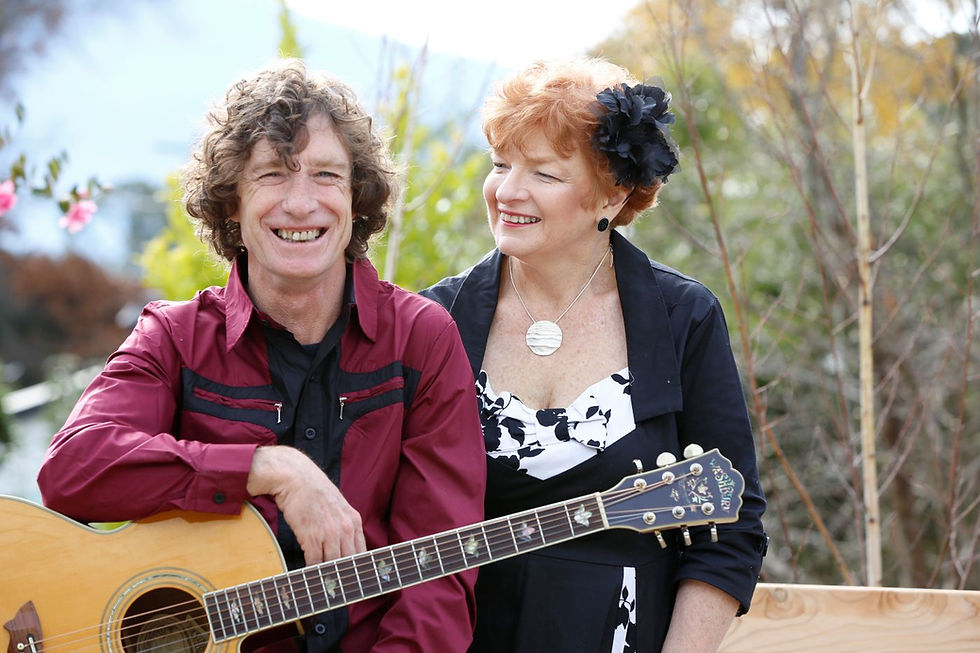
My soulmate Bill and I found each other the way musicians often do, through what appeared to be chance. He was a guitarist looking for a singer, and I was a singer looking for a guitarist. We lived in the same small town in rural Victoria, although we’d never met before. One afternoon, he came over to change my guitar strings (not a euphemism!). We ended up talking for hours. He was opinionated, funny, and had very little patience for mediocrity, in music or anything else. I liked him immediately.
From that first accidental afternoon, we played together and developed a close bond neither of us could quite define. We played pubs, festivals, and community gigs. We covered songs we loved and argued cheerfully about songs we didn't. Through our shared passion for seeing people die better, we created a Death Trivia Night. Yes, that is a real thing. Between rounds of morbid trivia, our band, The Immortals, performed songs like “Staying Alive,” “Dumb Ways to Die,” and “Only the Good Die Young.” Through the humour and levity of the night, the audience laughed and cried and started talking about things they'd been carrying around for years.
What we created together was, as I wrote to him once, total magic. His passion and commitment as a musician pushed me to places I'd never been musically. His guitar playing was extraordinary. I'd never made music like that with anyone. I called out of him a new way of playing that departed from his ‘80s rock influences and moved toward a softer, more nuanced way of performing, shaped by my background in a cappella, gospel, and musical theatre! Our musical styles were complete opposites, and yet, as a duo, what we created was magical.
What the set list knew before we did
Our relationship had its own twisted, complex course, and unbeknownst to either of us, the music was mapping our story as life imitated art and art imitated life. What materialised on the set list told our story: “Hooked,” “Bang Bang,” “Pleasure and Pain,” and “I Was Made for Loving You.” Later, there was “Maybe It’s Time” and “I’ll Take Care of You.” We’d been using music to tell that story the whole time. Music knows things, sometimes, before we do.
When he was in hospital once and heard a recording we'd made together, he sent me a text. Just four words: "I wanna play." That was everything, in four words. For a man who could philosophise for hours without drawing breath, four words were practically silence. But those four words said everything.
Singing him out
Bill left very explicit instructions for his funeral. Knowing Bill as I did, I dared not disobey. I sang Leonard Cohen’s “Bird on a Wire.” Solo, just me and the keyboard. This song represented Bill so well that Leonard could have written it specifically for him. Playing music on your own after you've played it with someone for years is its own kind of grief. Doing this, I think, helped me truly understand that we would never play together again. That’s the power of ritual.
At the graveside, my crew and I sang the Irish blessing “Parting Glass.” Unaccompanied. Standing in the brisk sunshine, we sang as the music commanded the stillness of the moment. I think we sang because nothing else was adequate. Language had run out. Ceremony had run out. What was left was music.
What I want you to take from this
I've never once, in all my years in palliative care, seen music make things worse. I've seen it open doors that grief had bolted shut. I've seen it let people say goodbye when they had no words for it. I've seen a room full of strangers suddenly weeping together over a song and then laughing about weeping together.
I’ve seen that in my own family, where music has a rich tradition. It brings us together and reminds us of who we are, where we’ve been, and what we’ve shared.
If someone you love is dying, or you are bracing for that loss, or you're somewhere in the thick of grief, consider music. Not as a distraction, but as medicine. As the thing that says what you can't.
It was how Bill and I found each other, in the end. It was how we said goodbye. It's still, some days, how I find him.
If this story resonated with you, explore The Bird and Bee, a memoir about love, music, and dying well. Buy the book.
Read more from Rose Sexton
Rose Sexton, End-of-Life Doula, Registered Nurse & Author
Rose Sexton is a palliative care nurse, end-of-life doula, and author based in Victoria, Australia. Throughout a nursing career spanning more than forty years, she has been drawn to those facing life's biggest transitions. The Bird and Bee (Balboa Press, October 2026) is her debut memoir, a dual-voice account of walking with her soulmate Bill, guitarist and philosopher, through his final journey.







