

When All That Matters Is a Healthy Baby Isn’t Enough
Updated: Aug 7
Written by Sarah Pearce, Certified Doula
Sarah Pearce is a nationally recognized full-spectrum doula, former pediatric nurse, placenta specialist, and midwifery student with nearly a decade of experience supporting families through fertility, birth, postpartum, and newborn care. She is the founder of Trinity Doula Services, one of the largest doula agencies in the St. Louis region.

“My only goal is to survive.” I see this sentence far too often. Pregnant people share it in online birth communities. They say it jokingly. They say it is a coping mechanism. They say it because they have absorbed the message that birth is something to endure rather than an experience they deserve to understand and participate in.
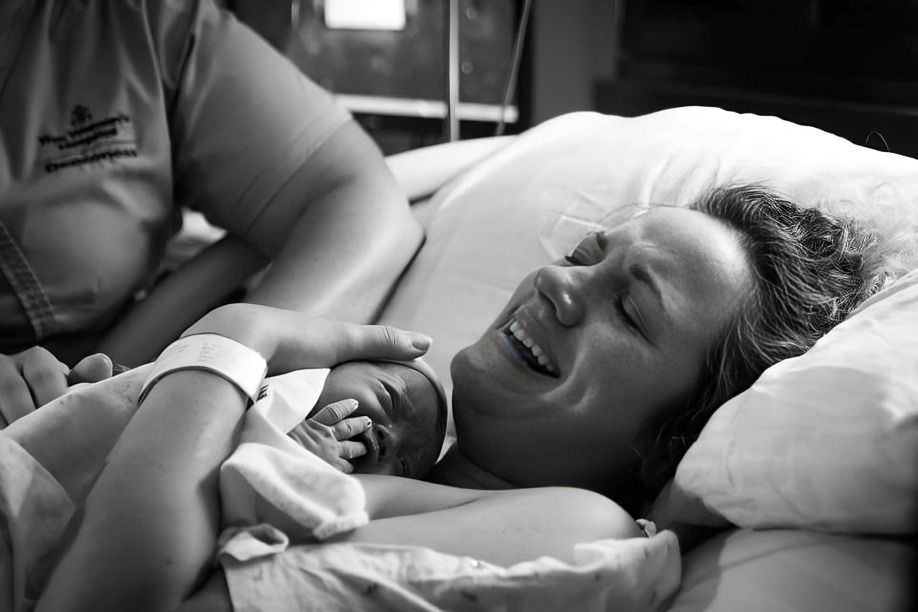
At first glance, the phrase sounds practical. Of course, every parent wants a healthy baby. But underneath those words is a much deeper concern: Why have we normalized entering one of the most significant experiences of our lives expecting only survival?
Birth is one of the few moments when a person can be physically, emotionally, and psychologically transformed in a matter of hours. While the safety of the baby is undeniably important, the person giving birth is not simply a vessel delivering a child. They are a patient, a parent, and a human being whose experience matters. A healthy baby and a supported, respected parent should never be competing goals.
The problem is not that we have too much medicine, it is that we have lost balance
I want to be very clear: Obstetricians save lives. As a former pediatric licensed practical nurse and current birth professional, I have immense respect for physicians, nurses, and hospital teams. I have witnessed firsthand how medical interventions can mean the difference between a scary situation and a safe outcome.
Cesareans, inductions, medications, monitoring, and emergency interventions all have a place. The problem occurs when a system designed for emergencies becomes the default model for everyone.
In the United States, maternity care often places obstetricians at the center of every pregnancy, regardless of risk level. This means highly trained surgical specialists are frequently managing normal, physiologic processes while also being responsible for the most complex and high-risk situations.
That is not a failure of obstetricians. It is a system design issue. Our OBs are often overworked, overwhelmed, and asked to fill roles they were never intended to carry alone.
What can we learn from other countries?
Many countries with stronger maternal health outcomes approach maternity care differently. The difference is not that they avoid medicine. The difference is that they build systems in which different professionals work within their areas of expertise.
The World Health Organization (WHO) recognizes midwifery models of care as an important component in improving maternal and newborn outcomes. These models emphasize continuity of care, respectful communication, informed decision-making, and the integration of midwives into the larger healthcare system alongside physicians and nurses.
Countries such as the Netherlands have long incorporated midwives as a central part of maternity care. Midwives often serve as the primary maternity providers for low-risk pregnancies, while obstetricians are available when complications arise or additional medical expertise is needed.
The goal is not to remove doctors from birth. It is to allow each professional to do what they are uniquely trained to do.
The midwifery model is about more than birth location
One of the biggest misunderstandings about midwifery is the assumption that it is only about home birth. It is not. The midwifery model of care is a philosophy centered on relationship-based care, longer appointments, education and preparation, shared decision-making, support for normal physiology when appropriate, recognition of when medical care is needed, and continuity throughout pregnancy, birth, and postpartum.
The WHO describes midwifery as skilled, knowledgeable, and compassionate care throughout the entire childbearing continuum, from pregnancy through postpartum and early newborn life. This model does not reject medicine. It creates a pathway for medicine to be used when it is truly needed.

Why birth experience matters
For years, we have been told, “The only thing that matters is a healthy baby.” Of course, a healthy baby matters. But the person who gives birth matters too.
Research and global health organizations increasingly recognize that quality maternity care includes not only survival but also dignity, respect, communication, and positive experiences of care.
A person can have a healthy baby and still experience trauma, fear, loss of autonomy, feeling unheard, a lack of informed consent, or difficulty processing their birth experience.
Those experiences matter because they can influence how someone enters parenthood, how they view themselves, and how they approach future pregnancies.
Where doulas fit into this system
As a doula, my role is not to replace an OB or midwife, practice medicine, or make medical decisions. My role is to support the person behind the pregnancy.
Doulas help bridge a gap that often exists in modern healthcare: the gap between receiving medical care and feeling truly supported. We provide education, preparation, emotional support, comfort measures, advocacy, and continuity.
Healthcare providers are responsible for medical safety. Doulas help families navigate the human experience of becoming parents. Both matter.
A better future for birth care
The future of maternity care should not be a battle between hospitals and home births, doctors and midwives, or medical and holistic care. The future should be built on collaboration.
Imagine a system in which low-risk pregnancies receive relationship-based, preventive care, midwives are fully integrated into healthcare teams, and obstetricians are available for complex medical situations. In this system, nurses are supported instead of overwhelmed, doulas help families feel educated and empowered, and every parent enters birth knowing they are respected.
That is not unrealistic. It is what many healthcare systems around the world are already working toward. Birth should not be something people simply survive. It should be an experience in which safety, dignity, education, and compassion exist together.
Families deserve more than a healthy baby. They deserve to feel healthy, heard, and whole when they meet their baby.
Read more from Sarah Pearce
Sarah Pearce, Certified Doula
Sarah Pearce is a highly sought-after birth and postpartum expert, a former LPN specialising pediatrics, a placenta encapsulation specialist, and the founder of Trinity Doula Services, a rapidly growing full-spectrum doula agency serving Missouri and Illinois. With over a decade of hands-on experience in fertility, labor support, physiologic birth, postpartum recovery, newborn care, and high-pressure pediatric nursing, she has become known for combining evidence-based education with deeply intuitive support. Sarah has supported families through all types of birth settings and is working towards becoming a Certified Professional Midwife. Her work empowers families during life's most transformative moments.
Sources and Further Reading:
World Health Organization. Transitioning to Midwifery Models of Care: Global Position Paper.
World Health Organization. WHO Calls for Global Expansion of Midwifery Models of Care.
World Health Organization. Maternal Health: Midwifery Education and Care.
World Health Organization. WHO Recommendations: Intrapartum Care for a Positive Childbirth Experience, including midwife-led continuity of care.





