When a Good Life No Longer Feels Like the Whole Story – An Interview with Deni Bale
Deni Bale is a coach specialising in midlife transitions, working with capable women whose lives look good on paper but who have begun to wonder what they want from the next part of their lives. In this interview, she explores why that questioning doesn’t necessarily signal a midlife crisis, how years of accommodating others can disconnect women from their own preferences, and why self-trust is rebuilt in the small, everyday moments where we choose whether or not to listen to ourselves.

Deni Bale, Midlife Aliveness Coach
What does feeling fully alive in midlife mean to you, especially when nothing in life is obviously wrong?
I think I began to understand and recognise what feeling fully alive meant when I started making changes in my own life. I could suddenly see the contrast between how I used to show up in my life and how I do now.
From seeing those shifts in myself, I’ve come to realise that it doesn’t need to manifest as some huge reinvention. I think it’s actually the small and ordinary signs that matter more. Aliveness shows up as having preferences (and giving yourself permission to follow them), as anticipation, curiosity and desire. It’s saying what you actually think, even if that is uncomfortable for others.
It’s not about constant excitement, because that would be exhausting, wouldn’t it?! It’s more about feeling present in your own life and no longer treating ‘fine’ as the most you’re allowed to want.
Where do you most often see women talking themselves out of what they already know they want?
In those everyday micro moments that happen so fast, so reasonably and so automatically that she doesn’t even recognise it as talking herself out of anything. Years, decades even, of being the accommodating, sensible one, the one who makes sure everyone else is comfortable, can make these overrides feel like maturity rather than self-abandonment.
It’s the ‘that’s fine’, the ‘of course’, the ‘I’d love to, but’ and the ‘but’ is the part that particularly interests me because it creates some very convincing reasons: money, timing, other people’s needs, practicality.
It really isn’t as simple as ‘just do it’. Sometimes there are genuine constraints. I’m interested in helping her notice those tiny moments where what she wants gets removed from consideration because she’s already calculating what will inconvenience everyone else least. Those hundreds of tiny moments make up a life.
Why can insight alone fail to create change, even when someone understands her patterns clearly?
Most of the women I work with don’t lack insight. On the contrary, they’ve read the books, listened to the podcasts, reflected, and in many cases, had therapy or coaching. They see the pattern, but still they repeat it.
That’s because understanding a pattern consciously doesn’t necessarily stop the more automatic response from happening. Knowing why the override keeps happening doesn’t necessarily make it feel safe to stop.
Part of that work involves reconnecting to the truth of the body. So we start by recognising what happens when she is about to abandon what she knows and getting curious about that choice point.
One of the practices I use is something I call the Body Yes/No. We take the two sides of a question in turn and notice the body’s response to each, whether there’s a sense of contraction or expansion. It’s a way of tuning into that intuitive sense before all the reasoning, explaining and accommodating gets involved.
Why do you think midlife is still so often framed as a crisis rather than a period of choice and expansion?
I think a lot can happen or shift at the midlife point of women’s lives. Roles change around children, work, caring responsibilities, approaching retirement and possibly relationships.
Time becomes more tangible as she becomes more aware of the years behind her and the years that might be ahead. Maybe she begins to ask herself if this is really how she wants the next twenty or thirty years to look. While that may sound disruptive, I think that, really, it’s more like an internal waking up.
I find it interesting that we’ve so often labelled this kind of questioning as a ‘midlife crisis’, as though questioning the shape of your life at this point means something has gone wrong. I wonder if it’s actually quite the opposite. Perhaps this is simply a point when we finally have the space, permission or reason to question things in a way we haven’t before.
After all, why is there an apparent assumption that, as we reach midlife, most of the interesting things are behind us? Most of us can probably look back and recognise that life rarely unfolds fully according to plan. So why assume we know what the next chapter is going to look like? For me, I love the idea that I have no idea what a normal Tuesday will look like in five years’ time.
What do you think is missing from conventional conversations about confidence and self-trust for women in midlife?
I think what can easily get overlooked is the assumption that capability somehow equates to confidence in all areas of life. The women I work with are already highly capable in many areas of their lives. They have a lot of evidence of competence. But despite this, they can still question their own wants, preferences and wisdom.
She may be very confident professionally, but in other areas of life, where she’s perhaps put everyone else’s needs above her own for years, she can struggle with something as simple as saying, “Actually, no, I’d rather.”
Confidence doesn’t magically appear, and it’s not a given throughout all aspects of your life just because it’s strong in some. I believe it’s about building self-trust through lived evidence: I noticed what I wanted, I didn’t automatically override that desire, and I acted accordingly even though it felt uncomfortable or unfamiliar. I discovered that the discomfort didn’t mean I’d done something wrong. From those repeated moments, confidence arrives.
So I think the distinction that’s often missing from conventional conversations is that confidence in your abilities doesn’t necessarily flow through to trust in your own inner authority.
In your Unbraced work, what helps a woman notice the moment she begins to soften, adjust or override herself?
This is one of the places where the different strands of my background in psychology, yoga and many years of teaching come together. Bracing can show up in the body in all sorts of ways. It might be a change in the breath, a tightening somewhere, a rush to explain yourself, or that split second of second-guessing before you change what you were going to say, that point where a ‘should’ arrives. It happens so quickly, and has often been happening for so long, that it simply feels normal.
In Unbraced, my coaching experience offering 90 days of individual support, we begin to slow those micro moments down enough for her to recognise what’s actually happening. I use visualisations and practices such as the Body Yes/No, where we tune into that sense of expansion or contraction in response to the different choices available. We also explore whether a choice feels like it’s moving her towards herself or away from herself, and what I call her ‘True North’, that intuitive sense of what feels true for her before all the explaining, accommodating and second-guessing begins.
Once she can recognise that moment, there is a little more space around it. And within that space, another choice becomes possible.
What is one small way a woman can begin turning self trust into action without making a dramatic life change?
One of the things I often hear women say is, “I don’t mind.” Maybe sometimes she genuinely doesn’t. But I think often, if she paused for long enough, she’d notice that actually she does. Or that, at least, she has a preference.
So it can start with simply noticing, in that tiny moment before she says those words: Do I actually mind? What would I choose if I wasn’t trying to work out what everyone else would prefer first? What might I opt for if I didn’t think there was a ‘right’ answer?
It could be something as simple as which film she wants to see at the cinema, the brain-resting romantic comedy rather than the noisy science fiction thriller. Or whether to go for that chocolatey dessert at the restaurant without feeling the need to apologise for being ‘bad’ or label it a ‘guilty pleasure’, as though enjoying something needs an apology attached to it.
Self-trust can begin in those very ordinary moments, noticing that you have a preference, allowing it to count and discovering that you don’t need to apologise for it.
Your own working life has moved through music teaching, yoga, coaching and embodied practice. How have those transitions shaped the way you understand what it means to change direction in midlife?
I think it’s less about understanding change and perhaps more about actually living it, taking it from the cerebral to the embodied.
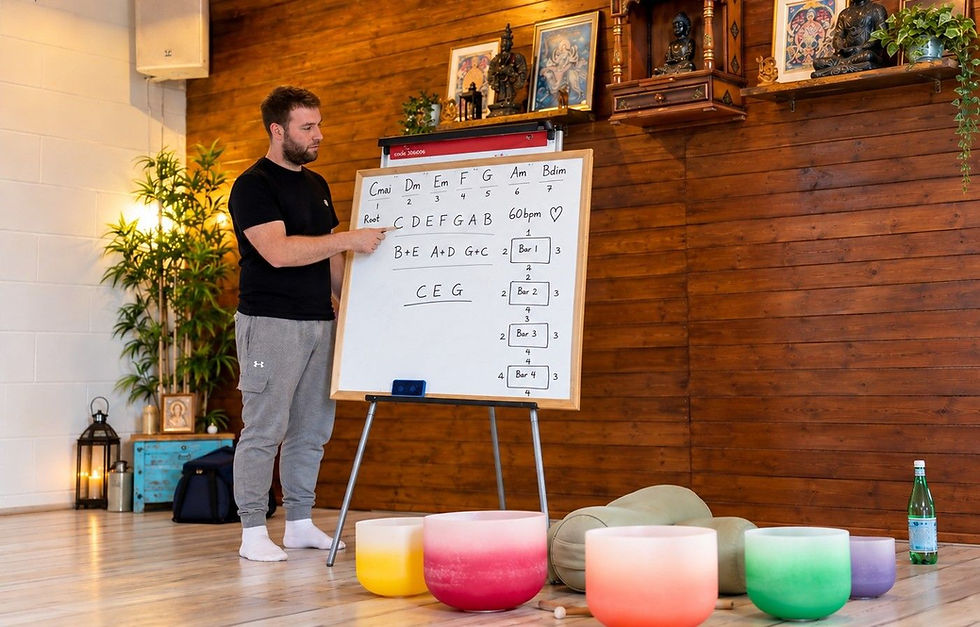
I was a teacher for over 30 years, and during that time I taught piano to hundreds of children. It was a job I loved and I was good at it. I’d certainly put in my 10,000 hours by the time I finished! But I began to feel pulled towards doing something different. The pathway wasn’t clear to begin with, other than knowing that I wanted to work with midlife women in some capacity.
As yoga became a bigger part of my life, I realised I needed a change of direction. There wasn’t anything wrong with my teaching career. But I had changed and shifted, and my career needed to shift with me.
Yoga brought a real sense of embodiment to my life. I began to trust my body again and pay attention to its signals. Within that was a really strong pull back towards psychology, which was where my education had begun. That eventually brought me into coaching and the work I do now.
All of those changes have happened in just the last few years. I think what I’ve learnt from living them is that I don’t have to remain the person I was simply because I’ve invested years in becoming her. Allowing myself to change direction has actually brought me closer to the freedom that matters so much to me.
What would you want a woman to remember if she’s reached a transition point in midlife, her life looks fine on paper, but she still feels there is more for her?
I’d want her to remember that she doesn’t need to talk herself out of that feeling simply because she has a good life. Those moments of frustration or flatness, which can be signposts that something wants to change, are probably swiftly followed by the voice reminding her how lucky she is to have what she has. You know the one. We’ve probably all done it. We would never say it to a friend. We reserve it for ourselves!
Because when she’s standing in the kitchen, cooking the meal she’s managed to concoct around everyone else’s likes and dislikes, she can still feel that there’s more out there for her. But because there’s nothing actually wrong with her life, she shuts the thought down and keeps cooking.
Or the television remote is in someone else’s hands and she finds herself watching the news when really, she’d rather watch some reality television because she loves watching people. It doesn’t matter in the grand scheme of things. It’s certainly not worth making a fuss about. That’s how easily her preference disappears again.
Being curious about what else she wants, especially at a point when other things in her life may be changing, doesn’t mean she isn’t grateful or proud of the life she’s built. She doesn’t need to manufacture a problem with her current life in order to acknowledge that something in her wants to change.
That “more” doesn’t have to mean greater achievement, success, possessions, or dramatic change. It might be more freedom, adventure, joy and laughter, or simply more of herself in her own days.
She doesn’t have to know exactly what the “more” is yet. I know I didn’t. But the fact that she’s beginning to wonder might be the beginning of a thread worth pulling.
Read more from Deni Bale