

What We Carry Forward From Our Ancestors
Reena helps people move beyond symptoms, grief, and limiting patterns to reconnect with their true selves. Inspired by her own journey of loss, healing, and spiritual awakening, she has created the 6R Ascension™ Process, a structured pathway for deep transformation, self-discovery, and conscious growth.

At this time of year, we observe Shraadh, a Hindu tradition of remembering and honouring our ancestors. Through prayers, offerings and acts of charity, we express our gratitude to those who came before us, and we pray for their peace. For me, that remembrance extends to ancestors whose names I may never know, but who are still part of the generations that came before me and made my life possible.
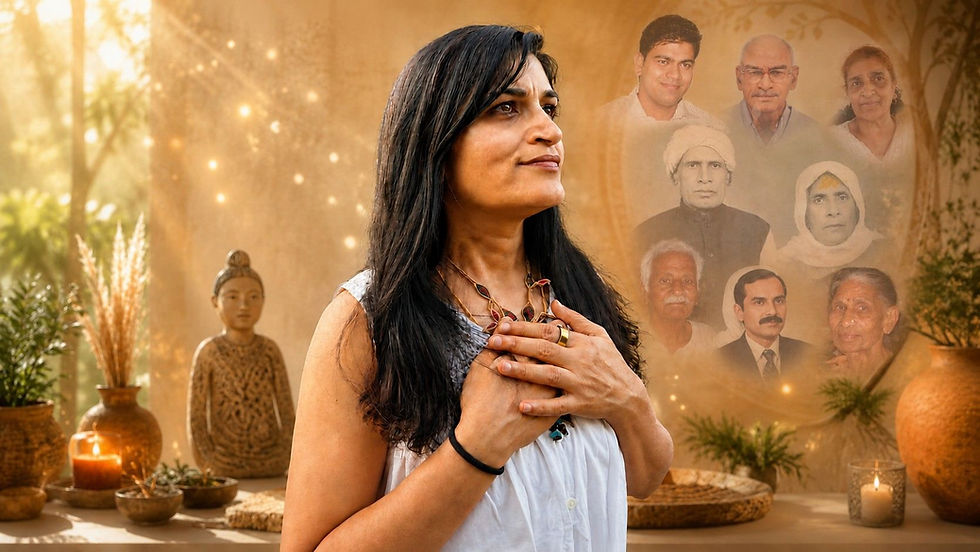
Remembering ancestors is certainly not unique to one tradition. Across cultures, there are different ways of keeping that connection alive, through ceremonies and rituals, family gatherings, or simply through the stories passed from one generation to another.
For me, this remembrance also brings a curiosity about what we may have inherited from them beyond the material things they left behind. Some of it is easy to recognize: a familiar expression, a sense of humour, the traditions we still enjoy. Love, strength, faith and the countless ways our families cared for one another are part of our inheritance. We may also inherit ways of thinking, behaving or responding that are less obvious to us, simply because they have always been part of our life.
To understand some of these less obvious things, it is helpful to consider the lives our ancestors were actually living and what they experienced. War, displacement and loss were part of their lives. Some of them had to leave their homes and everything familiar behind. Others lost their parents at a young age and were raised by relatives, or perhaps by someone unfamiliar to them at the time. I wonder how I would have coped in their circumstances.
Many of their decisions came from a need to survive, protect their families and give their children a better life. Being careful with money, working incredibly hard or holding on to things that might be useful may have been necessary at the time. Our circumstances have changed, but could we still be carrying some of those ways of living without even realising it?
Perhaps you grew up hearing, “Save it for a rainy day” or “We can’t afford to waste anything.” If your parents or grandparents had lived with very little, it’s understandable that they worried about money. They wanted to make sure their family had enough. You may have learnt to be just as careful with money, even though your circumstances are very different today. Perhaps you still don’t like wasting things, but now it comes from caring about the planet rather than worrying there won’t be enough.
Being strong may have meant managing every difficulty without asking for help. Perhaps there was once nobody to turn to. Over time, doing everything alone may simply have become what everyone expected of themselves.
These are just a couple of examples of how something that once made sense within a family can continue in different ways. This doesn’t mean every fear, habit or difficulty has an ancestral connection. Our own experiences, upbringing and social conditioning shape us as well. There may also be other parts of ourselves and our experiences that we choose to explore through inner child work, past lives or something else that feels meaningful. But when you notice a pattern running through your family, you may become curious about where it came from. You may never know exactly where it began, and that’s okay. You can simply notice how it shows up in your life and whether it still supports you today.
Ancestral healing goes beyond recognising these patterns. I believe we can connect with our ancestors and invite them to support us. I can ask for their help with something I feel ready to release.
When I connect, I don’t decide beforehand what I should experience. I may receive an image, a word, a memory or simply a feeling of their presence, or I may not experience very much at all. I have learnt to let the experience unfold in its own way. Connecting can feel different, though, when the ancestor is someone I knew during their lifetime. We may have loved someone very much and still carry hurt from something they said or did. That history can sometimes become part of the connection too. There have been times when I have sensed an ancestor coming forward and asking for forgiveness.
But what if I’m not ready?
Understanding an ancestor’s circumstances doesn’t excuse their behaviour or take away the hurt. I can choose to forgive if and when I am ready. If I am not ready, I can communicate that too, and that is absolutely fine.
At the same time, learning more about their life can sometimes change the way I see them. Things may begin to make more sense, or I may see them from a different perspective. It doesn’t change what happened, but it can help me see more of who they were and the circumstances in which they lived.
Sometimes, even when forgiveness doesn’t feel possible, I may still feel willing to connect with that ancestor. I may ask for their support in letting go of a fear or belief that I feel has been carried through our family. That willingness is a personal choice. You don’t have to invite a connection with someone who hurt you.
There are times when I sense their support, and my feelings towards them begin to change. I may understand something about them that I hadn’t understood before, or I may experience our connection differently. That is when forgiveness begins to feel possible. It may not come at all, and it isn’t something I expect or try to force.
When I connect with my ancestors to ask for support in releasing a pattern or belief that may once have helped or protected our family but no longer supports me, I simply speak to them as I would speak to anyone. I might say something like this, but you can use whatever words come from your heart:
“Thank you. I understand that this pattern/belief may have been needed once, and I honour the strength, love and courage that carried our family through. I am really grateful for all that has brought me here. I live in a different time and under different circumstances. My life is different now, and I am ready to choose differently. Please be with me and support me as I let go, with love, of what no longer needs to be carried. In doing so, I honour you, where I come from, and all the possibilities that lie ahead.”
Choosing to let go of something doesn’t mean I’m rejecting my ancestors. I honour their strength and am grateful for what they passed down, while allowing myself to live differently. It can begin with something quite ordinary. For example, if I have always felt I must manage everything myself, perhaps I can allow someone to help. If I feel guilty about resting, I might give myself an afternoon without expecting it to be productive.
I don’t expect an old habit to disappear simply because I have recognised it or explored where it may have come from. Sometimes I find myself responding in exactly the same way again. I may simply notice it a little sooner, and next time, I might make a different choice.
Ancestral healing isn’t something that happens while I am sitting quietly, reflecting or connecting with my ancestors. It also shows up in the choices I make afterwards. A small choice made differently can be meaningful. If the old pattern returns, I can notice it again without turning that into another reason to judge myself. I can keep choosing what supports me currently.
In healing something within myself, I believe that healing may also bring some peace to those who came before me and support the generations who come after me.
There is so much from my ancestors that I would be honoured to carry forward, their love, strength, faith, humour, traditions and the many things that give me a sense of where I come from. I feel grateful for all they gave me, including the strength to make choices they may never have had the opportunity to make.
At the same time, I don’t want to assume that what supports me today will necessarily be what future generations need. Something that made complete sense in one generation may not be right for another. So alongside everything else I hope to pass on, I would like to leave them something that matters very much to me: the freedom to choose.
I can make the choices that support the life I am living without expecting those choices to become rules for those who come after me. I would like them to know where they come from, appreciate what has been passed on to them, and still feel free to find their own way.
I hope they will be able to look at what I leave behind with the same compassion that I am learning to bring to what my ancestors left me, carrying forward what supports them, letting go of what doesn’t, and knowing that choosing differently does not mean loving us any less.
Read more from Reena Pathak
Reena Pathak, Creator of the 6R Ascension™ Process
Reena is the creator of the 6R Ascension™ Process and a passionate advocate for healing beyond symptoms and transformation beyond awareness. Drawing on her personal journey of grief, spiritual awakening, and conscious growth, she combines intuitive insight, spiritual and energy healing, ancestral healing, inner child healing, egression therapy, and Qi Gong to support meaningful, lasting change. Through her work, Reena helps individuals reconnect with who they truly are and step into lives of greater clarity, purpose, and alignment.






