What is Brainwave Entrainment? How Rhythm Can Influence the Meditating Brain
Morgan O. Smith is an author, meditation facilitator, and spiritual teacher with over two decades of experience. His teachings emphasize nonduality, spiritual awakening, and sound technology integration through his Yinnergy Meditation system, which promotes emotional, mental, and spiritual growth.

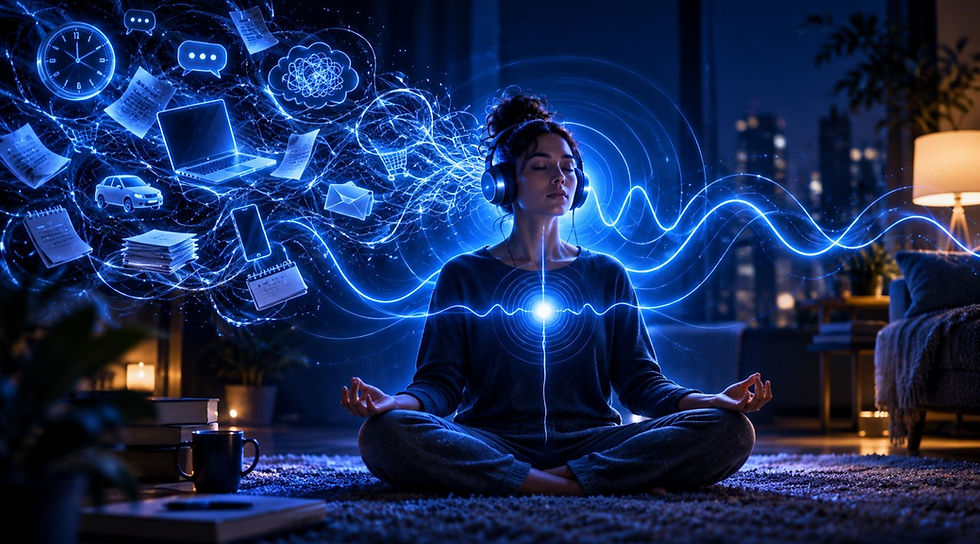
Sound does more than enter the ears. Rhythm can organize attention, alter the felt quality of experience, and become part of the process through which the mind and nervous system move into meditation. Brainwave entrainment sits at an unusual intersection of neuroscience, mathematics, sound technology, and contemplative practice.
What is brainwave entrainment?
Brainwave entrainment is the use of repeating sensory stimulation, most commonly sound or light, to interact with the brain’s ongoing rhythmic activity.
The brain is never electrically silent. Large populations of neurons continually communicate and organize their activity into oscillatory patterns that can be measured with electroencephalography (EEG). These rhythms are commonly discussed within frequency ranges such as delta, theta, alpha, beta, and gamma.
Entrainment introduces an external rhythm into that already rhythmic system. Human beings naturally respond to rhythm. We tap our feet to music. Musicians synchronize with one another. Crowds begin clapping in time. Breathing can change while listening to slow music. Walking, heartbeat, sleep, and speech all contain rhythm.
Brainwave entrainment asks a fascinating question: What happens when rhythm is intentionally designed as part of the meditation experience?
What are brainwaves?
Brainwaves are measurable patterns within the brain’s electrical activity. They reflect coordinated neural activity occurring at different speeds.
Delta: Delta generally refers to very slow activity and is strongly associated with deep sleep. For meditation, slow wave activity becomes especially interesting when profound physical relaxation occurs while awareness remains present.
Theta: Theta is commonly associated with internal attention, imagery, memory processes, drowsiness, and several contemplative states. It has therefore become one of the most discussed frequency ranges in meditation and auditory entrainment.
Alpha: Alpha is often associated with relaxed wakefulness, particularly with the eyes closed, and with shifts in attention and sensory processing.
Beta: Beta is frequently associated with active thinking, concentration, problem-solving, and engagement with the environment. Beta is not “bad,” nor does meditation require its elimination.
Gamma: Gamma involves faster activity and has been studied in relation to attention, perception, information integration, and advanced contemplative practice.
There is no single “meditation frequency.” Different forms of meditation can involve different neural patterns, and several frequency ranges can be active simultaneously.
How do binaural beats work?
A binaural beat is created when two slightly different tones are presented separately to the left and right ears. The left ear receives 200 Hz. The right ear receives 210 Hz. The difference is 10 Hz.
The auditory system perceives a rhythmic phenomenon associated with that difference. A physical 10 Hz tone is not simply being played through the headphones. The percept emerges through the brain’s processing of the two separate signals. This is why headphones matter for traditional binaural stimulation, as the left and right channels need to remain distinct.
Positive research has reported measurable outcomes from binaural beat exposure in areas including cognition, anxiety, and pain perception. A meta-analysis of 22 studies found an overall medium-sized effect, with longer exposure periods associated with stronger outcomes.
That finding is especially interesting because duration is not merely a practical consideration. Frequency is one variable. Time under exposure is another.
What are monaural beats?
Monaural beats are produced differently. Two tones are combined before reaching the ears, creating rhythmic amplitude modulation within the physical sound itself. The beat therefore exists acoustically rather than depending upon the brain receiving separate left ear and right ear frequencies.
Research has also reported positive results with monaural stimulation, including reductions in anxiety and improvements in emotional valence.
For my own work, this matters because I have never viewed auditory entrainment as being limited to one technique.
What are isochronic rhythms?
Isochronic stimulation uses clearly defined rhythmic pulses. Rather than relying upon a perceived difference between two continuous tones, the sound itself repeatedly rises and falls or switches on and off at a specific rate. The rhythm is explicit within the auditory signal.
Binaural, monaural, and isochronic stimulation therefore create rhythm in different ways. I eventually stopped thinking of brainwave entrainment as a single beat placed beneath music and began thinking about these techniques as components within a larger meditation architecture.
What is the difference between carrier frequency and beat frequency?
This distinction is fundamental to how I approach brainwave entrainment. If the left ear receives 200 Hz and the right ear receives 210 Hz, the 200 Hz and 210 Hz tones are the carrier frequencies. The 10 Hz difference is the binaural beat frequency.
Most popular discussions focus almost entirely on the difference frequency. “What theta frequency should I use?” “What is the best alpha frequency?” “What frequency produces deep meditation?”
But 210 Hz minus 200 Hz equals 10 Hz, and 110 Hz minus 100 Hz also equals 10 Hz. The beat relationship is identical. The carrier environment is very different.
That observation led me toward a larger question: If the beat frequency remains the same while the carrier frequencies change, does the meditation experience necessarily remain the same? That question became central to my later work.
Why one frequency is not enough
I do not think meditation can be reduced to one ideal number. Carrier frequency, beat frequency, duration, layering, stereo positioning, progression, breathing, attention, previous experience, and the practitioner’s current state can all influence the session.
That is why I prefer to think in terms of architecture rather than isolated frequencies. A meditation session can be designed as an evolving rhythmic environment. Frequencies can change. Layers can interact. Transitions can be timed. Different stages can serve different functions.
Brainwave entrainment becomes far more interesting when we stop asking, “What is the magic frequency?” and begin asking, “How can rhythm be structured across an entire meditation?”
Where brainwave entrainment goes next
Brainwave entrainment begins with sound, but its implications reach into attention, nervous system states, meditation, and consciousness. The deeper question is what happens when rhythm becomes sophisticated enough that it no longer feels like background audio but becomes part of the meditation itself.
In the next article, I explore low carrier frequencies, duration, and why I came to see entrainment as capable of becoming part of the meditative process itself.
If you’re interested in exploring the relationship between neuroscience, meditation, and nondual realization, my book Bodhi in the Brain (available on Amazon and Barnes & Noble) delves deeper into these topics.
For ongoing insights and discussions, connect with me on Instagram, YouTube, and my blog, where I share reflections on consciousness, self-inquiry, and the lived experience of awakening.
Read more from Morgan O. Smith
Morgan O. Smith, Meditation Facilitator, Spiritual Teacher & Creator of Yinnergy
Morgan O. Smith is a spiritual teacher, author, and meditation facilitator with over two decades of experience in mindfulness and nonduality teachings. Known for his pioneering Yinnergy Meditation system, he blends sound technology with traditional spiritual practices to promote deep personal and spiritual growth. His work emphasizes direct spiritual experiences, self-realization, and the clearing of emotional and mental blocks. Morgan's teachings are rooted in nonduality, and he encourages seekers to explore deeper states of consciousness through meditation and self-inquiry.
References: