What If Your Body is Speaking? Understanding Psychosomatics and What It Can Teach You About Yourself
Melanie Gibbs is a Master Practitioner and Teacher of Psychosomatic Therapy and the founder of Cellular Alchemy, based on Australia's Gold Coast. Over the past 12 years, she has helped more than 1,000 people use face, body, and lifestyle reading to resolve burnout, stress, and self-sabotage at the root.

Have you ever wondered why your body reacts before your mind has caught up? Why does your stomach tighten before a difficult conversation, your shoulders rise when you feel under pressure, or you suddenly feel exhausted after spending years being the person who “handles everything”?
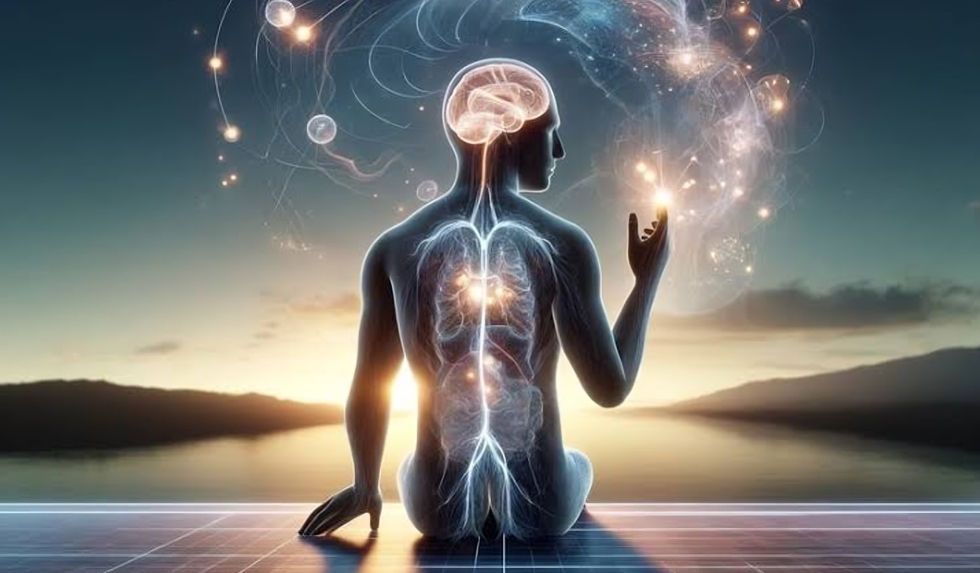
Our bodies and minds are not separate systems operating independently. Stress, emotions, thoughts, relationships, and life experiences can all influence how we experience ourselves physically.
This is where my fascination with psychosomatics began. Not with the idea that physical symptoms are “all in your head,” quite the opposite. The body is real. The symptoms are real. The experiences are real. But there can be valuable information in exploring the relationship between what we experience psychologically and what we experience physically.
For me, that exploration has become the foundation of Cellular Alchemy.
What is psychosomatics?
The word psychosomatic comes from two Greek words, psyche, relating to the mind, and soma, meaning body. Psychosomatics explores the relationship between psychological and physical processes.
We already experience this relationship in everyday life. Think about what happens when you are nervous. Your heart may beat faster. Your palms may become sweaty. Your breathing may change. Your stomach may feel unsettled. These aren't imaginary responses. They are physiological responses to what your brain and body perceive as stress.
The American Psychological Association explains that stress involves both psychological and physiological responses and can affect multiple systems throughout the body. Its resource on how stress affects the body provides a useful overview of the physical processes involved.
This doesn't mean that every physical symptom has an emotional cause. Nor does it mean that someone with a medical condition simply needs to “think differently.”
It means something much more interesting. The mind and body are constantly communicating, and learning to listen to that communication can give us another layer of understanding.
Your body responds to your experiences
Imagine a woman who has spent twenty years being the reliable one. She looks after everyone. She meets deadlines. She rarely says no.
She keeps going when she's exhausted. She tells herself, “I'm fine.” Perhaps she genuinely believes she is. But her body may be telling a different story. Her jaw may constantly clench. Her shoulders may remain tense. Her sleep may become disrupted. Her digestion may change.
She may feel wired but tired. She may find herself becoming increasingly disconnected from joy, intimacy, or even herself.
These experiences don't automatically tell us what is medically happening. They do, however, give us information worth paying attention to.
Stress is not simply something that happens in our thoughts. The body's stress response involves neurological, hormonal, and physiological changes. When stress becomes persistent, it can affect multiple aspects of physical and psychological well-being.
The American Psychological Association explores this broader relationship in its resource on stress and its impact on health.
So instead of asking only: “How do I get rid of this symptom?” I believe there is value in sometimes asking:
What else was happening in my life when this began?
What was I experiencing?
What was I carrying?
What did I believe I had to do to be safe, accepted, successful, or worthy?
Those questions don't replace medical care. They add another layer of curiosity.
When life becomes too much, too fast
One of the ways I describe trauma in my work is as an experience that becomes too much, too fast for the person experiencing it to adequately process or integrate at the time.
Sometimes that is one significant event. Sometimes it is a series of smaller experiences that continue to accumulate. A relationship where you continually felt unsafe. Years of being criticised. Growing up believing your needs came last. A workplace where you constantly had to prove yourself. A major loss. Divorce. Illness. Financial pressure. Caregiving. A childhood where you learned that expressing your emotions created problems.
Not every difficult experience becomes trauma, and people respond differently to the same circumstances. But our experiences can shape the way we perceive ourselves, other people, and the world around us. They can also influence the patterns we develop to cope. Sometimes those patterns remain long after the original circumstances have changed.
Your body can learn patterns
This is one of the concepts I find most fascinating. Your body doesn't necessarily respond to what is objectively happening in the present moment. It can respond to what it has learned to associate with danger, pressure, rejection, or lack of safety.
A situation today can resemble something from your past, and your response may happen before you've consciously worked out why.
You might suddenly become defensive. You might want to run. You might shut down. You might become incredibly busy. You might people-please. You might become controlling. You might disconnect. Or you might simply feel something in your body that you can't quite explain.
This is where I introduce one of the distinctions I use frequently in my work. What is real isn't always the same as what is true.
Your experience is real. Your feelings are real. Your reactions are real. But the meaning you learned to attach to those experiences may not be an objective truth about who you are.
For example:
“I have to do everything myself.”
“I can't trust anyone.”
“If I say no, people will leave.”
“I need to be perfect.”
“My needs don't matter.”
“I am only valuable when I am useful.”
Those beliefs can become deeply familiar, and what is familiar can feel true simply because we have lived with it for so long.
Awareness is only the beginning
I have worked with many people who are incredibly self-aware. They know their patterns. They know their triggers. They have read the books. They have listened to the podcasts. They have done the courses.
They may even be able to explain exactly why they behave the way they do. Yet they still find themselves repeating the same patterns.
That's where I believe we need to go deeper.
Self-awareness asks:
“What am I doing?”
Self-understanding asks:
“Why am I doing it?”
Deeper still:
What happened that taught me this was necessary?
What has my body learned? What am I still protecting myself from?
Is this response appropriate for the life I am living now?
This is the space that fascinates me. Because I don't believe transformation is about becoming someone else. I believe it is about understanding yourself deeply enough that you can finally make choices from who you are, rather than continually reacting from what you have learned.
Why I became a Cellular Alchemist
My name is Melanie Gibbs, and I am the founder of Cellular Alchemy, a Cellular Wisdom Alchemist, Psychosomatic Therapy Teacher, and Certified Neuro-Linguistic Programming (NLP) Practitioner.
My own path has not been a straight line. Like many women, I have experienced periods of feeling disconnected, stuck, overwhelmed, and weighed down by life. Those experiences became part of my education.
Over the past twelve years, I have had the privilege of supporting more than 1,000 women to align their Awareness, Alignment, and Action, to Shine Their Light and Be True to Themselves.
Along the way, I have trained in Psychosomatic Therapy, NLP, and Liquid Crystal Mineral Therapy, while continuing to explore the relationship between the body, mind, emotions, behaviour, identity, and our deeper sense of self.
What I discovered was that I didn't want to simply help people become more aware. I wanted to help them understand themselves. That distinction became central to my work.
What is Cellular Alchemy?
Cellular Alchemy is my approach to transformation at a deeper level, bringing together the mental, emotional, nervous system, physical, and spiritual dimensions of human experience.
It is not about pretending that one modality can explain everything. It is about looking at the whole person. I use the concept of Cellular Wisdom to describe five interconnected dimensions.
Mental wisdom, understanding thoughts, beliefs, perceptions, and conditioning.
Emotional wisdom, recognising emotions, patterns, and the messages beneath our responses.
Nervous system wisdom, understanding how the body responds to perceived safety, threat, stress, and connection.
Cellular wisdom, exploring the patterns and experiences that may have become deeply embodied.
Spiritual wisdom, reconnecting with meaning, purpose, identity, and the deeper sense of who you are.
Together, these dimensions create a much broader conversation than simply asking, “What's wrong with me?” Instead, we can begin asking, “What is happening within me?”
The body isn't the enemy
I believe many people spend years fighting their bodies. Trying to make them smaller. Trying to silence symptoms. Trying to push through exhaustion. Trying to control emotions. Trying to become more productive. Trying to become the person they think they are supposed to be.
But what if your body isn't actually working against you? What if some of the things you experience are invitations to become curious?
That doesn't mean every symptom has a hidden emotional message. It doesn't mean we ignore doctors, medical investigations, or evidence-based treatment. It certainly doesn't mean blaming ourselves for being unwell.
It means recognising that we are whole human beings. Our biology, psychology, environment, relationships, experiences, and our relationship with ourselves matter.
What can deeper self-understanding change?
When you begin to understand yourself at a deeper level, the goal isn't necessarily to create a life where you never experience stress, discomfort, disappointment, or difficult emotions.
That's not realistic. The goal is to develop more choice in how you respond. You may begin to recognise your triggers sooner. You may notice when you're moving into old patterns. You may become more aware of the difference between a present-day situation and an old learned response.
You may become more compassionate toward yourself. You may communicate more honestly. You may begin setting boundaries without the same level of guilt. You may recognise where you have been living according to someone else's expectations.
Perhaps most importantly, you may begin to ask, “Is this actually me, or is this something I learned?” That question can open a very different kind of conversation with yourself.
My vision for Cellular Alchemy
My vision is a world where people live in harmony with their true selves, where wellbeing is the foundation for thriving families, workplaces, and communities, and where transformation at a cellular level creates ripple effects of love, acceptance, and authentic connection.
I believe personal transformation doesn't stop with the individual. When we understand ourselves differently, we can relate to our partners differently. We can parent differently. We can lead differently. We can communicate differently. We can create workplaces differently. We can build communities differently.
The ripple effect begins with the individual. My mission is to help make that ripple much bigger. By 2030, Cellular Alchemy will guide over one million people worldwide into serenity and alignment through structured, holistic programs that integrate body, mind, and spirit.
What I stand for
Everything I do is guided by five core values:
Love, because transformation needs compassion.
Acceptance, because we cannot change what we refuse to acknowledge.
Authenticity, because living someone else's version of you is exhausting.
Flow, because wellbeing isn't about controlling everything. It is about learning how to move through life with greater awareness and adaptability.
Vivacity, because the goal isn't simply to function. It is to feel alive.
These values sit at the heart of Cellular Alchemy. They also sit at the heart of my favourite invitation. Be true to you.
Start with curiosity
You don't need to figure everything out today. You don't need to analyse your entire childhood. You don't need to find the perfect explanation for every symptom.
Start smaller. Notice what happens in your body when you feel pressured. Notice what happens when someone disappoints you. Notice what happens when you are asked to say no. Notice what happens when someone praises you. Notice what happens when you slow down.
Notice what happens when you finally have nothing you need to do for someone else. Your body may be giving you information you've been too busy to hear. Perhaps the first step isn't changing anything. Perhaps it is simply becoming curious enough to listen.
Ready to discover more about yourself?
If something in this article has made you pause and think, “Maybe there is more to understand about me,” I invite you to take the Cellular Alchemy Alignment Quiz.
It is a simple starting point for exploring where you currently are and what may be calling for greater awareness and alignment in your life.
From there, you can explore the work of Cellular Alchemy, learn more about my approach, or connect with me directly.
Visit Cellular Alchemy here to take the Alignment Quiz, explore my work, or get in touch. You can also connect with me through my social channels and follow along as I continue exploring the fascinating relationship between the body, mind, emotions, nervous system, and the person underneath all the conditioning. Because transformation isn't about becoming somebody else. It's about understanding yourself deeply enough to come home to who you are.
Be true to you.
Read more from Melanie Gibbs
Melanie Gibbs, Founder of Melanie Gibbs Cellular Alchemy
Melanie Gibbs is a Master Practitioner and Teacher of Psychosomatic Therapy and founder of Cellular Alchemy on Australia's Gold Coast. Her work combines face, body, hand, and foot reading with nervous system education to help people understand what their body is telling them. Over 12 years, she has supported more than 1,000 women through her Sacred Serenity Program, and created the Cellular Alchemy Educator Reset™ Program to bring that work to teacher burnout. She's a certified Psychosomatic Teacher through the Psychosomatic Therapy College and holds her NLP certification. Her mission is to guide one million people toward genuine serenity by 2030.