

They Fought So We Wouldn’t Have To, So Why Are We Still Fighting?
DJ Jesse Hudson is a cognitive health advocate, media creator, and founder of Chronic Traumatic Encephalopathy Fight (CTE Fight). Through The Rabbit Hole, he documents lived experience with brain injury while exploring how artificial intelligence (AI), storytelling, and community can support cognitive awareness, recovery, and resilience.

Every November 11, we pause. At the eleventh hour of the eleventh day of the eleventh month, we remember. We remember the soldiers who marched into battles from which they would never return. The families who waited for letters that never arrived. The mothers and fathers who buried their children. The children who grew up knowing their parents only through photographs, stories, and memories.
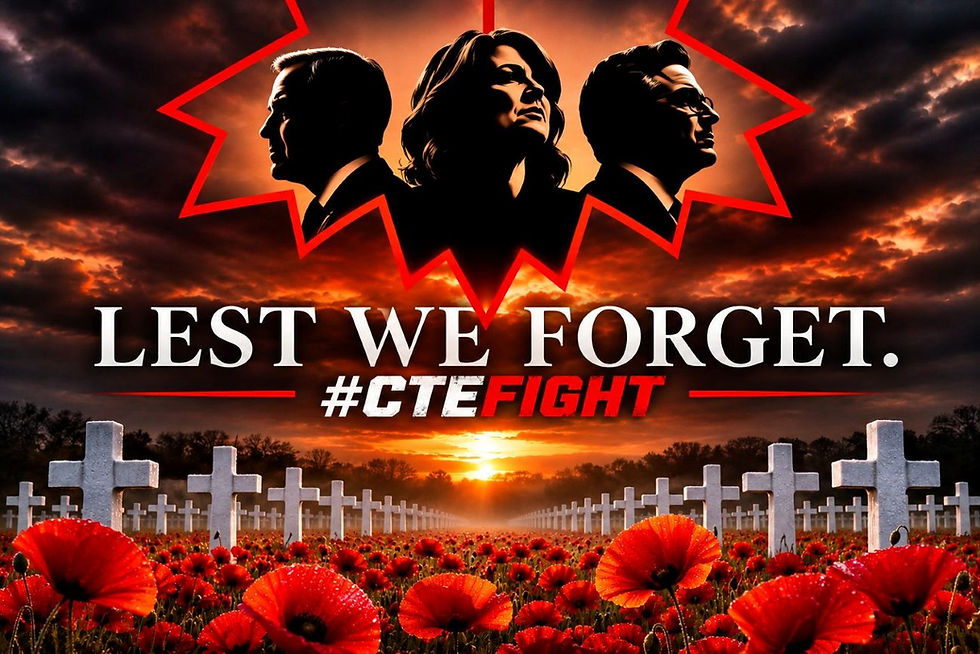
We remember the First World War, the Second World War, and the countless conflicts that came before and after. We remember those who fought, those who served, those who survived, and those who made the ultimate sacrifice.
We wear our poppies. We lower our flags. We observe our silence. We say three words. Lest we forget. But I have a question. What exactly are we promising never to forget?
The price of freedom
History is complicated. Wars have been fought for territory, resources, political ambitions, national survival, liberation, and competing visions of what is right.
Not every war was just. Not every government was honourable. Not every soldier had the luxury of choosing the circumstances into which they were sent.
But throughout history, ordinary human beings have made extraordinary sacrifices in the belief that their children and grandchildren might inherit something better. A world with greater freedom. A world with greater justice. A world where future generations might not have to endure the same suffering.
They weren't fighting for perfect societies. Such societies have never existed. They were fighting, in many cases, for the possibility of better ones. That possibility came at an unimaginable human cost.
So when we remember their sacrifice, perhaps we should also examine what we've done with the inheritance they left us.
The battles their descendants are still fighting
Jump forward to today. We live in countries that proudly celebrate democracy, freedom, equality, and human rights.
We have constitutions, charters, legislation, commissions, tribunals, and institutions supposedly designed to protect the individual. Yet people continue fighting battles against the very systems established to serve them.
An injured worker fights to receive benefits from a compensation system designed to protect injured workers. A person with a disability fights for accessibility in a society that publicly celebrates inclusion. A veteran fights to obtain the care and support promised in recognition of their service.
A patient fights to be heard within a healthcare system. A family fights for affordable housing, food, and the basic necessities of life. A citizen fights to have a legitimate complaint acknowledged by a government agency or corporation.
These are not the battlefields of Passchendaele, Vimy Ridge, or Normandy. We should never diminish the suffering and sacrifice of those who endured the horrors of war by pretending otherwise. But they raise a question that deserves an answer.
Why are the descendants of people who fought for freedom still having to fight for dignity, fairness, and basic human rights within their own societies? Perhaps more importantly, why have we become so accustomed to these struggles that we treat them as ordinary administrative inconveniences?
A new battlefront: Technology and the human equation
Now humanity finds itself racing into another extraordinary era. Artificial intelligence. Robotics. Automation. Machine learning. Technologies with the potential to transform medicine, education, accessibility, transportation, communication, and virtually every industry on Earth.
I believe these technologies can accomplish remarkable things. I work with artificial intelligence. I see its potential. I believe it can help humanity solve problems that have frustrated us for generations.
But I also see a question that isn't receiving nearly enough attention. As we race to replace human tasks, are we forgetting the humans those tasks were meant to serve?
We replace a customer service representative with an automated system. But what happens when that system cannot understand the circumstances behind a legitimate complaint?
We introduce automated decision-making into benefits, insurance, employment, and public services. But what happens when the person affected cannot challenge the decision, reach a human being, or obtain a meaningful explanation?
We celebrate digital accessibility. But what happens when the very technology advertised as accessible creates another barrier for someone with a disability?
We automate employment in the name of productivity. But what happens to the workers, their families, and their communities when efficiency becomes the only measure of progress?
Technology isn't inherently the enemy. Neither is artificial intelligence. The danger begins when we confuse replacing a human task with replacing the value of the human being who performed it.
A robot can perform a job. An algorithm can process a claim. An automated system can generate a response. But none of those accomplishments, by themselves, establish that the human being affected has been treated fairly.
Efficiency is not humanity. Automation is not accountability. Technological progress is not automatically human progress.
Who is responsible when the machine says no?
Imagine someone trying to access a service they desperately need. They encounter an automated phone system. Then a chatbot. Then a digital form. Then another automated response.
Their circumstances don't fit the available options. Their disability makes the process difficult. Their complaint requires judgment, context, or compassion. Somewhere behind that technological wall is an organization that proudly advertises its commitment to customer service and accessibility.
The person isn't asking technology to disappear. They're asking to be heard. Yet the more automated the process becomes, the harder it can be to identify who is actually responsible for the outcome.
That is not inevitable. Technology can also remove barriers, improve communication, and give people access to services they previously couldn't obtain. The difference lies in how we design it, govern it, and hold its operators accountable.
A system that saves a corporation money while denying a vulnerable person a meaningful opportunity to be heard is not necessarily an improvement. It's simply a cheaper system. Cheaper isn't always better.
The business of humanity
I've spent considerable time exploring the relationship between artificial intelligence (AI) and humanity through work on Guardian AI, a concept built around what I call the Business of Humanity.
The premise is straightforward. Technology should serve humanity, not require humanity to surrender its dignity in exchange for technological convenience.
That means accessibility must be more than a checkbox. Customer service must be more than an automated acknowledgement. Accountability must remain with identifiable human decision-makers. When technology makes a mistake, there must be a meaningful way to correct it.
We need innovation. We need new tools. We need the courage to explore possibilities previous generations could scarcely have imagined. But we also need boundaries. We need oversight. We need transparency.
Above all, we need to remember why we are building these technologies in the first place. Not merely to make businesses more profitable. Not merely to reduce staffing costs. Not merely to process more claims, transactions, or complaints in less time. But to improve the human condition.
Because if we create the most technologically advanced civilization in history while making it increasingly difficult for ordinary people to be treated with dignity, what exactly have we accomplished?
What would they think of the world we built?
I sometimes wonder what those who served and died in earlier generations would think if they could see the world today. They would witness extraordinary achievements. Medical advances that save lives. Communication technologies connecting continents in seconds. Scientific discoveries that once belonged exclusively to imagination. Rights and freedoms expanded through decades of difficult social progress. There is much to be proud of.
But they would also encounter poverty, homelessness, discrimination, political division, and people struggling to obtain assistance from institutions that claim to exist for their benefit. They would see governments with unprecedented administrative capabilities and corporations with extraordinary technological resources. They might reasonably ask why so many ordinary people still struggle to be heard.
We cannot know what those who died would say. They were individuals with different beliefs, experiences, and hopes. But we can ask ourselves whether we are meeting the responsibilities that come with the freedoms we inherited.
Because remembrance is not simply about looking backward. It is also about examining what we are doing today.
Lest we forget and lest we repeat
On November 11, I will remember. I will remember the Canadians who served at Vimy Ridge, Passchendaele, Dieppe, Normandy, and in conflicts around the world.
I will remember those from other nations who served, suffered, and died. I will remember the wounded, the missing, the prisoners of war, the families, and those whose battles continued long after the guns fell silent.
I will remember that peace, freedom, and human dignity are neither guaranteed nor permanent. They require protection. They require accountability. They require each generation to recognize that the responsibilities of citizenship do not end with the rights we inherit.
As we enter an era of artificial intelligence and increasingly autonomous technology, we have another responsibility. To ensure that the future we build does not forget the people it is supposed to benefit. To ensure that efficiency never becomes an excuse for indifference. To ensure that accessibility means genuine access. To ensure that the individual is never reduced to an inconvenience, a case number, or a data point. To remember that the freedoms secured and defended through generations of sacrifice mean very little if we stop respecting the humanity of those who inherit them.
"They fought so future generations might not have to fight the same battles. The least we can do is stop creating new ones for each other."
This November 11, wear your poppy. Observe the silence. Remember the fallen. But when the silence ends, remember the living, too.
Because the greatest tribute we can offer those who sacrificed their tomorrows is to take responsibility for the world we're building today.
"Lest we forget."
Read more from DJ Jesse Hudson
DJ Jesse Hudson, AI-Driven Cognitive Health Advocate
DJ Jesse Hudson is a cognitive health advocate, media creator, and founder of CTE Fight. Living with the long-term effects of brain injury, he uses storytelling and lived experience to raise global awareness around cognitive health and recovery. Through The Rabbit Hole, he explores how AI, media, and community can support resilience, continuity, and human dignity. His work bridges advocacy, innovation, and culture to make complex brain health conversations accessible and real.







