

The Silence That’s Killing Men and the Urgent Need to Rethink Men’s Mental Health
Updated: Aug 14
Written by Dr. Trish Avery, Founder of the AINT Foundation CIC and the AINT Model & Trauma-Informed Therapist
Dr. Trish Avery is a trauma-informed therapist and founder of the Avery Integrative Non-Judgmental Therapy (AINT) Foundation Community Interest Company (CIC) and creator of the AINT Model, recognised with two awards for innovation and mental health impact. She believes people heal when they feel safe, respected, and free from judgement, allowing the brain to relax, trust, and accept support.

Men’s mental health remains one of the most neglected, misunderstood, and insufficiently researched areas in the entire mental health landscape. This neglect is not because men experience less pain, but because society has spent generations teaching them to hide it. From early childhood, boys are told to toughen up, stop crying, push through, and be strong. These messages do not fade with age. They become internal rules that shape how men move through the world, how they cope with distress, and how they survive emotional pain they have never been allowed to name. The result is a silence that is not natural but conditioned, a silence that is not protective but harmful, a silence that has cost countless men their lives.
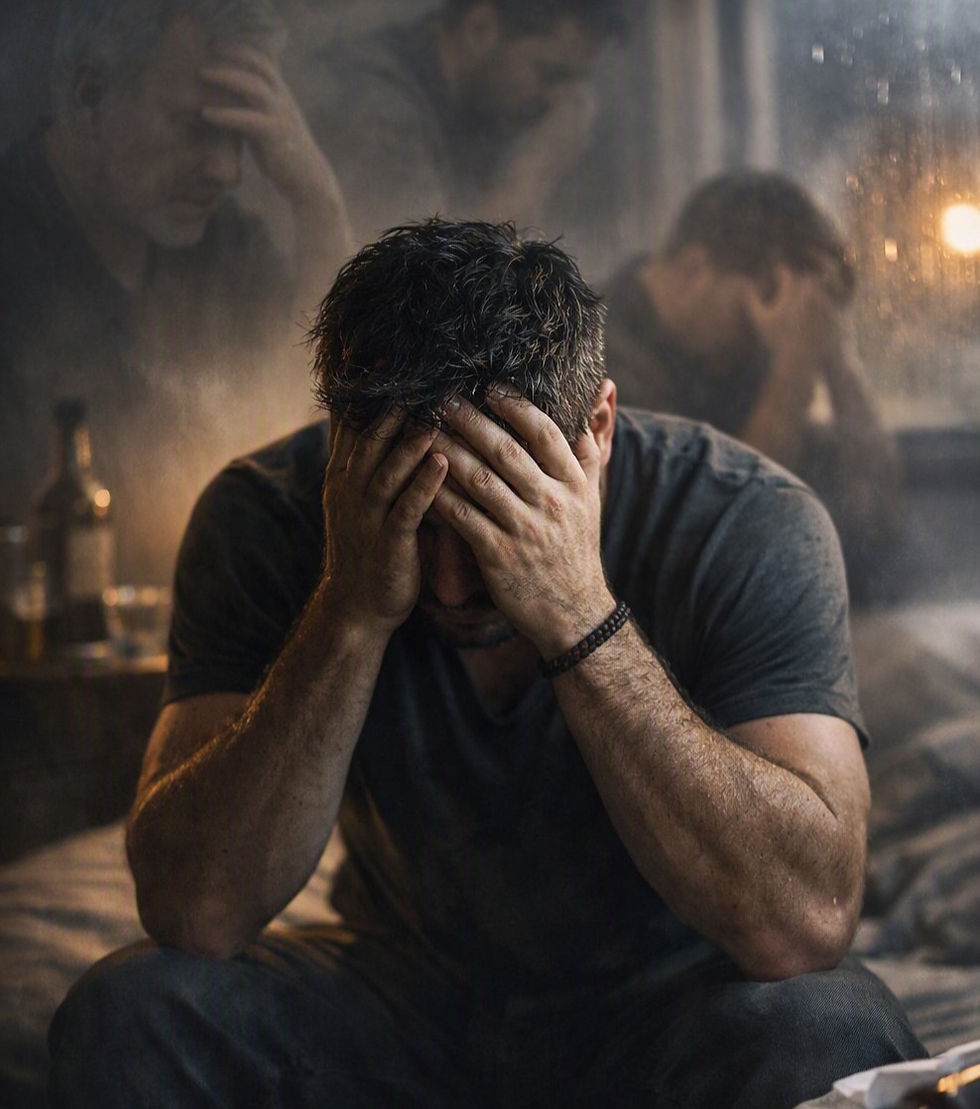
Men have some of the highest mortality rates connected to mental health distress, including suicide. Globally, men account for roughly 75% of all suicide deaths, and in the UK, the figure remains consistently around three-quarters year after year. These numbers are not abstract. They represent fathers, sons, brothers, partners, and friends whose pain went unseen or unsupported. Yet the research dedicated to understanding men’s emotional experiences remains shockingly limited. This lack of research is not accidental. It reflects a deeper cultural belief that men should cope alone.
Men are expected to be the strong ones, the stable ones, the protectors, the providers. When protectors need protecting, when providers need support, and when the strong feel weak, they often find very few places to turn. Many men describe feeling invisible in the mental health system. They see services designed for children, women, older people, and disabled people, all of which are vital and necessary, yet they notice that men are rarely spoken about with the same urgency or compassion. Men often feel they are placed last in the queue for care, expected to manage without support and expected to be fine because they are men. This sense of being unimportant or overlooked becomes another layer of silence. If society does not see their pain, men learn not to show it.
The emotional reality for men is far more complex than stereotypes suggest. Men are not less emotional. They are less permitted to be emotional. Their nervous systems respond to fear, shame, grief, and trauma with the same intensity as anyone else’s. Their bodies hold memories of distress even when their words do not. But instead of being encouraged to express these experiences, men are encouraged to suppress them. Suppression becomes a survival strategy. It becomes a way of staying acceptable, staying respected, and staying safe from judgement. Men learn to bottle their feelings because bottling feels safer than being seen.
This bottling has consequences. It shows up in withdrawal, shutdown, irritability, anger, numbness, exhaustion, and disconnection. It shows up in relationships where men struggle to express what they feel. It shows up in workplaces where men push through stress until they break. It shows up in communities where men isolate themselves rather than risk vulnerability. It shows up in families where fathers, brothers, sons, and partners carry burdens silently because they believe they must. It also shows up in the statistics that tell us men are dying from silence.
The tragedy is that men are not choosing silence. Silence was chosen for them. Silence was taught to them. Silence was rewarded. Silence became the measure of their worth. Now, silence is killing them. Men need spaces where they can be human instead of heroic, spaces where they can speak without being judged, spaces where they can feel without being shamed, and spaces where they can be supported without being told to toughen up. Men need mental health approaches that recognise the weight of social conditioning, the impact of silence, and the reality that many men have never been taught how to feel safely. They need environments where emotional expression is not seen as weakness but as humanity.
Improving men’s mental health requires more than awareness. It requires practical, accessible, culturally sensitive approaches. Effective support for men often includes trauma-informed practice that recognises shutdown, anger, and withdrawal as protective responses rather than failures, male-specific spaces where men can speak without fear of judgement, peer-led groups that feel safer than clinical environments, language that reduces shame by focusing on humanity rather than weakness, and community-based interventions for men who distrust formal services. These approaches help men feel safe enough to speak before they reach a crisis.
Men are not a single group. Their experiences of silence and stigma differ across cultural backgrounds, socioeconomic conditions, sexual orientation, disability, fatherhood, military service, and high risk professions. Lesbian, gay, bisexual, transgender, queer or questioning, and other identities (LGBTQ+) men often face layered stigma around vulnerability, while Black and minority ethnic men may experience cultural expectations of stoicism combined with systemic barriers to care. Recognising these differences ensures that support is not only available but relevant.
The lack of research into men’s mental health is not just an academic gap. It is a reflection of a deeper cultural belief that men should cope alone. When society assumes men do not need help, systems are built without them in mind. Services are designed without considering their needs. Funding is allocated elsewhere. Campaigns focus on other groups, and men continue to fall through the cracks because the cracks were never designed to hold them.
Men often say they do not seek help because they fear judgement. They fear being seen as weak, dismissed, misunderstood, or told they should be able to handle it. These fears are not irrational. They are based on lived experiences. Many men who have reached out for support describe being met with minimisation, confusion, or discomfort. They describe being told to calm down, to get on with it, to stop overthinking, or to be strong. They describe being treated as though their pain is less serious or less deserving of care.
This is why men often reach a crisis before they reach support. They wait until the pain becomes unbearable, the silence becomes suffocating, and they cannot carry the weight any longer. By the time they reach out, they are often already at breaking point.
Men deserve better. They deserve to be seen, heard, supported, and valued as much as anyone else. Their pain is real. Their struggles are human. Their lives matter. Men are not machines built to endure. They are human beings with nervous systems, emotions, histories, and vulnerabilities. They are fathers, sons, brothers, partners, friends, colleagues, and community members. They are people who feel deeply even when they do not show it.
A powerful shift is needed, one that reaches every level of society. A shift that challenges the belief that men must be invulnerable. A shift that recognises emotional expression as strength, not weakness. A shift that prioritises men’s mental health as a critical human issue rather than a secondary concern. A shift that encourages men to speak before they break. A shift that teaches boys that crying is human, not shameful. A shift that tells men they do not have to carry everything alone.
This shift requires action from policymakers, educators, clinicians, community leaders, workplaces, families, and society as a whole. Men’s mental health will not improve until systems are built that include them. It will not improve until research reflects their experiences. It will not improve until men are allowed to be human. It will not improve until we collectively recognise that strength is not the absence of emotion. Strength is the courage to feel, to express, to connect, and to seek support without fear.
Men have been strong for too long in ways that have harmed them. It is time to redefine strength so that it includes humanity. It is time to create a world where men no longer have to choose between being strong and being alive.
Read more from Dr. Trish Avery
Dr. Trish Avery, Founder of the AINT Foundation CIC and the AINT Model & Trauma-Informed Therapist
Dr. Trish Avery is a trauma-informed therapist and the founder of the AINT Foundation CIC, where she developed the AINT Model. Her work has earned both a Global Recognition Award and a Business Awards UK honour for innovation and mental health impact. Dr. Avery supports adults who do not feel understood or supported within traditional services. She believes healing begins with safety, respect, and the absence of judgement, allowing the brain to finally trust and accept help. Her mission is to offer therapy that feels gentle, human, and genuinely accessible.
References:
Courtenay, W. (2000). Constructions of masculinity and their influence on men’s well-being. Social Science and Medicine.
Seidler, Z. E., Dawes, A. J., Rice, S. M., Oliffe, J. L., & Dhillon, H. M. (2016). The role of masculinity in men’s help seeking for depression. Clinical Psychology Review.
World Health Organization. (2022). Suicide worldwide in 2022: Global health estimates.
Oliffe, J. L., & Han, C. S. (2014). Beyond stereotypes: Men’s depression and suicide. American Journal of Men’s Health.


