

The Role of Insulin in Sustainable Weight Loss
Updated: 2 days ago
Lena Maria Braun is a holistic nutrition coach, personal trainer, and natural bodybuilding athlete. She combines holistic nutrition, training, and mindset for sustainable physical and mental development.

For decades, weight loss has been presented as a simple equation: eat less, move more, and burn more calories than you consume. Count calories. Reduce portions. Exercise harder. But what if your next step isn't necessarily to eat less? What if improving your macronutrient balance means adding something to your plate rather than taking something away? What if changing when you eat could make a difference?
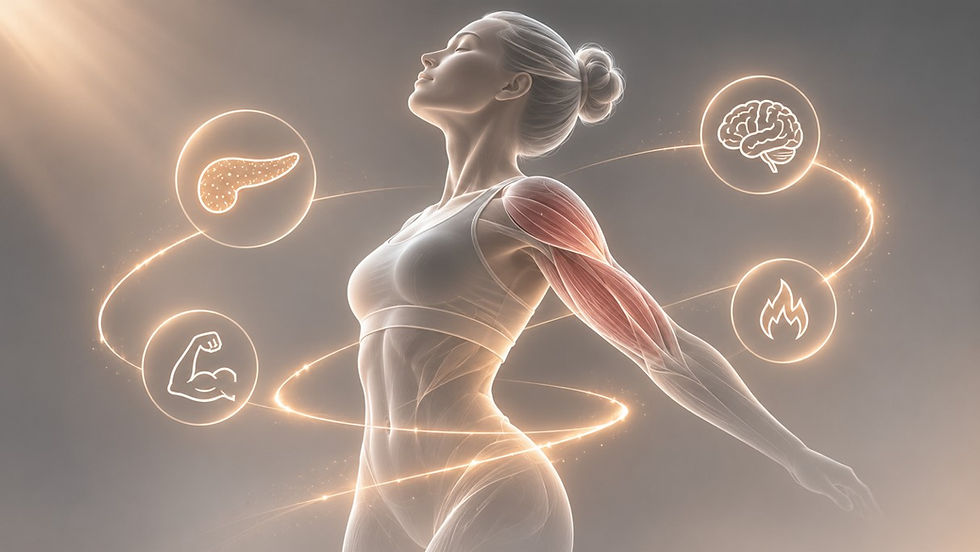
Energy balance remains fundamental to weight management. Yet it doesn't explain everything about hunger, fat storage, or how your body responds to food. To understand why sustainable weight loss can be challenging, we need to look beyond calories and consider the biological mechanisms involved. One hormone deserves particular attention: insulin.
Insulin: More than a blood sugar hormone
You probably associate insulin with blood sugar and diabetes. But its influence extends much further. Produced by the pancreas, insulin regulates glucose uptake in certain tissues and plays an essential role in energy storage. It also suppresses lipolysis, the process through which stored fatty acids are released from your fat cells.
When insulin rises, fat release generally decreases. As insulin falls, stored fat becomes more available for energy use. Metabolic scientist Dr. Benjamin Bikman has extensively explored the relationship between insulin resistance, adipose tissue, and metabolic disease.
His research highlights an important point: understanding how your body responds to insulin matters beyond blood sugar regulation. Insulin itself is not harmful. Its release after eating is normal and necessary, and temporary insulin spikes do not automatically cause weight gain. The more relevant question is whether your cells are responding to it efficiently.
Insulin resistance: What your blood sugar doesn't tell you
Imagine receiving perfectly normal blood sugar results and believing your metabolism is functioning optimally. But what if your body is producing considerably more insulin than necessary to maintain those numbers?
This can happen when your muscle, liver, and fat cells become less responsive to insulin. To compensate, your pancreas produces more of the hormone, a condition known as compensatory hyperinsulinemia.
Blood glucose may remain normal even as insulin resistance develops. Routine diabetes screening commonly relies on fasting glucose and HbA1c. Although essential for assessing glucose regulation, these measurements do not necessarily identify early insulin resistance.
Fasting insulin and indices such as the homeostatic model assessment of insulin resistance (HOMA-IR) may offer additional information in selected clinical situations, although no single universally accepted threshold establishes the diagnosis. This isn't exclusively a concern for people with obesity.
Your blood sugar can be normal while your insulin is already working overtime. Your weight and appearance alone cannot tell you how metabolically healthy you are.
Why your breakfast may deserve a second look
Think about your usual breakfast. Does it leave you satisfied for hours, or do you find yourself searching for something to eat shortly afterward? The composition of your first meal can influence your glucose response and satiety.
Rapidly digestible carbohydrates generally produce a greater rise in blood glucose, while protein, fat, and fiber influence digestion and nutrient absorption. A breakfast rich in high-quality protein and healthy fats, combined with an individually appropriate amount of carbohydrates, may therefore support more stable post-meal glucose levels.
Protein also stimulates insulin secretion, but it does not necessarily produce the same glucose response as rapidly absorbed carbohydrates.
A randomized clinical trial published in The American Journal of Clinical Nutrition in 2023 found that a low-carbohydrate, higher-fat breakfast improved several measures of daily glucose regulation in adults with type 2 diabetes compared with a higher-carbohydrate alternative.
This does not mean that one breakfast works for everyone. Your activity level, muscle mass, metabolic health, and nutritional needs all matter.
But it raises an important question. Before reducing your portions, have you considered changing the composition of your meals? The timing of your meals may also be worth examining.
A randomized study published in Obesity in 2013 found that women with overweight or obesity and metabolic syndrome who consumed a larger breakfast and smaller dinner experienced greater weight loss and improvements in insulin-related markers than those following the opposite pattern, despite having the same prescribed daily calorie intake.
While this doesn't establish one ideal meal schedule, it suggests that how you distribute your food throughout the day may also matter.
Metabolic flexibility: Your body has more than one energy source
Your body is remarkably adaptable. It can switch between carbohydrates and fats as energy sources depending on nutrient availability and physical demands.
This ability is called metabolic flexibility. As insulin levels decrease between meals, your body increasingly uses stored fatty acids. During longer periods without food or with sufficiently low carbohydrate intake, your liver can also produce ketone bodies, including beta-hydroxybutyrate (BHB).
Here is where the science becomes particularly interesting. Ketones are more than an alternative fuel. They are also messengers within your metabolism.
Research by Newman and Verdin (2017) describes how BHB can influence cellular pathways involved in gene regulation, inflammatory signaling, and responses to metabolic stress.
Ketones can also provide your brain with an alternative energy source, although they do not replace insulin or automatically improve insulin sensitivity.
So, what does this mean for your weight-loss journey? It means your body has natural mechanisms for accessing stored energy, and understanding them may help you make more informed dietary decisions.
Appropriate meal intervals, nourishing food, and regular movement can be part of that approach. Accessing stored fat does not automatically mean losing body fat. Long-term energy balance still matters. The smarter approach isn't to ignore calories, but to understand the biology behind them.
Why building muscle could change the equation
Have you ever considered how much glucose your muscles can store? Depending on muscle mass, training status, and nutrition, skeletal muscles can store approximately 300 to 700 grams of glycogen, equivalent to around 1,200 to 2,800 calories of carbohydrate energy (Murray & Rosenbloom, 2018).
Insulin activates signaling pathways that bring glucose transporter type 4 (GLUT4) transporters to the muscle cell surface, enabling glucose to enter and be used for energy or stored as glycogen.
Interestingly, muscular contractions can also stimulate glucose uptake independently of insulin. Now consider the same person in two different situations.
Situation A. You have relatively little muscle mass and spend most of your day sitting. Your overall capacity to store glucose as muscle glycogen is comparatively limited.
Situation B. After months of consistent resistance training, you have developed more muscle, improved glucose uptake, and increased your potential glycogen storage capacity.
Imagine eating the same meals in both situations. Your body's response may be different.
In Situation B, you have more functional muscle tissue available to store and utilize glucose. Training can also improve insulin sensitivity and increase energy expenditure.
If your overall energy expenditure rises while your food intake remains unchanged, you may be able to lose more body fat over time.
This is why I consider progressive resistance training especially valuable. Walking, cycling, and running provide important cardiovascular and metabolic benefits. But if your goal is specifically to build and preserve muscle mass, targeted resistance training provides a particularly effective stimulus.
Exercise helps you use glucose. Building muscle can also increase your capacity to store it. Muscle is not simply about strength or appearance. It is one of your body's most important glucose reservoirs.
Before you decide to eat less, ask yourself this
What if your next step toward sustainable weight loss isn't another restriction?
What if you first reconsidered the composition of your breakfast, the balance of nutrients on your plate, or your daily eating rhythm?
What if building muscle became as important to you as burning calories?
None of these strategies eliminates the importance of energy balance. But they can help you create more favorable conditions for sustainable change.
As a holistic nutrition coach, I believe that understanding how your body functions is far more valuable than following another rigid set of dietary rules.
Before asking yourself what you need to eat less of, perhaps start asking what your body actually needs more of. Because sometimes, meaningful change begins not with another restriction, but with a better question.
Read more from Lena Maria Braun
Lena Maria Braun, Holistic Nutrition Coach & Personal Trainer
Lena Maria Braun is a Holistic Nutrition Coach, Personal Trainer, and Natural Bodybuilding athlete in the Wellness category. With over ten years of experience, she combines holistic nutrition, training, and behavioral psychology. Her work focuses on sustainable health, mindset development, and long-term performance. In 2025, she founded her own company to support people in reaching their physical and mental goals.
Reference:







