The Pouch Generation – When Baby Food Doesn’t Need Teeth
Anastasia Schenk is a Pediatric Feeding Specialist and Integrative Nutrition Health Coach. She supports children from starting solids to young adulthood with evidence-based strategies for ARFID, picky eating, gut health, immune support, allergy prevention, and chronic inflammation.

Walk into any supermarket, and you’ll see a glossy wall of baby food pouches, lined up like tiny fuel canisters for small humans. They promise convenience. “On-the-go.” “Mess-free.” “100% fruit.” And the modern toddler has learned the ritual, twist, squeeze, suck, and move on.
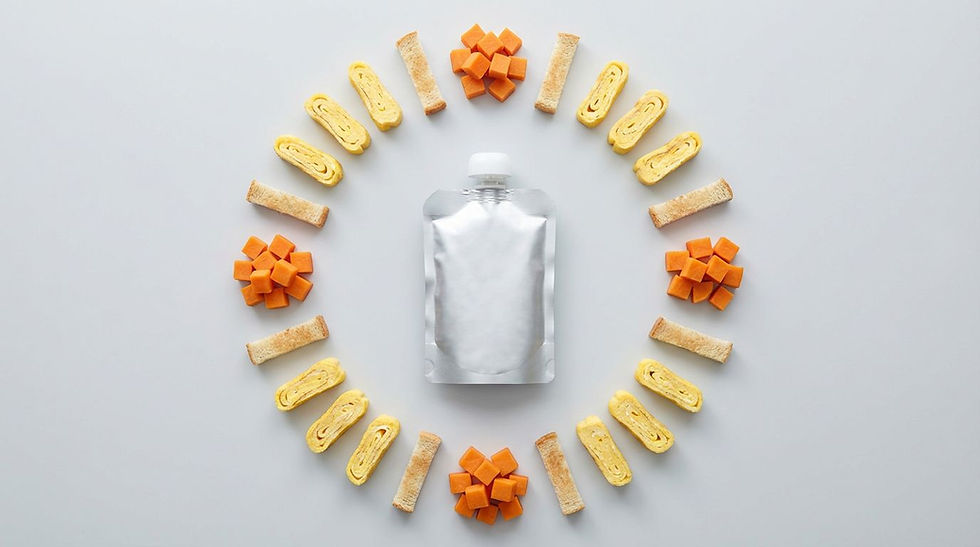
In many families, pouches have quietly become a default meal format, not just a backup. And here’s the uncomfortable question we rarely ask:
What happens when an entire generation grows up eating in a way that barely requires chewing?
Because chewing isn’t just a food skill. It’s a developmental signal. It shapes how the mouth grows, how the airway forms, and how well sleep does its job. In other words, chewing doesn’t only affect the menu, but it may also influence the architecture.
This article isn’t a moral panic about pouches. They’re not “bad.” They’re a tool. But tools can be overused, and overuse can create unintended consequences. Let’s zoom out.
The great de-chewing
Humans didn’t evolve on smoothies. We evolved on foods that demanded work such as fibrous plants, tougher proteins, textures that made the jaw earn its keep. Chewing loaded the facial bones, trained oral muscles, and widened dental arches across childhood.
Modern food technology has reversed that requirement. We now live in a world where calories can be consumed with minimal resistance, and baby food culture is at the front of that shift.
When the early diet is dominated by ultra-soft textures (purees, pouches, “melties,” snack foods that dissolve instantly), the jaw gets less mechanical training. And bones are not passive. They respond to use.
Your child’s face isn’t only genetic. It’s genetics plus the environment acting on developing tissue.
Chewing is a growth stimulus, not a bonus feature
The mouth is part of a larger system, including muscles, bones, tongue posture, breathing patterns, and swallowing. Orthodontists call this the stomatognathic system, basically, the “chew-swallow-breathe” ecosystem that shapes the lower face.
During childhood, the jaw and palate are still forming. And mechanical forces matter. The simple act of chewing creates loads that stimulate bone remodeling and muscular development.
That’s why researchers have repeatedly found links (in animal models and emerging human data) between softer diets and reduced craniofacial development, including smaller jaws and narrower dental arches.
Again, this doesn’t mean a pouch causes orthodontic issues. It means a diet that rarely challenges chewing may contribute to a low-stimulation environment for facial growth, especially if it becomes the norm during key developmental windows.
The palate is the floor of the nose
Here’s the part most parents never get told. The roof of the mouth (the palate) is also the floor of the nasal cavity.
So when the palate develops narrow and high-arched, there may be less room above it, meaning less space in the nasal airway. In pediatric sleep medicine, certain craniofacial features (like a narrow, high palate) are commonly discussed as part of the phenotype seen in childhood obstructive sleep apnea.
This matters because breathing patterns influence everything. Sleep quality, nervous system regulation, and even how the tongue rests in the mouth. When the tongue rests low and the mouth tends to stay open, the palate may miss the gentle widening pressure that healthy tongue posture can provide over time.
Development is a chain reaction. When one part of the system adapts, everything else starts negotiating.
Sleep is where the brain pays its bills
Pediatric obstructive sleep apnea isn’t always obvious. Adults with sleep apnea often look exhausted. Kids can look wired.
In children, disrupted breathing at night is associated with learning and behavioral issues, including difficulty paying attention and ADHD-like symptoms.
When sleep fragments, the brain loses its overnight maintenance cycle. Memory consolidation, emotional regulation, impulse control, and attention stabilization.
So if early feeding choices nudge oral development toward narrower structures and mouth-breathing patterns, the downstream effects may show up years later as “behavior” when the root issue is actually physiology.
We are quick to label kids as difficult. Sometimes they’re simply tired.
The pouch problem isn’t nutrition, it’s texture and mechanics
The real issue isn’t that pouches exist. It’s how they’re used.
When babies suck directly from a pouch spout, they bypass key skills:
Moving food around the mouth
Practicing lateral tongue movement
Biting and chewing
Learning textured variety
Developing oral strength and coordination
And pouches tend to deliver a uniform texture. Even the “chunky” ones are often the same sensory experience as smooth, sweet, predictable.
That predictability matters. Not just for the jaw, but for food acceptance.
Large studies tracking thousands of children have found that delaying lumpy textures past the end of infancy is associated with more feeding problems later, including reduced acceptance of fruits and vegetables and more reported feeding difficulties in childhood.
This is why many public health guidelines emphasize progression with purees are a stage, not a lifestyle. Babies need to move through textures in order to develop the oral-motor skills that make real family food feel safe.
Convenience becomes a problem when it freezes development at one stage.
How to use pouches without raising a liquid-diet kid
Here’s the good news, you don’t need to ban pouches. You just need to stop letting them become the default format.
1. Treat pouches as “occasion food,” not daily food
Use them for travel days, emergencies, and busy transitions. Don’t let them replace the developmental work of meals.
2. Don’t let babies suck straight from the spout
Squeeze onto a spoon or into a bowl. It slows the pace, supports skill-building, and reduces constant contact with teeth.
3. Pair every pouch with a “chew opportunity”
If you use a pouch as part of snack time, add something age-appropriate that requires gentle chewing:
Soft finger foods
Tender cooked vegetables
Strips of omelet
Soft meatballs
Toast fingers (when ready and safe)
4. Move up the texture ladder on purpose
You’re not “rushing” your baby by offering mashed/lumpy textures and finger foods in the
appropriate window. You’re teaching their mouth what food feels like.
5. Slow the meal down
Pouches are fast. Chewing is slow. Development happens slowly. A child who learns to sit, explore, chew, and self-feed is building more than nutrition, they’re building coordination, confidence, and regulation.
When to take a closer look
Not every child who likes pouches has an airway issue. But certain signs are worth paying attention to:
Persistent mouth-breathing
Regular snoring
Restless sleep, night waking, sweating
Daytime hyperactivity or difficulty focusing
Gagging or refusal of textured foods well past the early stages
Prolonged “puree-only” eating without a medical reason
If these show up, it’s worth discussing with your pediatrician, and sometimes a feeding specialist, ENT, pediatric dentist, or sleep specialist can help connect the dots.
The bigger picture
Pouches didn’t ruin childhood. They solved a modern problem including time, stress, and convenience.
But convenience has a side effect, it removes friction.
And the developing body, especially the developing face, needs a little friction. It needs resistance, texture, and time.
Let pouches be what they were meant to be, a backup tool. Then build your child’s everyday diet around real textures that teach their mouth how to grow.
Because sometimes the most revolutionary thing you can do for a child’s future health isn’t adding a supplement. It’s giving them food that lets them use their teeth.
Read more from Anastasia Schenk
Anastasia Schenk, Pediatric Feeding Specialist/Integrative Nutrition
Anastasia Schenk is a Pediatric Feeding Specialist and Integrative Nutrition Health Coach who reversed her own autoimmune disease through nutrition. A mother of two, she combines clinical expertise with lived experience to help families navigate picky eating, Pediatric Feeding Disorders, ARFID, gut health, and chronic inflammation. Her programs are evidence-based and rooted in real life, supporting children from starting solids to young adulthood. She is the founder of Early Eaters Club, a platform dedicated to raising resilient, adventurous eaters for lifelong health.