The Gap After Recovery and Why Strength is the Bridge Back to Life
Neil Sheppard is a registered kinesiologist (Ontario, Canada) with over 20 years of experience helping people move without pain and stay strong for life. He is the founder of Dynamic Strength Rehab (DSR), built around the step most people skip after injury: getting truly strong again.

Discharge day feels like a finish line. The surgery is behind you, the physio sessions are done, and someone tells you that you are good to go. But most people know the feeling that comes a few weeks later. The stairs still feel uncertain. You hesitate before lifting the grocery bags. The sport, the hike, the game on the floor with the grandkids still feels a step too far.
That feeling is not in your head. It is a gap: the space between being cleared and being capable. It is one of the most common and least talked about stages of recovery. The thing that closes it is strength.
The 5 stages of recovery
Whether it is a torn anterior cruciate ligament (ACL), disc surgery or a new hip, most recoveries follow the same path.
The injury. Something breaks down: a fall, a tear, a joint worn out over decades.
The surgery or acute care. Surgeons and hospital teams repair the damage. Their job is to fix the structure.
Outpatient rehab. Physiotherapists calm the pain, restore range of motion and rebuild basic function. Their job is to get you moving safely.
The gap. Formal care ends. Insurance runs out, appointments stop, and you are on your own with a sheet of home exercises.
Life. Work, sport, travel, kids, grandkids. The demands that were waiting for you the whole time.
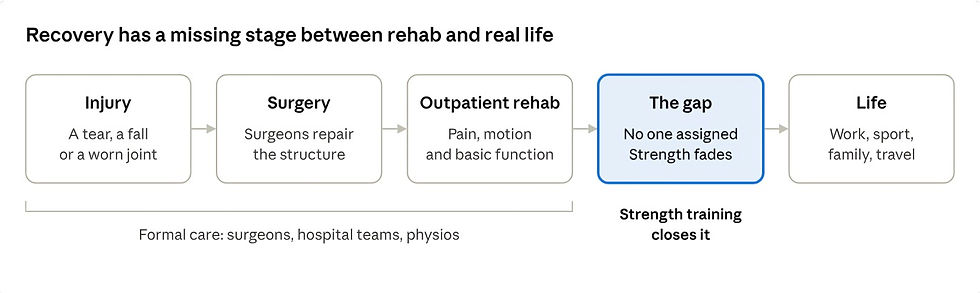
Stages one to three are well built. Each has trained professionals, clear protocols and a plan. Stage five is the reason you went through it all.
Stage four is where the system goes quiet. Nobody is assigned to it. It is exactly where outcomes over the long term are won or lost.
How many people pass through the gap
This is not a niche problem. Millions of people across North America, and hundreds of millions worldwide, reach stage four.
Injuries. Canada: about 4.6 million emergency visits and 231,530 hospital stays a year, at a cost of $29.4 billion, with falls alone costing $10.3 billion, according to 2018 data.[1] United States: 7,338.7 emergency department visits for nonfatal unintentional injuries per 100,000 people in 2022, according to Healthy People 2030.[2] Worldwide: injuries kill 4.4 million people a year, nearly 8% of all deaths, and injure tens of millions more, according to the World Health Organization (WHO).[3]
Joint replacements. Canada: 175,242 hip and knee replacements in 2024 to 2025, up 5.3% in one year and 26.5% since before the pandemic, according to the Canadian Institute for Health Information (CIHI).[4] United States: about 680,000 knee and 370,000 hip replacements in 2014, projected to reach roughly 2.6 million knees and 1.2 million hips annually by 2060, according to research presented at the American Academy of Orthopaedic Surgeons (AAOS) annual meeting.[5] Worldwide: 595 million people had osteoarthritis in 2020, up 132% since 1990, with the knee the most common site, according to the Global Burden of Disease (GBD) 2021 Osteoarthritis Collaborators.[6]
Musculoskeletal conditions. Worldwide: about 1.71 billion people live with a musculoskeletal condition. These conditions are the leading contributor to disability on the planet and account for about two-thirds of adults who need rehabilitation.[7]
Faster discharges. Canada: about a third of hip and knee replacements for osteoarthritis are now day surgeries, roughly four times the rate in 2020 to 2021.[4] That is good news for hospitals and patients. It also means people go home sooner, with more of the rebuilding left to them.
Many of these people eventually hear “you're discharged.” What happens next helps determine how well they live for the next twenty years.
What happens in the gap
The research on life after formal rehab tells a consistent story. Recovery that stops at “cleared” often stalls there.
Muscle disappears fast when you are inactive. In one study, healthy adults in their late 60s lost almost 1 kg of leg muscle in just 10 days of bed rest. Younger adults lost less than half that over nearly three times as long.[8] Every surgery comes with a stretch of reduced activity, and that lost muscle does not come back on its own.
Strength often never fully returns. After knee replacement, quadriceps strength can sit 30% to 40% below that of healthy people the same age. In a study that followed patients for three years, they “never reached the levels of function” of healthy peers. Even their nonoperated leg kept getting weaker.[9]
A new joint does not automatically mean a more active life. A review of 17 studies found no significant change in physical activity in the year after hip replacement compared with before surgery.[10] The pain is gone, but the habits, the fear and the weakness often stay.
Another ACL injury is common after a return to sport. Among athletes under 25 who return to sport after ACL reconstruction, nearly 1 in 4 (23%) suffer a second ACL injury.[11]
Satisfaction is not guaranteed. Most joint replacement patients are happy with their result: in Canadian data, about 9 in 10 report improvement a year later.[4] But in one large Ontario study, about 1 in 5 (19%) knee replacement patients were not satisfied with their outcome.[12]
Home exercise programs fade. Nonadherence to home exercise programs runs as high as 70%. In a recent United States survey, 76% of people said they did not finish all their assigned home exercises.[13] That is not a willpower problem. It is what happens when nobody is guiding, progressing or checking in.
Why strength is the missing link
Pain relief and mobility get you out of the injury. Strength gets you back into your life. Here is why it matters so much.
Strength is a marker of how long and how well you live. A study of almost 140,000 adults in 17 countries found that every 5 kg reduction in grip strength was linked to a 16% higher risk of death from any cause.[14] Grip is not magic. It is a simple window into how strong the whole body is.
Strength protects the repair. Muscle is the body's shock absorber. A strong quad takes load off a new knee. Strong glutes and trunk muscles protect a healed back. When the muscles around a joint are weak, the joint takes the hit.
Strength prevents the next injury. Falls are the leading cause of injury death in Canada.[1] Leg strength, balance and the ability to catch yourself are what keep a stumble from becoming a fracture.
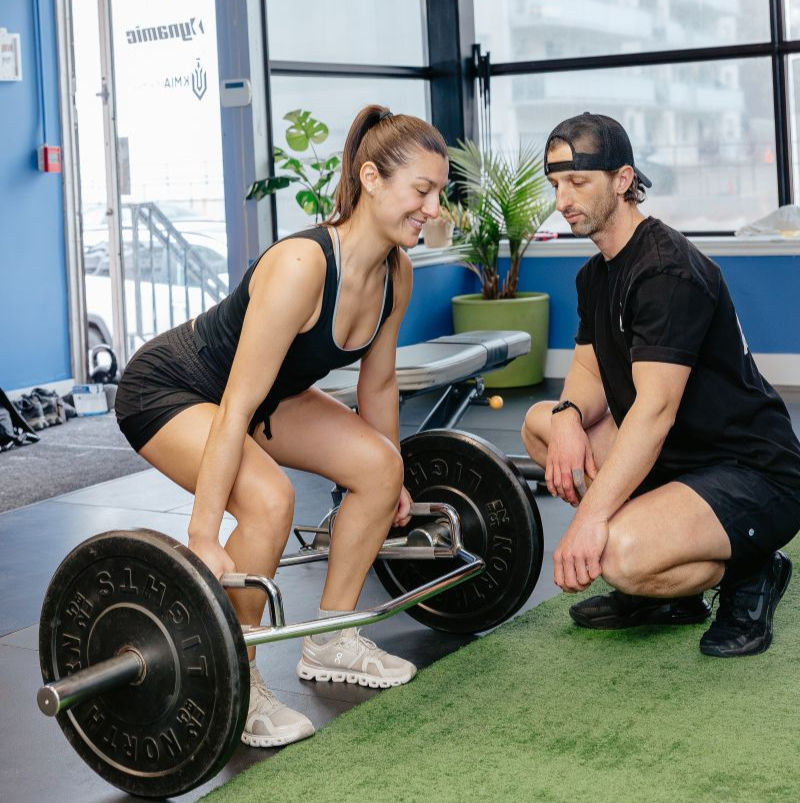
Strength builds confidence. Many people stay inactive after surgery not because they cannot move, but because they do not trust their body. Lifting a little more each week is proof, in your own hands, that you are capable again.
Strength keeps life big. Carrying luggage through an airport. Getting up off the floor. Playing a full round of golf. Hiking the trail you put off for years. These are strength tasks. The stronger you are, the more of life stays open to you.
How to cross the gap
You do not need to be an athlete to close the gap. You need a plan that keeps going after your last appointment.
Ask about “what next” before you are discharged. Ask your surgeon or physiotherapist what you should be able to do in 3, 6 and 12 months, and what to avoid. Get your restrictions in writing.
Measure where you are. Simple numbers tell the story: how long you can stand on one leg, how many times you can stand up from a chair in 30 seconds, how many calf raises you can do on one leg. Write them down and retest every month.
Keep adding a little load. Muscle grows when it is asked to do slightly more than last time. A few more repetitions, a little more weight, a slower lowering. Small, steady steps beat big jumps.
Train the whole body, not just the injured part. The other leg, the hips, the trunk and the upper body all weaken during recovery. They all need to come back.
Train two to three times a week. Consistency matters more than intensity. Short, regular sessions build more strength than occasional hard ones.
Get support. People stick with exercise when someone is guiding, adjusting and checking in. A qualified professional, such as a kinesiologist, exercise physiologist or strength coach who works with clients after rehabilitation, can bridge the gap safely.
Listen to your body, not your fear. Mild soreness that passes quickly is normal. Sharp pain, new numbness or symptoms that keep getting worse mean you should stop and check in with your healthcare provider.
Resilience is the real finish line
The goal of recovery was never just to stop hurting. It was to get your life back, and to keep it.
Surgery repairs the structure. Physiotherapy restores the movement. Strength is what makes the result last. It turns a fixed joint into a capable body, and a cautious person into a confident one.
If you are standing in the gap right now, you are not behind. You are at the most important stage of all. Every repetition from here is an investment in the next twenty years: more independence, fewer setbacks and a bigger, stronger life.
Read more from Neil Sheppard
Neil Sheppard, Registered Kinesiologist (Ontario) & DSR Founder
Neil Sheppard is a registered kinesiologist (Ontario, Canada) and founder of Dynamic Strength Rehab (DSR) in Oakville, Ontario. With over 20 years of experience, he helps people rebuild real strength after injury, surgery, or physiotherapy, the step most rehab programs stop short of. His training programs are built around each client's actual injury history and goals, delivered in person in Oakville or virtually through DSR's platform. The result: clients don't just move without pain again, they get strong enough that it stays that way.
Reference:
[1] Parachute. Cost of injury in Canada. Report published in 2021 using 2018 data.
[2] Office of Disease Prevention and Health Promotion. Healthy People 2030: Reduce emergency department visits for nonfatal unintentional injuries.
[3] World Health Organization. Injuries and violence.
[4] Canadian Institute for Health Information. Canadian Joint Replacement Registry annual report: Hip and knee replacements in Canada, 2024 to 2025.
[5] American Academy of Orthopaedic Surgeons. Projected volume of primary and revision total joint replacement in the United States, 2030 to 2060. 2018.
[6] Global Burden of Disease 2021 Osteoarthritis Collaborators. Global, regional, and national burden of osteoarthritis, 1990 to 2020 and projections to 2050: A systematic analysis for the Global Burden of Disease Study 2021. The Lancet Rheumatology, 2023.
[7] World Health Organization. Musculoskeletal health.
[8] Kortebein P, et al. Effect of 10 days of bed rest on skeletal muscle in healthy older adults. Journal of the American Medical Association, 2007.
[9] Farquhar S, Snyder-Mackler L. The Chitranjan Ranawat Award: The nonoperated knee predicts function 3 years after unilateral total knee arthroplasty. Clinical Orthopaedics and Related Research, 2010.
[10] Withers TM, et al. Is there a difference in physical activity levels in patients before and up to one year after unilateral total hip replacement? A systematic review and meta-analysis. Clinical Rehabilitation. Published online in 2016.
[11] Wiggins AJ, et al. Risk of secondary injury in younger athletes after anterior cruciate ligament reconstruction: A systematic review and meta-analysis. The American Journal of Sports Medicine, 2016.
[12] Bourne RB, et al. Patient satisfaction after total knee arthroplasty: Who is satisfied and who is not?. Clinical Orthopaedics and Related Research, 2010.
[13] The Ohio State University Wexner Medical Center. Survey: 3 in 4 skip physical therapy homework, stunting progress. February 16, 2026.
[14] Leong DP, et al. Prognostic value of grip strength: Findings from the Prospective Urban Rural Epidemiology (PURE) study. The Lancet, 2015.