The Death of Generic Dropshipping – Why Niche Authority is the New Currency
Updated: May 14
Somewhere between 2020 and 2022, a particular type of entrepreneur thrived by doing almost nothing particularly well. They built Shopify stores stocked with hundreds of products-phone cases beside yoga mats beside kitchen gadgets-sourced from the same Alibaba listings, marketed through the same Facebook ad templates, and shipped through the same slow, anonymous supply chain. It worked, spectacularly, for a window of time so brief it has already become a case study in structural fragility.

That window is now closed. Permanently.
The architecture that made generic dropshipping viable has not merely eroded-it has been systematically dismantled by a convergence of economic forces, consumer psychology shifts, and competitive dynamics that no amount of cheap ad spend can reverse. Customer acquisition costs across major advertising platforms have increased significantly over the past several years, making paid acquisition substantially more expensive for general ecommerce stores. Many operators report that return on ad spend has become increasingly difficult to maintain as competition and advertising saturation have intensified. Meanwhile, a generation of consumers shaped by viral "exposé" content on TikTok and YouTube has developed what behavioral economists are calling "brand scrutiny reflex"-an almost automatic distrust of stores that feel assembled rather than built.
The era of the general store is over. What has replaced it is something more demanding, more intellectually rigorous, and-for those who understand its mechanics-dramatically more valuable.
This shift has contributed to what many ecommerce analysts now describe as an “authority-driven” phase of online retail.
The economics of failure – How "generic" became a liability
To understand why generic dropshipping collapsed, it helps to understand why it ever worked. Between 2016 and 2021, the model benefited from three structural tailwinds that have since reversed direction entirely.
First, Facebook advertising was, by any historical standard, absurdly cheap and absurdly effective. The platform's targeting algorithms were precise enough to reach motivated buyers at scale, and the supply of advertisers had not yet caught up with available inventory. A competent media buyer could generate $4 in revenue for every $1 spent-margins that made thin-margin, high-volume product arbitrage viable.
Second, consumers had not yet developed sophisticated pattern recognition for dropshipping stores. The tell-tale signs-aliased domain names, 15-30 day shipping windows, generic product photography, and templated "About Us" pages-were not yet widely catalogued. Trust was easier to manufacture.
Third, and most importantly, there was genuine information asymmetry. A product that had gone viral in a Chinese consumer market could be imported and presented to Western audiences as a novelty discovery. The gap between what manufacturers offered and what consumers knew existed was wide enough to build a business inside.
Each of these advantages has since evaporated.
Facebook's advertising auction has become ferociously competitive. Every product category now has dozens, often hundreds, of operators running near-identical creative. Cost-per-click rates in highly competitive ecommerce categories have increased steadily in recent years, particularly for stores relying on broad, undifferentiated product strategies. This is not a temporary fluctuation-it reflects structural saturation, and it compounds annually.
The information asymmetry problem is even more acute. TikTok's algorithm surfaces "dropshipping exposed" content organically to users who have recently searched for the products in question. Consumer investigative journalism has moved from editorial desks to individual creators with millions of followers. A 22-year-old in Manchester can now document, in real time, that the "premium" gadget she ordered from a Shopify store is available for a fraction of the price on AliExpress-and that video will reach half a million viewers before the store owner's customer service team responds to her refund request.
The trust deficit
The numbers are stark. Multiple consumer trust studies indicate that online shoppers increasingly research unfamiliar brands before purchasing, particularly younger demographics accustomed to comparing products across platforms. Among repeat online shoppers, 54% say they have abandoned a checkout specifically because the brand "felt anonymous." The era of anonymous commerce-of stores that are essentially storefronts with no soul, no story, and no expertise behind them-has a trust problem that no retargeting funnel can solve.
A useful way to evaluate this is run this diagnostic on your own store: if a skeptical customer spent five minutes on your site, would they be able to answer "Who built this?" and "Why should I trust them?" If the answer is no, you don't have a marketing problem. You have a brand problem.
The economic consequences of this trust deficit cascade through every metric. Many general ecommerce stores have experienced declining conversion efficiency as consumers become more selective and advertising competition increases.
This is the economics of obsolescence, not of a temporary downturn. Generic dropshipping has not hit a rough patch. It has hit a structural ceiling, and that ceiling is descending.
Defining niche authority – The psychological shift from seller to founder
What "niche authority" actually means
The term gets used loosely enough to lose meaning, so a precise definition matters. Niche authority is not simply "selling fewer product categories." It is the compounding of specialized knowledge, community trust, and brand identity into a defensible market position that competitors cannot replicate by copying a product feed.
A generic store sells products. An authority brand solves a specific problem for a specific person-and does so with the credibility of someone who genuinely understands that problem.
The distinction sounds philosophical. Its financial consequences are not. Ecommerce acquisition trends suggest that brands with strong customer loyalty, niche positioning, and recognizable identity often attract significantly higher valuations than undifferentiated general stores.
This is not a marginal difference. It is the difference between building a job and building an asset.
The founder identity shift
Embedded in the transition from general store to authority brand is a psychological reorientation that most aspiring entrepreneurs underestimate. Running a general dropshipping store requires the mindset of a media buyer: optimize spend, find the next winning product, move fast, and stay detached from the inventory. It is, by design, emotionally uninvested.
Building an authority brand requires the opposite orientation. It demands that the founder ask-and answer with conviction-a question that general store operators never have to confront: Why am I the right person to serve this customer?
This is not performative. Consumers are remarkably good at detecting authentic expertise versus assembled expertise. An operator who built a general pet supply store because "pets is a growing category" communicates something different-implicitly, in every piece of content and every product selection-than someone who built a brand around raw-fed dogs because they spent three years researching optimal nutrition for their own working dog and found the existing market lacking. The latter approach tends to create a more recognizable brand identity and stronger audience alignment.
The identity shift from "seller of things" to "founder of a brand" is not cosmetic. It restructures how a business acquires customers (content and community, not just paid ads), how it retains them (identity and belonging, not just discounts), and how it exits (as a media and brand asset, not just a revenue stream).
One practical consideration is: Before choosing your niche, run the "dinner party test." If a stranger at dinner asked what you do and you described your brand's focus, would the people around the table find it interesting enough to ask follow-up questions? Authority niches generate conversation. Generic stores generate polite nodding.
Identifying high-velocity niches – Where authority compounds fastest
Not every specialized market rewards the authority-building approach equally. Four markers distinguish niches where expertise can be monetized at premium margins from those where specialization is necessary but insufficient.
Identity-driven consumption: The customer's purchasing choices in this category are expressions of who they are, not merely what they need. Outdoor survivalism, functional fitness, plant-based nutrition, biohacking, and competitive gaming all qualify. The customer is not buying a product; they are affiliating with a tribe.
Information density: The category rewards knowledge. There are right answers and wrong answers, and a credible expert can provide genuine guidance that casual competitors cannot. This creates organic content opportunities and justifies premium positioning.
Repeat purchase mechanics: The business model should include consumables, memberships, or natural upgrade cycles. One-time purchase niches are structurally harder to build authority brands within because there is no retention engine to amplify the initial trust investment.
Underserved community pain: The existing market either over-serves mass consumers (big retail, Amazon) or under-serves specific subsets. The authority brand finds that underserved subset and becomes their definitive resource.
The wellness industry: A case study in authority economics
No sector illustrates the authority-era dynamics more clearly than health and wellness-and within it, the supplement and functional nutrition space is the cleanest example available.
The global supplement market is valued at approximately $177 billion as of 2025, growing at a compound annual rate of roughly 8.6%. But raw market size obscures the more instructive story: the market is bifurcating sharply between commodity supplement retailers-Amazon sellers competing on price for undifferentiated protein powders and multivitamins-and premium authority brands commanding 2x to 4x price premiums by owning specific communities and specific health philosophies.
The commodity end is crowded, margin-compressed, and increasingly dominated by private label giants with procurement advantages that small operators cannot match. The authority end is, by contrast, still remarkably accessible to focused operators-because the barriers to entry are not capital or manufacturing access, but expertise, community trust, and consistency of message.
Consider the structural profile of a successful niche supplement brand: a founder with genuine expertise in a specific wellness application (perimenopause support, endurance athlete recovery, wellness-oriented products marketed toward productivity-focused professionals), a content ecosystem that demonstrates that expertise across platforms, and a product line curated around a specific philosophy rather than assembled to maximize SKU count. This operator does not compete with Amazon. They compete with the customer's own research-and they win because they have already done that research, synthesized it, and packaged it into a trustworthy system.
The manufacturing challenge that once made this model prohibitive for small operators has been largely resolved by the emergence of on-demand supplement manufacturing platforms.
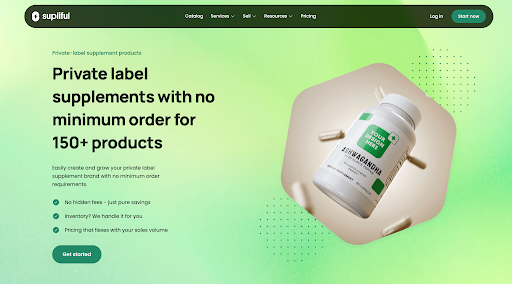
The growth of on-demand supplement manufacturing platforms, including services such as Supliful, has lowered operational barriers for smaller ecommerce brands entering the wellness sector. These platforms typically provide manufacturing, packaging, and fulfillment infrastructure without requiring large upfront inventory commitments.
This is exactly why modern entrepreneurs choose to start your own supplement brand using on-demand platforms, which bridge the gap between high-quality manufacturing and lean startup logistics. The ability to produce FDA-compliant, professionally formulated supplements in small initial runs-without six-figure inventory commitments-removes the historical capital barrier that kept the supplement authority space accessible only to funded operators.
What remains as the differentiator is precisely what cannot be outsourced: the founder's expertise, the community's trust, and the brand's coherent point of view.
The supplement space also exhibits exceptional exit economics. In recent years, wellness-focused ecommerce brands with strong customer retention and community engagement have drawn considerable attention from investors and strategic buyers.
One practical consideration is in the supplement space, the most defensible niches are those tied to a specific outcome rather than a specific ingredient. "Magnesium supplements" is a commodity category. "products and content targeted toward endurance-focused athletic communities" is an authority position. The product overlap may be significant; the customer relationship and pricing power are not.
Other high-velocity authority niches for 2026
The supplement sector is not unique in its dynamics-it is merely an unusually clear illustration of them. Several other categories exhibit the same structural characteristics.
Tactical and preparedness gear for the overlapping communities of competitive shooters, backcountry hunters, and emergency preparedness practitioners. This audience is intensely research-driven, brand-loyal once trust is established, and deeply underserved by mainstream outdoor retail.
Specialty pet nutrition, specifically the raw feeding, species-appropriate diet, and performance animal communities. Consumer knowledge levels in this niche are high, incumbent retail options are poor, and the emotional intensity of the purchasing relationship (pet owners treating pets as family members) drives premium willingness to pay.
Adaptive fitness and recovery for ageing athletic populations-a demographic growing faster than any supplement marketing team has fully recognised. Functional mobility, joint health, and performance longevity for adults over 45 is a category with genuine unmet demand and almost no dominant authority voice.
Building the invisible supply chain – Content as the new storefront
The operational model that enables authority-era commerce has been quietly reengineered. The "invisible supply chain" refers to a fulfilment and manufacturing architecture that operates entirely behind the brand experience, where the customer never sees a third-party manufacturer, a generic shipping label, or any signal that the product's origin is anything other than the brand itself.
This is not deceptive. It is, in fact, the same model used by virtually every major consumer brand in existence. Apple does not manufacture its own chips. Nike does not weave its own fabric. The brand is the relationship, the philosophy, and the guarantee-not the factory.
What has changed for independent operators is the accessibility of this architecture. On-demand manufacturing partners in supplements, apparel, skin care, and functional foods now offer white-label and private-label production with:
Regulatory compliance built in: Supplement manufacturers operating under NSF or cGMP certifications handle FDA compliance as a baseline, not a premium add-on.
Low minimum order quantities: The ability to launch with 50-200 units removes the inventory risk that once forced entrepreneurs into either massive capital commitments or compromised quality.
Professional packaging and design integration: Modern print-on-demand and private-label operations produce packaging that is indistinguishable from funded brand output.
The operational result is that a solo founder can now execute what once required a team, a warehouse, and seven-figure capital: a premium, differentiated brand with a defensible product line and professional fulfillment.
Content as infrastructure, not marketing
The most consequential strategic shift in the authority era is the reconceptualization of content. In the generic dropshipping model, content was a marketing cost-ads, product descriptions, maybe some retargeting creative. It was fuel for the paid acquisition engine.
In the authority model, content is infrastructure. It is the mechanism by which expertise is demonstrated, trust is accumulated, and organic acquisition compounds over time.
The economics are meaningfully different. A piece of paid advertising generates a customer once, at a cost that rises annually as competition intensifies. A piece of authoritative content-a comprehensive guide, a research synthesis, a founder's documented journey-generates customers continuously, compounds in search authority over time, and costs less per acquisition with every passing month.
Authority operators build what search strategists call "entity-based content ecosystems": interconnected bodies of content that establish the brand as the definitive resource for a specific topic. When a prospective customer searches for information aboutnutrition-related wellness topics frequently discussed within consumer health communities, or sleep-focused lifestyle content aimed at shift-based professionals, or choosing the right gear for high-alpine winter camping-the authority brand's content should be present, credible, and compelling.
The content that builds the most durable authority is not the content that sells hardest. It is the content that teaches most genuinely. A buyer who finds your brand through a piece of content that solved a real problem for them arrives with trust already banked. The conversion work is largely done before they visit your store.
The community multiplier
The final structural element of the authority model-and the one most often underweighted by operators focused on product and logistics-is community. Authority brands that build genuine community around their niche do not merely acquire customers; they acquire advocates.
The mechanics of community-building in 2026 are better understood than they have ever been. Email lists that provide genuine value (not promotional blasts) maintain open rates above 35% for authority brands versus under 15% for generic stores. Private community platforms-whether Discord servers, membership forums, or moderated social groups-create network effects that increase switching costs organically. Members who feel connected to a community are not merely customers; they are stakeholders in the brand's success.
This community infrastructure also has direct implications for exit value. Acquirers of e-commerce businesses have become increasingly sophisticated in their due diligence. The metrics they weight most heavily are not top-line revenue or even gross margin-they are retention rate, repeat purchase rate, net promoter score, and community engagement. These metrics are the fingerprints of a brand that people trust, return to, and recommend. They are extraordinarily difficult to fabricate and impossible to replicate quickly. They are, in the language of competitive strategy, genuine moats.
Conclusion: The survival of the focused
There is a pattern in every major market evolution: the moment a model becomes broadly accessible, it begins its decline. The generic dropshipping window opened when Facebook advertising was cheap and consumer trust was abundant. The operators who understood what they were riding-not a business model, but a temporary arbitrage of attention and logistics-built their profits and moved on. The operators who mistook the arbitrage for a durable business model are now discovering, with considerable difficulty, that the window has closed.
The authority era does not offer an easier path. It offers a more defensible one.
Building a niche authority brand requires genuine expertise, consistent content investment, and the patience to allow trust to compound. It requires the founder to shift from the psychology of a media buyer to the psychology of a publisher-from "how do I acquire a customer today?" to "how do I become the resource this community cannot do without?"
Businesses that successfully establish niche authority may be better positioned for long-term customer retention and brand stability than stores built primarily around short-term product arbitrage.
The general store had its moment. The specialists are inheriting what comes next.
The question is not whether the authority era is real-the data, the M&A multiples, and the consumer behaviour research are unambiguous. The question is whether you are willing to be specific enough, expert enough, and patient enough to claim your position before the next wave of operators recognises what you already understand.
The broader trend suggests that highly specialized brands are becoming more resilient, while undifferentiated ecommerce models face increasing competitive pressure.