The Architecture of Inner Freedom – Where Buddhist Wisdom Meets Modern Psychology
Viviana Meloni is the Director of Inside Out Multilingual Psychological Therapy, a private principal psychologist, HCPC-registered, chartered member of the British Psychological Society, EMDR UK member, with recognition for her clinical leadership, and author of specialist trainings in trauma, emotional dysregulation, and personality disorders. She also holds a Senior Leader Psychologist role in the National Health Service in the United Kingdom at SLaM, a globally recognized leader in mental health research. Moreover, she is reviewing institutional partnerships in the United Arab Emirates.

I would like to express my heartfelt gratitude to Ven. Dhamma Suseela Théro from the Mindfulness Meditation Centre in Galle for his inspirational guidance, profound insight into Buddhist philosophy and wisdom, and invaluable support throughout my time in Sri Lanka. This article emerges from my journey through Sri Lanka, where I spent time exploring Buddhist monasteries and engaging in conversations with monks about consciousness, suffering, attachment, and the nature of human existence. As a Chartered Psychologist, I found that these encounters offered an opportunity to examine the relationship between Buddhist contemplative wisdom and contemporary psychological science while reflecting on what it truly means to cultivate inner freedom.
The paradox of the human mind: When having more means experiencing less
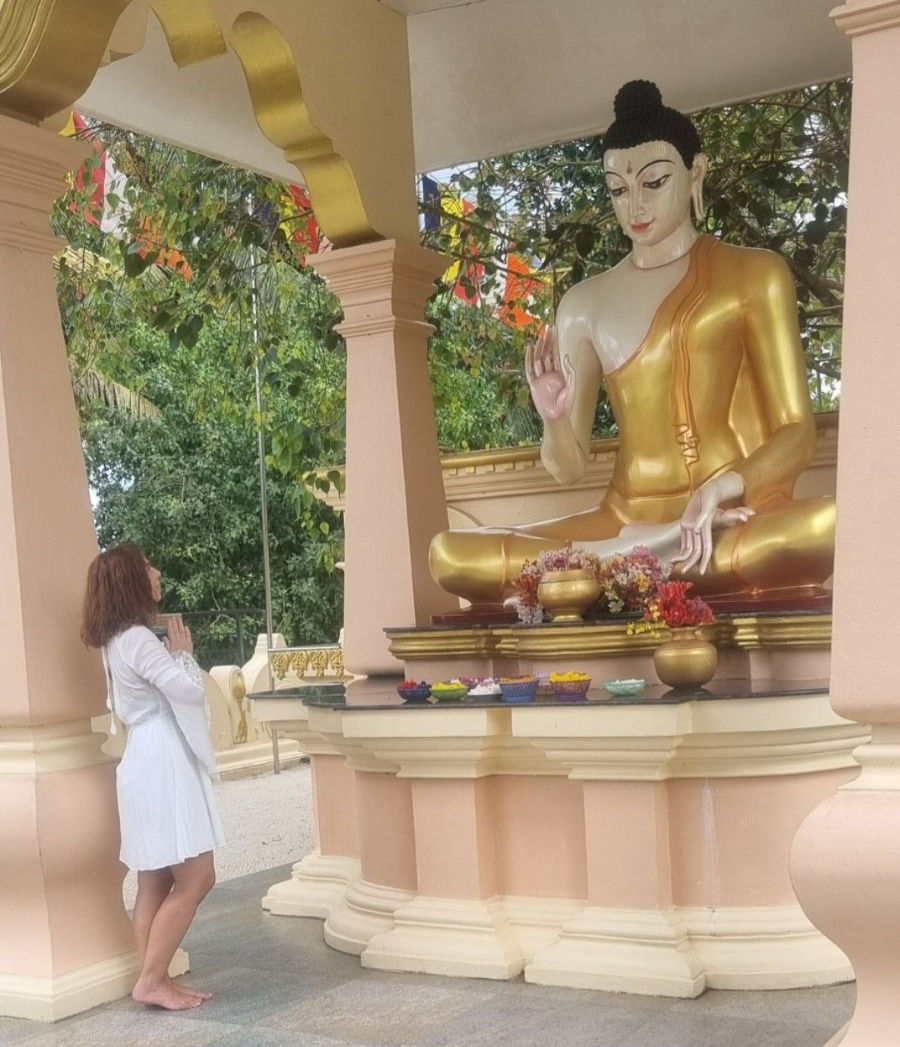
We have learned to conquer extraordinary aspects of the external world, yet we remain remarkably vulnerable to the turbulence of our own minds. Entering a Buddhist monastery in Sri Lanka, I encountered a silence that felt almost unfamiliar. What I sensed was not the absence of sound but the presence of something increasingly elusive in contemporary life, a stillness without expectation.
The simplicity of the surroundings, the peaceful atmosphere, and the apparent absence of material preoccupations created a profound sense of calm. There was no visible urgency to achieve, accumulate, or demonstrate personal worth. As I spent time in monasteries and engaged with Buddhist monks, I became increasingly fascinated by the contrast between the contemplative principles underlying their way of life and the psychological demands of modern society.
We have developed sophisticated methods for understanding cognition, regulating emotions, and modifying behaviour. Yet Buddhist philosophy invites us to consider a more fundamental question about human experience. Could the mind’s persistent pursuit of security, permanence, and satisfaction itself contribute to the suffering we seek to escape? I found myself returning to how these two traditions, separated by centuries and differing in methodology, could offer complementary questions about the architecture of human experience.
1. Dukkha and cognitive psychology: The architecture of suffering
The Four Noble Truths constitute the foundation of Buddhist teachings on suffering. The concept of dukkha extends beyond emotional pain to encompass the dissatisfaction inherent in experiences that cannot provide permanent fulfilment. The Dhammacakkappavattana Sutta, found in the Saṃyutta Nikāya (SN 56.11), identifies craving as a central condition sustaining suffering and presents the Noble Eightfold Path as the way towards its cessation.
Contemporary cognitive psychology offers a different but illuminating perspective. Aaron Beck demonstrated how cognitive schemas and interpretations influence emotional responses, sometimes perpetuating distress beyond the original event.
Both approaches recognise that subjective experience is shaped by mental processes. Yet their objectives differ. Cognitive therapy seeks to modify dysfunctional patterns, while Buddhist practice ultimately concerns liberation from the conditions sustaining dukkha. The profound intersection lies in recognising that suffering is shaped both by what happens to us and by the mental processes through which experience acquires meaning.
2. Anicca and psychological flexibility: The courage to embrace impermanence
The Buddhist principle of anicca challenges one of humanity’s most persistent psychological aspirations, the pursuit of permanence. Relationships evolve, identities transform, emotions fluctuate, and circumstances remain inherently unstable. Yet the mind frequently interprets predictability as security and change as a threat. During my monastery visits, the simplicity of monastic life encouraged me to reflect on how much psychological energy contemporary society invests in preserving what cannot remain unchanged.
Acceptance and Commitment Therapy, developed by Steven Hayes and colleagues, provides a compelling comparison through the concept of psychological flexibility, which involves remaining open to difficult internal experiences while engaging in values-guided action. The Buddhist principle of impermanence extends beyond therapeutic adaptation, inviting insight into the changing nature of all conditioned phenomena. Perhaps psychological resilience reaches its deepest expression not when we become capable of controlling change but when change no longer determines the stability of our inner world.
3. Attachment and non-attachment: The psychology of loving without clinging
Few concepts reveal the importance of distinguishing Buddhist philosophy from psychological theory as clearly as attachment. John Bowlby’s attachment theory establishes the developmental significance of secure emotional bonds. Attachment provides a foundation for emotional regulation, interpersonal trust, and psychological security.
Buddhist teachings examine two distinct processes, taṇhā (craving) and upādāna (clinging). These processes concern the desire to possess, preserve, or identify with experiences that are inherently impermanent. The Saṃyutta Nikāya explores how clinging contributes to suffering, while psychological attachment theory demonstrates why meaningful emotional connections are essential to human development.
The apparent contradiction dissolves when we distinguish connection from possessiveness. Non-attachment does not require emotional withdrawal. Rather, it invites us to cultivate relationships without transforming love into control or uncertainty into fear. The psychological sophistication of non-attachment lies not in learning to love less but in discovering how to remain deeply connected without making possession the condition of emotional security.
4. Sati and metacognitive awareness: The freedom to observe the mind
Mindfulness is frequently presented as a contemporary technique for stress reduction. Yet its Buddhist foundations are considerably more complex. In the Satipaṭṭhāna Sutta, found in the Majjhima Nikāya (MN 10), mindfulness forms part of a disciplined contemplative path involving observation of the body, feelings, mind, and mental phenomena.
Modern psychological approaches, including Jon Kabat-Zinn’s Mindfulness-Based Stress Reduction, have adapted elements of contemplative practice for clinical and secular settings. A particularly important psychological process is decentering, which involves recognising thoughts as transient mental events rather than unquestionable representations of reality.
The silence I experienced in Sri Lankan monasteries made this distinction especially meaningful. Without constant external stimulation, I became more attentive to the mind’s habitual production of expectations, interpretations, and internal narratives. The transformative possibility of mindfulness is not that the mind becomes silent but that we develop the awareness to recognise its activity without becoming psychologically captive to it.
5. Bhāvanā and the science of mental cultivation
Buddhist meditation is not merely a relaxation technique. The term bhāvanā refers to cultivation or development, encompassing practices intended to refine attention, insight, and beneficial mental qualities. The Ānāpānasati Sutta (MN 118) describes mindfulness of breathing within a broader process of contemplative development.
Contemporary psychological science investigates how meditation may influence attention, emotional regulation, and cognitive functioning. However, findings vary across practices, populations, and research designs.
The distinction between therapeutic application and Buddhist contemplative purpose is essential. Where clinical interventions may aim to reduce distress, Buddhist meditation is traditionally situated within a path towards wisdom and liberation. Meditation therefore raises a question that extends beyond symptom management. Can systematic awareness transform both how we respond to experience and how we understand the very processes through which experience is constructed?
6. Anattā and narrative identity: Beyond the psychological self
The Buddhist teaching of anattā, or non-self, challenges the assumption of a permanent, independent, unchanging identity. The Anattalakkhaṇa Sutta, found in the Saṃyutta Nikāya (SN 22.59), examines the changing aggregates of experience and questions whether they can be identified as a permanent self.
Contemporary psychology approaches identity differently, examining how autobiographical memory, interpersonal experience, and cognitive processes contribute to a sense of personal continuity. The dialogue becomes particularly interesting when we consider psychological rigidity. Individuals may become attached to identities constructed around trauma, achievement, rejection, or perceived inadequacy. Such narratives can influence expectations and constrain future behaviour.
Although the Buddhist teaching of non-self differs from psychological theories of identity, it invites reflection on the limitations of rigid self-identification. Perhaps psychological transformation begins when we recognise that the identity we defend so fiercely may be less permanent than the suffering we create in defending it.
7. Karuṇā, mettā, and compassion-focused psychology
Compassion occupies a central position within Buddhist ethical and contemplative traditions. Karuṇā concerns the recognition and alleviation of suffering, while mettā involves cultivating goodwill towards oneself and others. The Karaṇīya Mettā Sutta, found in the Sutta Nipāta (Sn 1.8), emphasises the importance of extending goodwill beyond narrow personal interests.
Contemporary psychological research offers meaningful parallels. Kristin Neff’s work on self-compassion examines the relationship between self-kindness, shared humanity, and mindful awareness. Compassion does not imply passivity, emotional weakness, or the abandonment of boundaries. It represents a deliberate response to vulnerability that avoids adding hostility to suffering.
Reflecting on my encounters in Sri Lanka, I became increasingly interested in the contrast between contemplative simplicity and the relentless self-evaluation encouraged by achievement-oriented cultures. Perhaps one of the greatest expressions of psychological maturity is the ability to recognise suffering without transforming it into another reason to condemn ourselves.
8. The Middle Way: Beyond the endless pursuit of more
The Buddhist Middle Way (Majjhimā Paṭipadā) rejects the extremes of sensual indulgence and severe self-mortification. It is inseparable from the Noble Eightfold Path, which integrates ethical conduct, wisdom, and mental cultivation. Its relevance to contemporary psychology extends beyond the superficial notion of moderation.
Modern society frequently equates well-being with maximising achievement, recognition, productivity, consumption, and control. Yet the psychological consequences of pursuing these objectives without reflection can include dissatisfaction, perfectionism, and an increasingly conditional sense of personal worth.
The monastic environments I encountered in Sri Lanka offered a striking contrast. Their simplicity encouraged me to question whether psychological fulfilment necessarily increases alongside material accumulation. This is not an argument against ambition, financial security, or meaningful achievement. It is an invitation to examine the psychological cost of allowing desire to become the organising principle of existence.
Buddhist wisdom draws a distinction of extraordinary psychological significance between pursuing what enriches human existence and becoming dependent upon what can never guarantee lasting fulfilment.
Conclusion: The extraordinary architecture of inner freedom
When I reflect on my journey through Sri Lanka, I return to the silence of the monasteries. The simplicity. The stillness. The absence of the constant urgency that so often defines contemporary existence. What fascinated me was not simply the apparent distance of monastic life from material preoccupations but the philosophical depth underlying that way of living.
As a chartered psychologist, I approached these encounters with an intellectual interest in the human mind. Yet they invited a more profound reflection on the assumptions through which we understand happiness, security, and personal freedom. Buddhist philosophy does not promise a life without change, loss, or uncertainty. Instead, it examines how craving, clinging, and identification with impermanent experiences sustain suffering.
Contemporary psychology provides powerful frameworks for understanding emotional processes and supporting psychological well-being. Buddhist contemplative traditions introduce another dimension by cultivating wisdom that may fundamentally transform our relationship with suffering. The two traditions are neither identical nor interchangeable. Their intellectual value lies partly in the questions their differences allow us to ask.
I travelled to Sri Lanka seeking to understand Buddhist philosophy through the eyes of a psychologist. I returned reflecting on a paradox that reaches into the very foundations of human existence. We devote extraordinary energy to mastering our circumstances, securing our identities, and pursuing what we believe will finally bring lasting satisfaction. Yet the Buddhist path invites us to recognise that everything we attempt to possess is subject to change, while the craving to preserve it may become an enduring source of suffering.
Perhaps the most profound architecture of inner freedom is built not through everything we succeed in acquiring but through the wisdom we cultivate in understanding what we no longer need to cling to. For the greatest achievement of the human mind may not be its extraordinary capacity to conquer the world but its capacity to become free from the suffering it creates in trying to possess it.
Visit my website for more info!
Read more from Viviana Meloni
Viviana Meloni, Private Chartered Principal Psychologist
Viviana Meloni is the founder and the clinical Director of Inside Out Multilingual Psychological Therapy, a London-based private psychology consultancy across popular locations including Kensington, Wimbledon, Chiswick, West Hampstead, and Canary Wharf. Viviana Meloni provides psychological consultations, assessments, formulations, and treatment in English, Italian, Spanish, and her company’s extensive network enables multilingual collaborations and liaison with Arabic, Chinese, Japanese, Punjabi, and Russian languages. She firmly believes that in every challenge lies an opportunity to grow, heal, and inspire.
References:
Tremblay, L., Van Gordon, W., & Elander, J. (2024). Toward greater clarity in defining and understanding nonattachment. Mindfulness, 15, 1275 to 1288.
Sys, S., Van Gordon, W., & Gilbert, P. (2024). A qualitative comparison of secular and Buddhist-informed mental health practitioners’ perceptions of non-attachment. Mindfulness, 15, 345 to 358.
Macri, J. A., & Rogge, R. D. (2024). Examining domains of psychological flexibility and inflexibility as treatment mechanisms in acceptance and commitment therapy. Clinical Psychology Review, 110, 102432.
Zainal, N. H., & Newman, M. G. (2024). Mindfulness enhances cognitive functioning: A meta-analysis of 111 randomized controlled trials. Health Psychology Review, 18(2), 369 to 395.
Dahl, C. J., Lutz, A., & Davidson, R. J. (2015). Reconstructing and deconstructing the self: Cognitive mechanisms in meditation practice. Trends in Cognitive Sciences, 19(9), 515 to 523.
Van Gordon, W., Shonin, E., & Griffiths, M. D. (2015). Towards a second generation of mindfulness-based interventions. Australian & New Zealand Journal of Psychiatry, 49(7), 591 to 592.
Garland, E. L., Farb, N. A. S., Goldin, P. R., & Fredrickson, B. L. (2015). Mindfulness broadens awareness and builds eudaimonic meaning: A process model of mindful positive emotion regulation. Psychological Inquiry, 26(4), 293 to 314.
Hölzel, B. K., Lazar, S. W., Gard, T., Schuman-Olivier, Z., Vago, D. R., & Ott, U. (2011). How does mindfulness meditation work? Proposing mechanisms of action from a conceptual and neural perspective. Perspectives on Psychological Science, 6(6), 537 to 559.
Van Gordon, W., Shonin, E., & Griffiths, M. D. (2016). Buddhist emptiness theory: Implications for psychology. Psychology of Religion and Spirituality, 8(4), 309 to 318.