Sarah McEneany Paints a Life of Color and Everyday Moments
Michael Klein is best known for his work and achievements in the field of contemporary art. As both a dealer and curator, he has had a long and distinguished career as a New York gallery owner and director, representing an international roster of emerging and mid-career artists. He became the first in-house curator for Microsoft Corp.

For more than four decades, McEneany has painted her life. She has documented her life at home in her Philadelphia studio, accompanied by her pets and surrounded by her gardens. She shows us her travels and her moments of quiet thought and solitude. Hers is a visual inventory of a lived life, she is both master of her vision and subject of that vision. Like a great novelist, she captures the everyday life of an artist at work. McEneany has made her life, both in sickness and in health, her career, her ambitions, and her travels, the very subject of her work.
Many contemporary artists focusing on the self would turn to photography or video, but McEneany uses tempera on canvas, a more traditional method for recording contemporary life and creating the unique character that is her work.
Used by historical masters, tempera consists of pigment mixed with a water-soluble binder, primarily egg yolk. It dries to an incredibly durable, matte finish. These flat colors become the structure with which she builds and shapes her compositions. It is through bold, dynamic color that she defines and depicts her world.
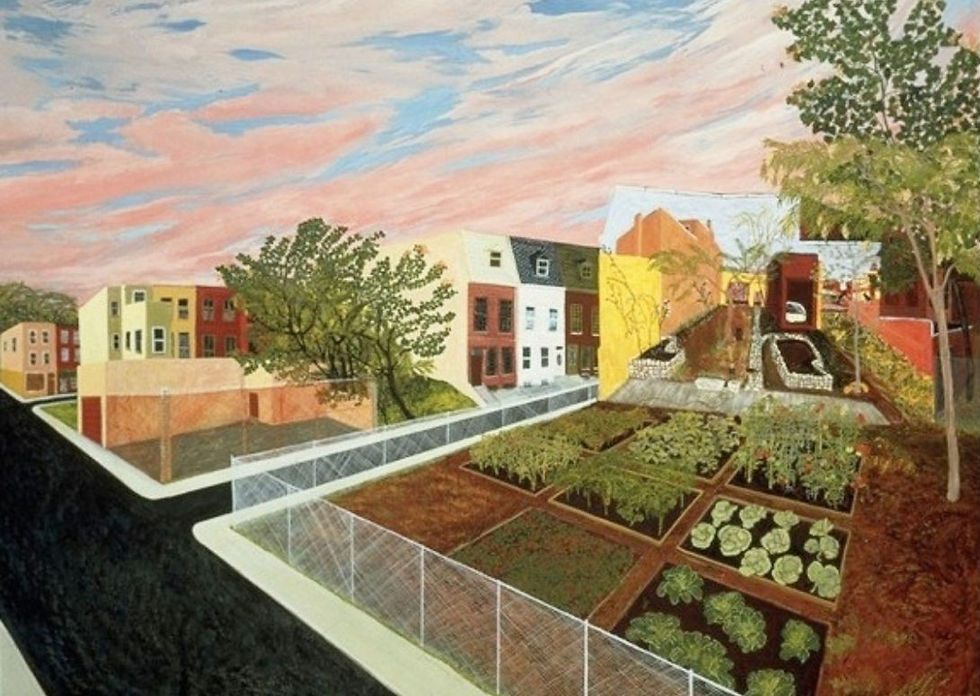
F & D Summer Garden, 2000, is a wide, almost panoramic view of McEneany’s home garden in the downtown neighborhood of Philadelphia, which she has called home for many years. There are, in fact, multiple points of view, no specific perspective, as if we see the visualization of a conversation by the artist talking about her place, her vegetable garden, the neighborhood, and the fine summer weather, all combined into a single but complex image. Everything is depicted under bright sunshine, in fact, the moon is visible too as the sun sets, painting cirrus clouds pink against a blue sky. This wide, all-inclusive panorama is typical of her vision, giving the viewer the whole world before them to explore.
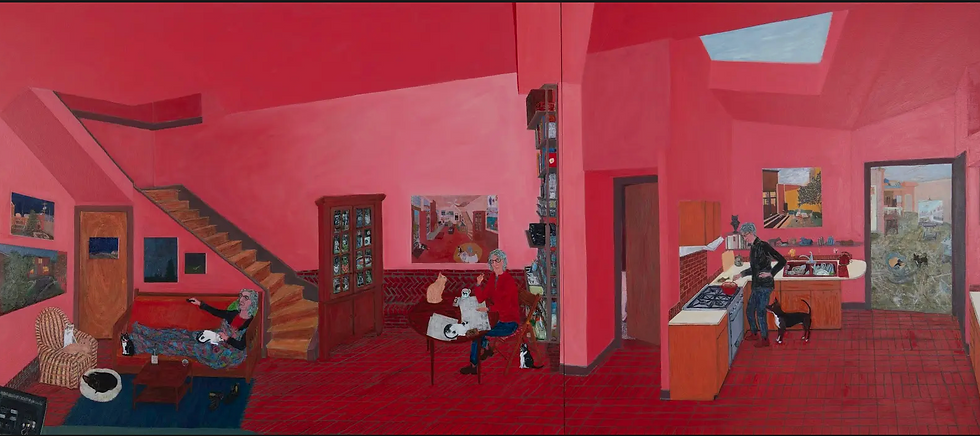
In a more recent painting from 2024, we again find multiple viewpoints united by a single deep red color, as if a nod to Matisse’s Red Studio of 1911. The painting is a long horizontal map of the interior of her studio. Moving from left to right, we discover other rooms in her home and finally an open door to the far right, leading visually into a distant, lush garden. No rational perspective was used, instead, it is a composite of interiors that illustrate her life in her home and studio. We see her at rest on a sofa, at work at her drawing board, and in the kitchen preparing food. It is an entire day composed into a single scene, compressing time and events into one grand image populated by details like a wooden staircase, a vitrine and bookshelves, various finished paintings, a well-appointed kitchen, and always a plethora of pets, cats and dogs. Akin to painters such as Alice Neel, Philip Evergood, and even Alex Katz, who also focused on family and friends in their respective work, domestic life is both subject matter and theme for these well-recognized painters, as it is for McEneany today. Her work is pure autobiography.
On another day back in 2002, McEneany reports on her travels. Alone in a train compartment, the monochrome interior contrasts with the bright colors of the Hudson River outside her window, along with the dark silhouette of the New York City skyline in the far distance. Looking up from the book on her lap, she thinks about her plans, a show in New York, reviews, success, anything is possible as the train heads north to New York’s Penn Station.
Paintings tell stories but also serve as tools to explore one’s own psyche. McEneany’s work is the viewpoint of an independent woman telling her story, sharing her life, and creating a template for other artists who want to talk about their lives and experiences through painting.
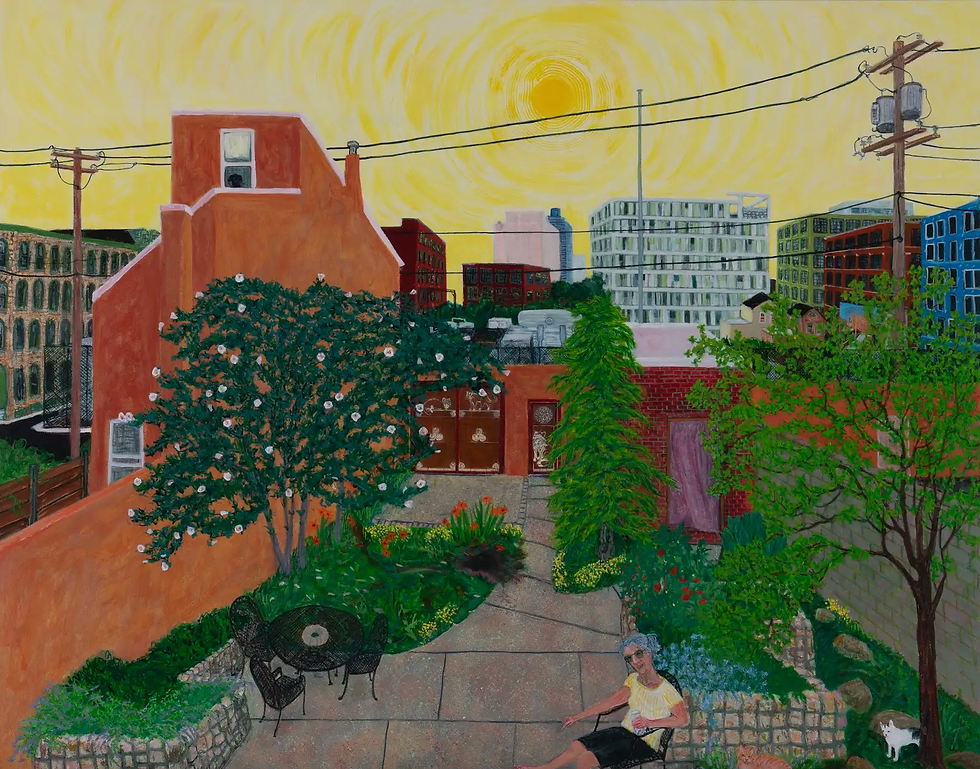
Second Summer is another portrait, showcasing her terrific new garden that blooms in this downtown section of a somewhat industrial area of Philadelphia called Callowhill. She entertains her dog in a small pool, while her many cats sit quietly on a clear, warm summer day.
All of McEneany’s narratives are meditations on her life and actions. Each illustrates for the viewer how life can be lived. Even now, in her 70s, the simple things in life are what have the greatest meaning, a home, a garden, our work, and, of course, our pets.
Read more from Michael Klein
Michael Klein, Owner & Director at Michael Klein Arts, LLC
Michael Klein's expertise lies in his role as a private art dealer and freelance, independent curator for individuals, institutions, and arts organizations. Today, Michael Klein Arts works with a diverse group of artists, estates, galleries, and non-profit institutions, providing management, curatorial, and other consulting services. At the same time, the company serves institutional as well as private collectors, focusing on developing collections of emerging, mid-career, and established artists. The company also organizes traveling exhibitions both in the United States and abroad.