

Paradox-Generated Figures as Jungian 'Counterterms' in Dark
Updated: Dec 16, 2025
Dr. Dragana Favre is a psychiatrist, psychotherapist, and seeker of the human psyche's mysteries. With a medical degree and extensive neuroscience education from prestigious institutions like the Max Planck Institute and Instituto de Neurociencias, she's a seasoned expert.

Dark (Netflix, 2017-2020) is a German sci-fi drama about a missing child that unfolds into a labyrinth of time travel, interlocked families, and causal loops where the past and future continually create each other.
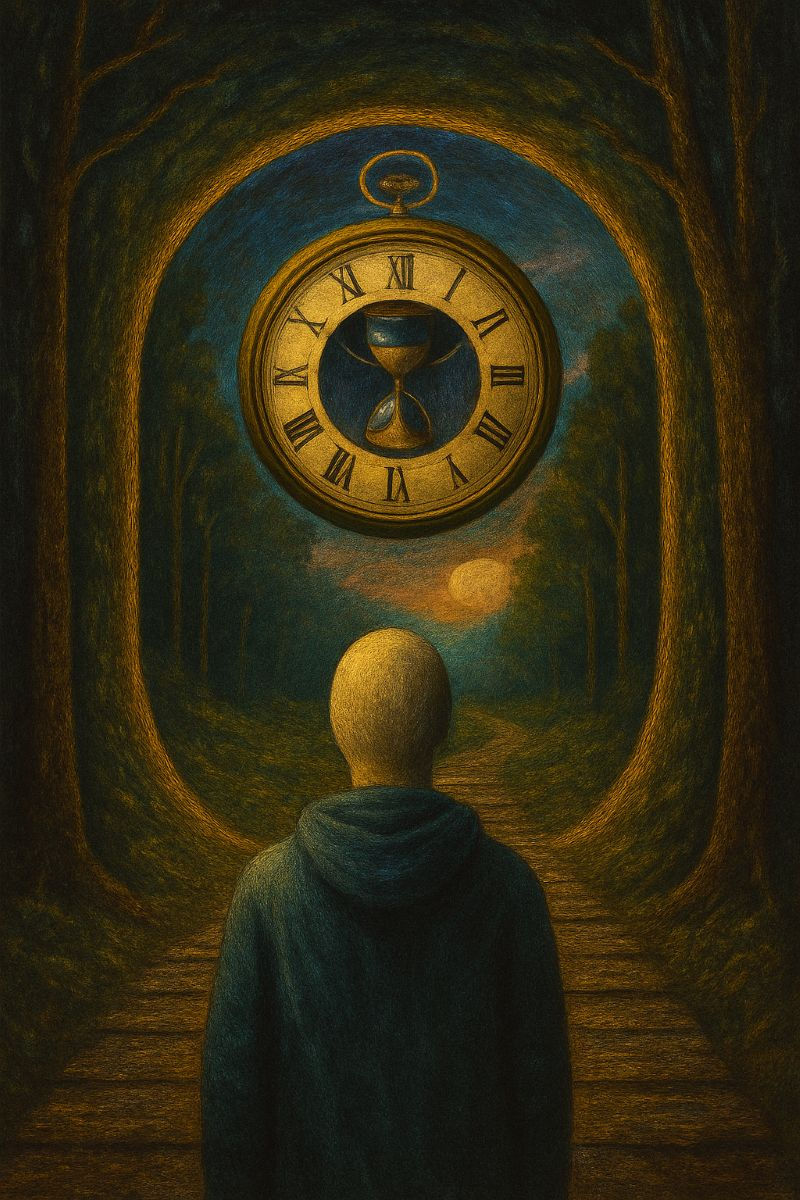
In that world, the strangest “people” are those who only exist because the timeline is broken, paradox-born subjects with no clean origin outside the loop. Instead of treating them as mere sci-fi gimmicks, we can read them as psyche-made entities, figures the story needs in order to carry what ordinary linear life cannot hold, grief that won’t complete, trauma that won’t integrate, guilt that keeps reproducing itself. They are not “real” in an ontological sense, but they are real in the only way symptoms are, they have effects, they organize relationships, they drive repetition, they demand loyalty.
That’s why the series’ “darkness” isn’t only literal (forests, bunkers, black matter) but psychological, the loop behaves like a closed grief-circuit. It keeps loss from settling into the past, so the past keeps returning as a living presence. Paradox-people then become embodied grief-solutions, if the system cannot accept absence, it manufactures a form of presence that depends on contradiction. The wound generates its own inhabitants.
The equation metaphor in Dark: Why healing needs “nonexistent” terms
Think of this like solving a difficult physics or mathematics equation. Sometimes you can’t isolate what matters unless you add terms that look pointless, like adding +x and −x to both sides. They cancel out, so they don’t change the “truth” of the equation, but they change what you can do with it. They create a new structure that makes a hidden relationship solvable.
Paradox-born persons function like those neutral terms. They don’t belong to a stable reality (they’re “nonexistent” in origin). Yet they’re instrumental, they allow the system to express what it otherwise can’t resolve. They act as conceptual scaffolding, temporary, strange additions that enable transformation.
So the loop doesn’t only trap characters, it calculates with them. These figures are the psyche’s algebra, a way to “think outside the box” when ordinary causality (or ordinary coping) cannot balance the books.
In Jungian terms, these paradox-entities resemble autonomous complexes, psychic formations charged with affect that behave as if they have their own agency. When grief, fear, shame, or longing cannot be symbolized and owned by the ego, it doesn’t simply vanish, it becomes figure-like. It appears as someone, something, a voice, a fate.
That’s why Dark is so compatible with a Jungian reading, the show externalizes inner structure. The loop is repetition compulsion made architectural, the family tree is trauma transmission made literal, and paradox-people are “dream figures” who have walked out of the unconscious and into the town.
Dreams, therapy, and the function of “as-if beings”
In analysis, you don’t “solve” grief by deleting it. You relate to it differently. Jungian work often uses images, dream figures, fantasies, inner dialogues, not because they are factually real, but because they are psychically true. The psyche heals through symbolic mediation, it creates an as-if person so the ego can finally encounter what it avoided.
Paradox-born subjects in Dark can be understood as exactly that, dream-figures with consequences, carriers of the shadow (what was disowned), and avatars of unmourned loss (what was never finished).
They’re the mind’s “temporary variables.” You meet them, learn what they represent, and integrate the meaning they carry.
Why resolution feels like erasure
When the knot in Dark is untied, paradox-people disappear. Narratively it’s brutal, but symbolically, it matches a Jungian endpoint, once the underlying contradiction is integrated, the psyche no longer needs to personify it. In equation language, once the solution is reached, the +x and −x scaffolding is removed. What mattered wasn’t keeping the extra terms forever, it was what they allowed the system to become.
So the show’s final logic can be read as a severe allegory of healing, not “saving every figure,” but ending the structure that required them.
In that sense, the “nonexistent” entities are not mistakes, they are the psyche’s necessary additions, the neutral counterterms that let trauma be worked, grief be symbolized, and darkness finally stop repeating as fate.
Read more from Dragana Favre
Dragana Favre, Psychiatrist and Jungian Psychotherapist
Dr. Dragana Favre is a psychiatrist, psychotherapist, and seeker of the human psyche's mysteries. With a medical degree and extensive neuroscience education from prestigious institutions like the Max Planck Institute and Instituto de Neurociencias, she's a seasoned expert. Her unique approach combines Jungian psychotherapy, EMDR, and dream interpretation, guiding patients towards self-discovery and healing. Beyond her profession, Dr. Favre is passionate about science fiction, nature, and cosmology. Her ex-Yugoslav roots in the small town of Kikinda offer a rich backdrop to her life's journey. She is dedicated to helping people find their true selves, much like an alchemist turning lead into gold.
References:
Civils, S. M. (2023). Trauma structures in Dark (Master’s thesis, Bowling Green State University). OhioLINK Electronic Theses and Dissertations Center.
Freud, S. (1955). Beyond the pleasure principle (J. Strachey, Trans.). Hogarth Press. (Original work published 1920)
Jung, C. G. (1959). Aion: Researches into the phenomenology of the self (R. F. C. Hull, Trans.; Vol. 9, Pt. 2). Princeton University Press.
Jung, C. G. (1966). Two essays on analytical psychology (R. F. C. Hull, Trans.; Vol. 7). Princeton University Press.
Jung, C. G. (1968). The archetypes and the collective unconscious (R. F. C. Hull, Trans.; 2nd ed., Vol. 9, Pt. 1). Princeton University Press.
Lacan, J. (2006). Écrits (B. Fink, Trans.). W. W. Norton. (Original work published 1966)
Łysak, T. (2023). The future: Missing children, time travel, and post-nuclear apocalypse in the Dark series (Netflix). Arts, 12(6), 235.
Netflix. (n.d.). Dark.
Pacifica Graduate Institute Library. (2023). A guide to Jung’s concept of complexes.
Smith, N. J. J. (2013). Time travel. In E. N. Zalta (Ed.), The Stanford encyclopedia of philosophy (Fall 2013 ed.). Stanford University.



