Mountaineering Training and How to Know You're Actually Ready
Written by Jakob Ulcnik, Founder
Jakob Ulcnik, the founder of Train to Mountain, who turned the science of training into a personalised system for everyday mountaineers. Imagine a mountaineering training that adapts to you, your needs & goals, answering one question, "Will I be ready?"

Most people who turned around on a mountain were not lazy. They trained hard, followed a plan they found online, and still showed up at the trailhead unsure. The problem is almost never fitness. It is that nobody taught them how to measure the one thing that matters, whether their body is actually ready for the day ahead.
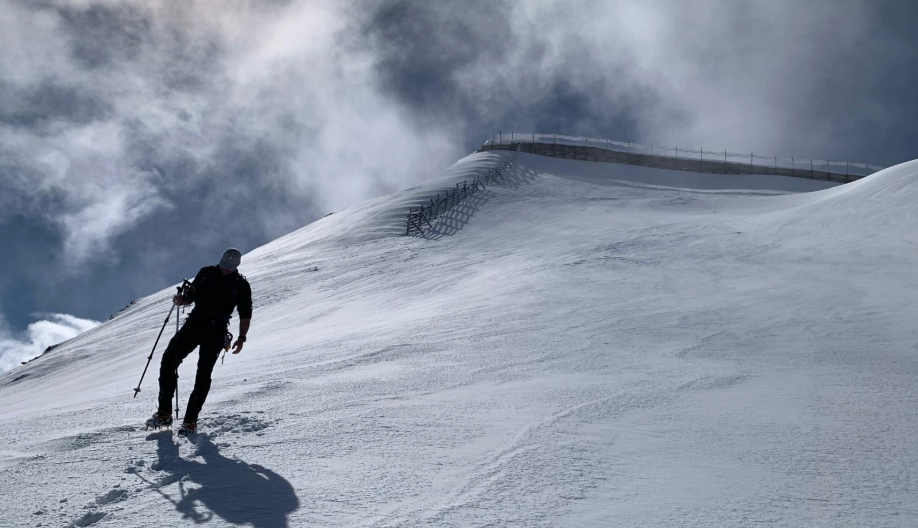
What does "ready" actually mean on a mountain?
Ready is not a feeling. It is not how good your last gym session felt. Ready is specific to the day you are about to have, and a mountain day looks nothing like most training.
You are going uphill for hours, not minutes. You are carrying a pack. Then you turn around and go down, and the descent loads your legs in a way most plans never train. The air gets thinner as you climb, so the same effort costs you more. You often do it again the next morning on tired legs.
General fitness helps with all of that. But general fitness is a wide, blunt thing. Readiness is narrow. It asks a harder question, "Can this body, carrying this weight, hold this pace, climb this much vertical gain, then recover and do it again?" You can be very fit and still answer no.
Why do fit people still turn around?
I learned this the expensive way. I trained hard for marathon fitness before attempting a 3,800 m (12,500 ft) peak. I could run for hours. I thought that was enough. It was not.
Marathon fitness is flat, rhythmic, and light. Mountain fitness is slow, loaded, and vertical. On the climb, my engine was fine, but my legs were not built for the sustained uphill grind or the pounding on the way down. Descent strength is the gap almost nobody trains, and it is often the thing that breaks people before the summit does.
Then there is the air. Acute mountain sickness affects roughly 25 to 43 percent of people who ascend to elevations between 2,500 and 4,300 metres (8,200 to 14,100 ft), according to StatPearls, published on the NIH's National Center for Biotechnology Information. Fitness does not make you immune. Preparation and a sensible ascent do more than a raw engine ever will.
The plan you found online was built for someone else
Here is the quiet problem with most training plans. They assume a life you do not have.
They assume you never get sick. They assume work never eats up a week. They assume you never tweak a knee, never travel, and never sleep badly. They assume your fatigue builds at exactly the rate written on the page, week after week, like a spreadsheet with a pulse.
Real bodies do not work like that. Some people adapt fast and can take more. Some need more recovery than the plan allows, and a generic plan quietly overtrains them. A fixed twelve week plan is a guess about an average person, and you are not average. Nobody is.
This is the same trap high performers fall into everywhere. A lot of capable people assume that if things feel hard, the answer is more discipline. A good piece on why high-functioning people need systems rather than more self-pressure makes the point well. Willpower carries you in short bursts, but it is not stability. Pushing harder against a plan that does not fit your life is not training. It is just grinding.
Fitness versus readiness, and why the difference matters
So here is something to keep in mind. Being active does not equal adaptation. Believe me, I know.
Doing a workout is an activity. Getting fitter is adaptation, and adaptation only happens when the load and the recovery are right for you. You can be busy every day and still not be adapting. You can be fit in general and still not be ready for one specific mountain.
Training science has a name for the balance underneath this. The fitness fatigue model, which comes out of real exercise physiology, says your performance on any given day is fitness minus fatigue.
Train, and you build fitness, but you also build fatigue. If fatigue is high, your fitness is masked, and you feel flat even though the engine is there. Readiness is what is left when fatigue clears and fitness stays. That is the number that tells you the truth. Not how many sessions you did. What your body actually turned them into.
How to measure whether you're ready
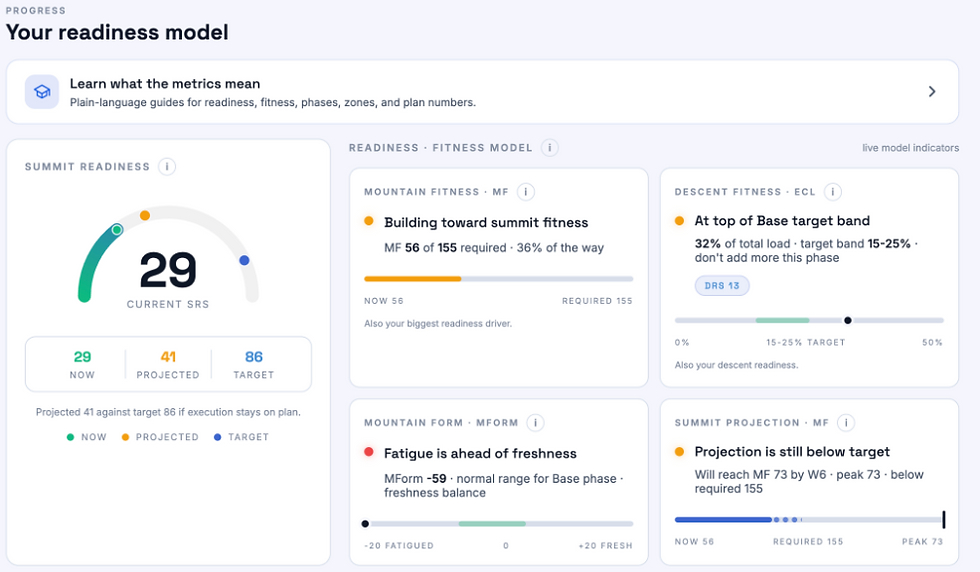
A summit readiness score alongside mountain fitness and descent fitness, with a current, projected, and target reading for the climb.
Readiness is not one number pulled from the air. It is built from specific things, how much sustained uphill you can hold, how your legs handle the descent, whether you are fresh or buried under fatigue, and how consistent you have been. When you can see those parts separately, you stop guessing which one is holding you back.
You do not need a lab. You can test readiness yourself this week with a few honest checks.
Pick the vertical gain your mountain day demands and see if you can hold it at a conversational effort. Not gasping. Talking. If you can only hit your target vertical gain by redlining, you are not ready for a long day yet. You are ready for a short, hard one, which is a different thing.
Carry the pack you will actually carry. Not a lighter one you would prefer. Weight changes everything about how your legs and back hold up over hours, so train with the real number.
Then test the part people skip, recovery. Do your session, sleep, and see how you feel the next morning. Then repeat it. Back to back days are where mountain readiness lives because that is what the mountain asks. If day two falls apart, that is useful information, not failure.
The honest tracking is the point. A pep talk tells you that you can do it. A number tells you whether you can. When you are trying to know rather than hope, the number wins every time. It is the same logic behind setting clear and achievable goals. Measurable progress beats vague intention because you can see it move.
The mistakes that catch strong people out
The mountain asks three things, endurance for the long hours, strength for the descent, and a body that copes with thin air. Most people who come up short are not unfit. They were fit and aimed at the wrong target. A few traps I see again and again:
Too much, too soon. Your fitness rises faster than your tendons and joints adapt. Ramp up gradually because an injury eight weeks out costs you far more than an easier week ever would.
Training only uphill. The descent ends more days than the climb. If your training never points downhill, you have prepared for half the mountain.
Testing yourself the week before. A big effort to prove you are ready just dumps fatigue when it should be clearing. You arrive tired and call it fit.
Copying someone else's plan. It was built for their body, their schedule, and their peak. A borrowed plan overtrains you in one place and leaves a gap in another.
No time on your feet. Short, convenient sessions build a body that is good at short, convenient sessions. The mountain asks for many hours, and hour seven is where the day is won or lost.
None of these is about effort. Each one is a committed person working hard in the wrong direction. You can read more about it in this a short free guide, which lays out the self tests above step by step.
Training around a real life without losing the goal
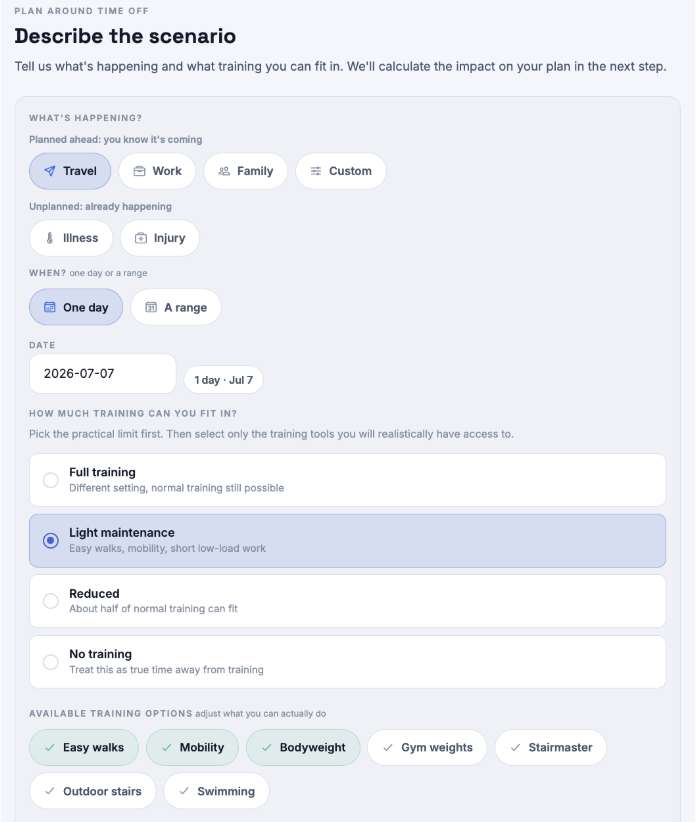
Life will interrupt your training. It always does. The mistake is treating an interruption as a reason to skip, then feeling like you failed, then skipping more.
Do not skip. Sick, slammed, or wrecked from a bad night's sleep? Cut the session down instead of dropping it. A short, easy effort keeps the rhythm and does not dig you deeper into fatigue. The goal is not a perfect week. The goal is a body that keeps adapting.
Change the unit you judge yourself by. Stop scoring individual days. Score the week. One missed session in a good week is nothing. A good week inside a good month is how readiness is actually built. This is close to what people mean when they talk about being burned out when they are really out of coherence. The problem is rarely one bad day. It is a system pulling against itself. Fix the system, and the days take care of themselves.
This is exactly the gap I could not fill when I was training for my first, second, and third peaks. Now you understand why we built Train To Mountain.
It is a personalised mountaineering training app built on established training science, including the fitness fatigue model and a proprietary Train To Mountain model. It looks at how your body is actually responding and recalibrates the plan week to week, so the plan bends around your life instead of the other way around. It is not a generic plan with your name on it. It is a plan that changes when you do.
Know before you go
There is a specific feeling I want for you. You are standing at the trailhead in the dark. Your pack is on. The climb is ahead and instead of that low hum of doubt, you feel something quieter and better.
You know. Not hope. Know.
That peace of mind is what Train To Mountain provides. Not more workouts. The calm certainty that your body has done the specific work this specific day asks of it.
If you want to find out whether this way of training fits you, see who Train to Mountain is built for. Not everyone needs it. But if you have ever trained hard and still shown up unsure, it was built for exactly that.
Read more from Jakob Ulcnik
Jakob Ulcnik, Founder
Jakob Ulcnik, the founder of Train To Mountain, turned the science into a personalised mountain-ready training system for everyday mountaineers. A Slovenian alpinist based in Amsterdam. He trained for his first big peak and still could not tell whether he was ready. Every plan he found online assumed a life without work, illness, or injury, so he built one that adapts to the athlete instead. Train to Mountain runs on established training-science models, including the fitness-fatigue model, plus a proprietary model developed in-house that adjusts week to week to the person using it. Reach the summit prepared rather than hopeful.