How to Write a TEDx Talk in 58 Minutes
Written by: Alka Patel, Executive Contributor
Executive Contributors at Brainz Magazine are handpicked and invited to contribute because of their knowledge and valuable insight within their area of expertise.

I’ve watched hundreds of TEDx talks over the years, engrossed by the storytelling, fascinated with the punchy messages. And at the end of each viewing, the same, recurrent thought, “I’d love to do a TEDx talk.”
Then one day. I just changed the words from, "I’d love to do a TEDx talk” to, “I’m going to do a TEDx talk.”
What happened next happened fast because I made it happen fast.
When you know you’re going to do a TEDx talk, you know exactly what you want to share with the world. Not just want to share but NEED to share. Because the impact of what you need to share is that powerful. There’s no Richter scale. It’s a ripple effect that can’t be measured. TEDx is not about a talk. It’s about THE talk. And that’s why it took me just 58 minutes to write my speech. Because it already existed, somewhere deep, somewhere meaningful.
Here’s what I did in 58 minutes:
1. Created a visual storyboard with 9 screens.
2. Added 9 pictures to the storyboard to capture the heart of the talk.
3. Added 9 captions under each image.
4. And then let my heart form words through my fingers – and out it, all poured without pause – in 58 minutes.
I’d watched so many TEDx talks that I knew the 5 key elements that I needed to incorporate into my talk to create a lasting effect.
Opening hook
Closing question
Catchy catchphrase
Visuals
Rollercoaster for emotion, story, fact.
This took me 58 minutes. Because when you know, you’re going to do a TEDx talk, it comes with a sense of urgency. And when I start something, I get it finished. I’m a classic Belbin completer-finisher.
My heart, my message, my life’s work, on paper, in just 58 minutes.
What I quickly acknowledged once I’d written my talk was that here I was amid lockdown, with TEDx events suspended all around the globe, and yet it was that sense of urgency that held me steadfast to my words, “I’m going to do a TEDx talk.”
I found out that, like the rest of the world, TEDx had also pivoted into the virtual space, with opportunities now to record a TEDx talk yourself. I explored virtual TEDx events and found out who worldwide had virtual events coming up in the next month. I sent pitches to 3 event organizers, and within 72 hours of saying out loud, “ I’m going to do a TEDx talk,” I received my yes! An invitation to be a TEDx speaker. There was no time for coaching or mentoring or reading any one of the vast TEDx books out there. My talk had to be delivered in the next 28 days!
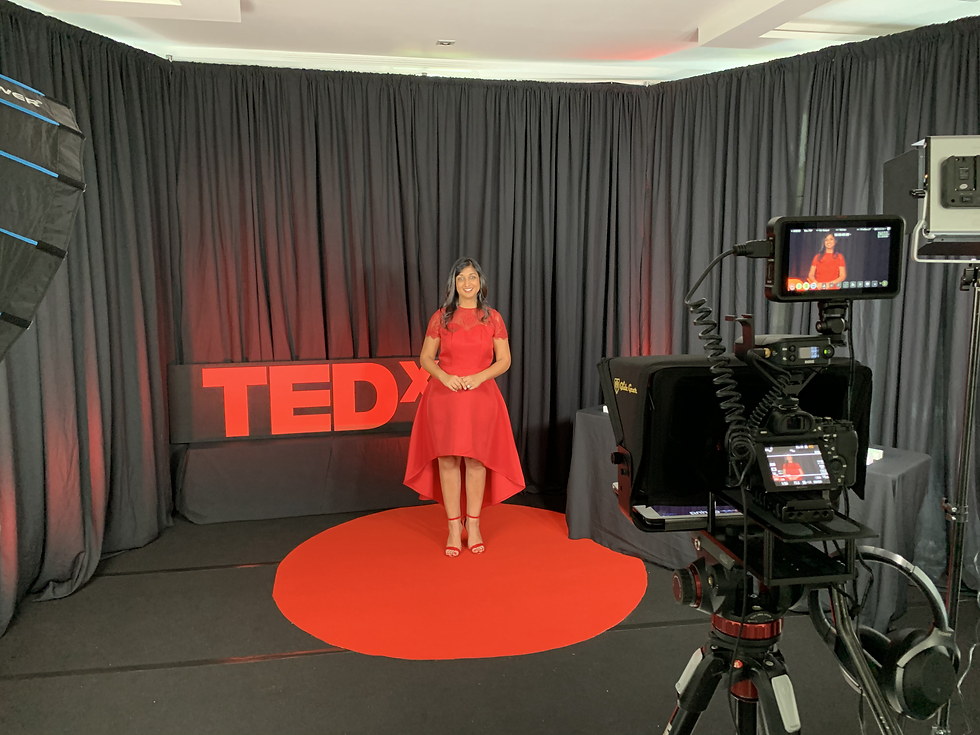
I marinated in the elation of that moment. Closed my eyes. I visualized myself on that stage, except there was no stage. This was a virtual event. Yet, I wanted the magic. The black and red backdrop. The lettering. The iconic round red carpet. I wanted all of it.
And within 10 days of my yes, I had it all. I recreated the magic of a TEDx stage within my own home. Carpet, backdrop, letters, lights, camera, action.
Covered by the beauty of my red dress, I stepped onto the red carpet, completely naked and exposed by my every word.
Listen carefully, and you’ll hear the quiver in my voice.
Watch intently, and you’ll see the glisten in my eyes.
And 18 minutes later, it’s a wrap.
A few more shots from a few more angles for the camera crew and the day is done.
It is etched in my memory, every moment.
It took a single moment to say I’m going to do a TEDx talk.
72 hours to get my yes.
58 minutes to move my talk from heart and mind to paper.
10 days to step onto the red carpet, naked in a red dress.
28 days for my idea worth sharing to be spread around the world.
18 minutes for impact to be felt.
What else can I tell you about how to write a TEDx talk in 58 minutes and deliver it to the world within 28 days?
5. Don’t pause – write without pausing. Write your whole talk in one go, beginning to end, without going back, without trying to correct what you have written. Do this to allow all the subconscious depth and meaning of your talk to flood through.
6. Connectors. Once you have written your talk in full, uninterrupted flow, go back and look at your connectors. How have you linked your different story elements together? Add these connectors in if they are missing, as they are essential to the flow of your talk. Every word counts, every phrase counts, every pause counts, and you need meaningful connection.
7. Write for the ear. How we write and how we talk are very different, and for the script of your TEDx talk, you need to write as if you are talking. Talking as you write will help you find the flow. Use easy language. Use everyday language. Include questions. As you write, talk out loud.
8. Check your word count. At an average speaking rate of 130 words per minute, an 18-minute talk will have 2340 words. Your talk will have pauses and variations in speed – aim for 2000 words to stay within the 18 minutes. For each of your 9 storyboard elements, aim for 220 words each. The elements don’t all need to be the same length, but it’s a useful starting point.
9. Perform for the eye. Your TEDx talk is a performance like no other. A monologue that’s acted. And like any performance, you need rehearsal—practice, practice, practice. Practice won’t take away your passion. Your passion will still show through as if you are performing each time afresh. Record yourself - just a simple camera or phone. Watch yourself back and look at where you can sculpt your performance for entertainment, education, emotion, and energy with a natural ebb and flow in your narrative to take the audience on a journey with you. Let the performance come from your heart. If you feel it, your audience will feel it.
10. Have fun. Expect a roller-coaster of emotion when you do a TEDx talk. Fear. Frustration. Sadness. Confusion. Fulfillment. Elation. Expect it all. It touches every nerve fiber in your body, every neurotransmitter. Experience it all, but don’t forget fun. When I decided I would do a TEDx talk, I bought myself a mini red carpet. Just a tiny 70cm circle that I’d stand on every day. And I loved standing on it. Barefoot. In my heels. I was playing with my dogs on it. That was fun. It made me feel grounded and ready. I had fun with my clothes too. What you wear matters. It helps you feel confident. For me, it had to be a red dress. Always. And I had a lot of fun trying on lots of dresses – and when it’s the one, you know! And when I saw my talk on the TED Talks youtube channel for the first time – that dance I did, what fun!
One idea. One story. One catchphrase. One question. One red dress. One red carpet.
That’s how to write and deliver a powerful TEDx talk – written in 58 minutes, recorded in 28 days, delivered in 18 minutes.
Watch my talk: Health is a verb, not a noun.
Follow Dr. Alka on her Twitter, Youtube channel and check out her website.
Dr. Alka Patel, Executive Contributor Brainz Magazine
Dr. Alka Patel is a sought-after TEDx speaker, doctor, coach, author, and podcaster who amplifies health as a skill and an asset to inspire individuals and bold businesses to create compassionate lifestyle changes for happy, healthy living and connected workplace wellness.
One of her greatest passions is empowering and equipping individuals and organizations to connect to their DNA- Discover, Notice and Activate who they are, what they want, and where they are going.
She is the Founder of Lifestyle First® and Creator of The Lifestyle First Method® - a groundbreaking, research-backed blueprint for life transformation. She is the host of the acclaimed Lifestyle First Podcast. And she’s changing the definition of health!