How to Unmask the Hidden Forces of Miscommunication
Updated: Oct 29, 2025
Dr. Veronica Powell, PhD, LPC, is a Licensed Clinician, Industrial-Organizational Psychologist, and Communication Coach. As the Founder and CEO of Measures4Success Academy, she empowers individuals, leaders, and organizations to master communication through Kendall’s Life Languages™ Framework, also known as Communication Intelligence (CQ).

Miscommunication isn’t just about words, it’s shaped by fears, stress responses, and the invisible masks we wear in everyday conversations. Discover how Kendall’s Life Languages™ Framework helps reveal these hidden forces so we can build clarity, empathy, and stronger relationships.

The masks we wear
Every October 31st, millions of people put on masks for fun, creativity, or transformation. Yet in our daily lives, some of us wear invisible masks too.
We mask discomfort with busyness, conflict with compliance, and misunderstanding with silence. These masks do not simply protect us, they often separate us. Nowhere is this more evident than in how we communicate with one another.
This article explores how these invisible masks affect our ability to connect and understand each other. It examines the hidden forces that shape communication and reveals how Kendall’s Life Languages™ Framework, also known as Communication Intelligence (CQ), developed by Fred and Anna Kendall (2019), helps us unmask what is really happening beneath our words.[1] [2]
Miscommunication is not just a clash of words. It is a collision of unspoken fears, assumptions, and emotional filters that quietly distort connection. Recognizing these invisible influences is the first step toward building empathy, clarity, and stronger relationships.
The hidden forces behind miscommunication
Communication today is constant, emails, meetings, and messages fill our days, yet understanding feels increasingly rare. Even experienced professionals encounter moments when the words they speak are not the ones that are heard.
Most of us rely on communication techniques that focus on what to say rather than why we say it. Traditional communication training, as I experienced during my days of graduate school, emphasizes phrasing, tone, and timing, but it rarely examines the deeper motivations that drive how we communicate.
Miscommunication is not simply about poor listening or careless words. It is shaped by our experiences, emotional filters, and stress responses. We do not hear others as they are speaking. We hear them through the language we are living in.
Recognizing these dynamics helps us see that communication is more than an exchange of information. It reflects who we are and how we relate to the world around us. Yet, even with this awareness, traditional models often miss one critical layer, understanding our communication identity.
Beyond styles: The missing ingredient
Most communication models explain what happens between people, but few help us understand what happens within them. We learn about the typical four communication styles (or more in some models), passive, assertive, or analytical, and study verbal and nonverbal cues, but these frameworks only describe what communication looks like on the surface.
They do not explain why people communicate the way they do or how their internal patterns influence what they say and how they listen.
This is where Kendall’s Life Languages™ Framework fills the gap. It is not a personality or temperament test. It is a character-based communication analysis tool that uncovers the internal structure behind our words. By identifying the seven languages that form every person’s communication identity, the framework helps individuals move from misunderstanding to authentic connection.
The 7 life languages™
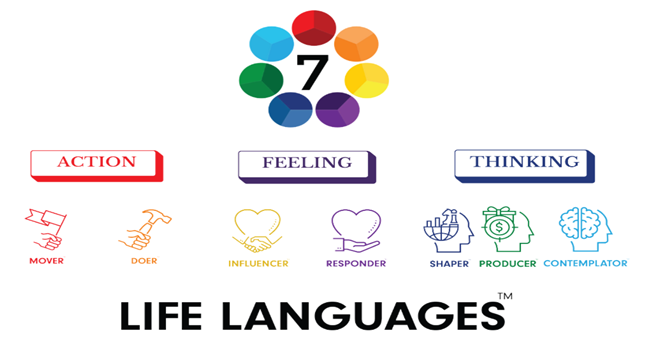
Kendall’s Life Languages™ Framework, developed by Fred and Anna Kendall, identifies seven distinct communication languages grouped into three main categories – Action, Feeling, and Thinking.
Category | Life Language | Focus |
Action | Mover | Initiates change and leads with courage |
Doer | Executes with discipline and reliability | |
Feeling | Influencer | Inspires and motivates through encouragement |
Responder | Protects and nurtures peace with compassion | |
Thinking | Shaper | Strategizes and drives vision |
Producer | Resourceful, organizes and sustains order | |
Contemplator | Reflects deeply and pursues truth |
Each person speaks all seven languages, but in different intensities. Together, they form a communication sequence, our unique combination that determines how we interact, make decisions, and manage conflict.
Consider a conversation between a person who speaks Contemplator, Influencer, and Mover languages. The Contemplator values accuracy and reflection, the Influencer thrives on enthusiasm and connection, and the Mover focuses on swift action. Without awareness, frustration can arise. But when each understands their own and others’ languages, differences become strengths and communication becomes collaboration.
When communication shifts under stress
Communication flows easily when we feel safe and understood, but stress changes everything. In the Life Languages™ Framework (AKA: CQ), this is described as entering distress levels. When any Life Language™ score falls below 50, it shifts from connection mode into protection mode, or as we call it, our trauma or survival languages.
A Mover, normally bold and decisive, may become impatient or controlling under pressure. An Influencer might seek constant reassurance, while a Contemplator may retreat into silence to regain clarity.
These behaviors are not failures. They are protective responses. However, without awareness, they are often misinterpreted as defensiveness or disinterest. Recognizing when communication shifts into protection mode allows us to pause, reflect, and respond with empathy rather than reaction.
This awareness transforms miscommunication into insight. It teaches us that moments of tension are not roadblocks but opportunities to restore understanding and trust.
Unmasking the real meaning of connection
Unmasking communication begins with self-awareness. It is not about exposing weakness but about revealing truth. When we ask, "How am I showing up in this conversation? Or am I communicating from connection or protection?" We begin to replace reaction with reflection.
This practice invites courage. It requires listening without judgment, valuing presence over performance, and seeking to understand others in their own communication language.
This is the essence of character-based communication, the heart of Kendall’s Life Languages™ Framework. It reminds us that communication is not merely about words but about integrity, empathy, and awareness.
When practiced consistently, this awareness transforms relationships. It shifts communication from reaction to reflection and from conflict to collaboration. It reminds us that understanding is always possible, even when agreement is not. And go into conversations with these words spoken by Stephen R. Covey, “Seek first to understand, then to be understood.”
Closing reflection and call to connection
Unmasking miscommunication begins with the willingness to pause and see what lies beneath our words. True communication happens when we choose understanding over assumption and empathy over reaction.
By integrating the principles of Kendall’s Life Languages™ Framework, also known as Communication Intelligence (CQ), we gain the tools to communicate with clarity and compassion.
Every conversation offers a choice. We can communicate from fear and frustration, or we can communicate from awareness and grace. Choosing the latter moves us closer to the kind of understanding that heals, restores, and transforms.
If this message resonates with you and you would like to learn more about upcoming events, trainings, or communication services, I invite you to connect with me here.
“Because understanding begins the moment, we are willing to unmask what has been misunderstood and listen with intention, compassion, and purpose.” – Dr. Veronica Powell
Follow Dr. Powell on Facebook, LinkedIn, Instagram, and visit her website, and BlueSky handle for more insights and updates.
Read more from Dr. Veronica Powell
Dr. Veronica Powell, PhD, LPC, PC, Measures4Success, LLC
Dr. Veronica Powell, PhD, LPC, is a Licensed Clinician, Industrial-Organizational Psychologist, and Communication Coach. As the Founder and CEO of Measures4Success Academy, she empowers individuals, leaders, and organizations to master communication through Kendall’s Life Languages™ Framework, also known as Communication Intelligence (CQ).
Dr. Powell is a Senior Executive Contributor for Brainz Magazine and the creator of the Communication Matters newsletter, where she teaches professionals how to build trust, empathy, and relational intelligence in every conversation.
References:
[1] Kendall, F. & Kendall, A. (2019). Communication IQ: A Proven Way to Influence, Lead, and Motivate People. Life Languages International. New Kensington, PA: Whitaker House.