Finding Your Ikigai In Retirement
Updated: Mar 10, 2024
Written by: Jennifer Rovet, CPRC, Executive Contributor
Executive Contributors at Brainz Magazine are handpicked and invited to contribute because of their knowledge and valuable insight within their area of expertise.

Recently, I learned about a Japanese concept called Ikigai which translates to your “reason for being”. It refers to the mental and spiritual circumstances in which people feel their lives are valuable. I also learned that a small village in Japan called Okinawa has the largest number of centenarians, that is, people over 100 years old. These people are happy and continue to have a deep and purposeful life.

This got me thinking…isn’t finding your purpose what we always talk about and strive for in retirement? What is it about the people in Okinawa that enable them to live such long and meaningful lives? What do they do differently than others? Maybe these people are happy and live longer than others because they have found their Ikigai.
Let’s dive into this concept a little further and break it down so you and I can find our Ikigai.
Ikigai is divided into four distinct components of your life that overlap and lead you to the sweet spot at the center – your Ikigai.
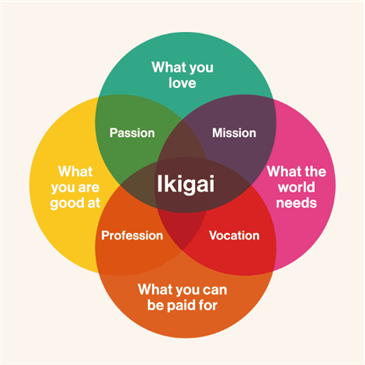
To help find your Ikigai, ask yourself these four precise questions:
What do you love and what are you good at? This is your PASSION.
What do you love and what is something that the world needs? This is your MISSION.
What is something you are good at and can get paid for? This is your PROFESSION.
What is something you can get paid for and is it something the world needs? This is your VOCATION.
Let’s explore each question and how they can be applied to retirement.
What do you love?
This is the gut feeling you have about the things that you truly enjoy doing and puts you into a state of flow. For many people, this can be artistic and creative endeavors such as reading, writing, filmmaking, but it is certainly not limited to this.
What you are good at?
This is not simply a natural gift or talent. These are the things that you are curious about, things you can work at and develop your skills so eventually you become great at them.
What the world needs?
This means that through your talents or services, you can provide value to others. Leaning into this will allow you to make a difference in some way and have an impact.
What can you get paid for?
If there is something you are good at and want to continue, you must find a way to make it financially sustainable. By doing that, you check off a major component to your happiness: the freedom to do what you want without worrying about how you are going to make ends meet.
All four of these questions can be applied to one’s retirement planning.
Without a job to go to each day, people find themselves with lots of time. They can now fill that time with things they truly love to do, are good at, and what the world might need.
For example, you might love writing fiction and know you are good at it. Retirement could be the right time to embrace this “passion” and write that book you have always wanted to write but never had the time to.
Not all retirees want or need to earn money, and are not necessarily looking for a new “profession”. But if this is something you are interested in, you could turn your passion into a source of income. Let’s go back to the writing example. Again, if writing is your passion and you love to write about fiction, you could publish your book. You never know, it just might be the next 1 bestseller on Amazon!
This is just one example, but the possibilities are endless. It takes some time and deep soul-searching to figure out and answer these four questions to bring you to your sweet spot, your Ikigai.
Follow me on Facebook, Instagram, LinkedIn, and visit my website for more info!
Jennifer Rovet, CPRC, Executive Contributor Brainz Magazine
Jennifer Rovet is a Certified Professional Retirement Coach and owner of Retire Ready Canada. She started her coaching business in 2019 when she saw a need to help people as they started to plan and transition into retirement. While retirement can be an exciting time, people choose to work with a Retirement Coach when they are struggling, maybe feeling overwhelmed and not sure what to do once they leave the traditional 9-5 working world. Jennifer is passionate about helping people find purpose, meaning, and happiness in their retirement years. She empowers her clients to find ways to keep active and connected in this next stage of life.