Exploring the Complexities of Human Behaviour in the Strange Life Podcast – Interview with Daisy Onubogu
- Brainz Magazine

- Dec 5, 2025
- 8 min read
Updated: Dec 9, 2025
Daisy Onubogu is a podcast host, public intellectual, and social scientist whose work sits at the intersection of neurodiversity, culture, and identity. She is the creator of Strange Life, a storytelling and analysis platform unpacking the complexities of human behaviour and experience. A sought-after speaker and facilitator, her insights have been featured across major stages including Slush, Pioneers, and Latitude59, as well as in publications such as Sifted, The Independent and TechRound. Daisy’s career spans leadership roles in venture capital, community-building, and creative operations, giving her a uniquely interdisciplinary perspective on how people work, lead, and relate.
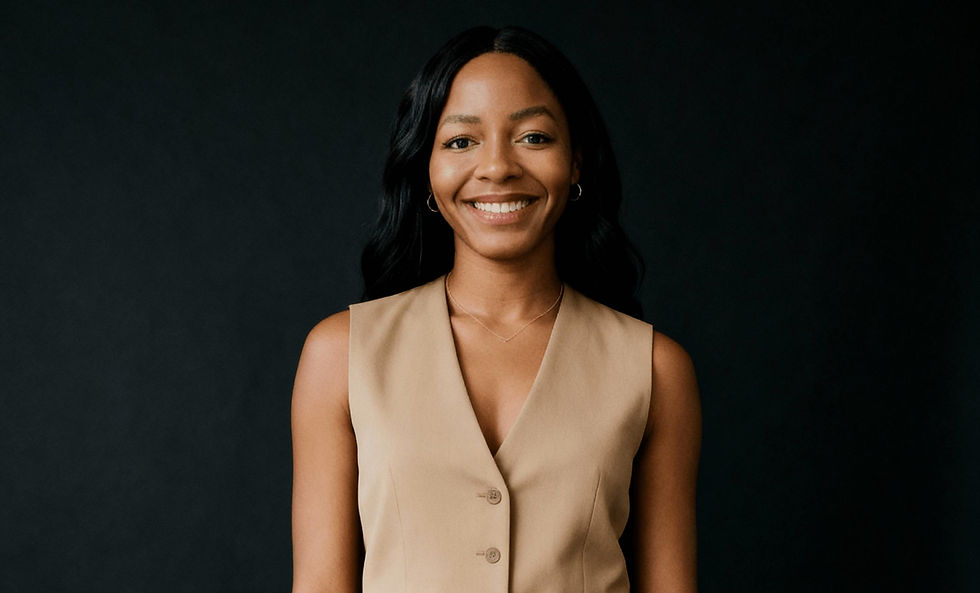
Daisy Onubogu, Podcast Host & Public Intellectual
Who is Daisy Vera Onubogu? Introduce yourself, your hobbies, your favorites, you at home and in business, and tell us something interesting about yourself.
I’m a social scientist, public intellectual, and the creator of Strange Life, a podcast and cultural analysis platform exploring all things human behaviour. At home, I guess I’m an unrepentant overthinker, joyful nerd, and a committed hedonist, happiest when reading four books at once, dancing to afrobeats, annotating podcasts, or reverse-engineering the emotional physics of ordinary life. I love long walks, big questions, and the small rituals that make daily living feel both grounded and whimsical.
In business, I’m a first-principles thinker who helps organisations figure out how to do hard things they’ve never done before. My work spans community architecture, culture design, and complex problem-solving. I have developed repeatable playbooks for generating deep, high-value interpersonal bonds, from figuring out how to convince VVIP speakers to waive their fees and speak for free on Web Summit’s stages, to building a tribe among digital nomads at Roam Co-Living, to training deal scouts for Backed VC, and cultivating psychological safety and alignment among employees at RoomPriceGenie. I thrive in spaces where logic, intuition, and human behaviour intersect.
As an autistic human, I have to manually code for all my behaviour, and I have spent my life needing to logically understand and “solve for” each life experience before I can simply experience it. It’s a trait that makes me both an unusually perceptive analyst and, occasionally, a very amusing companion, a person who automatically maps the structure of a moment even as I’m living it.
And I guess a random interesting thing about me is that I once dropped acid and hung out with Snoop Dogg in his trailer at NOLA Jazz Fest.
What inspired you to start the work you do today, and how did your journey shape the expert you’ve become?
The work I do today centres on two offerings. First, my platform, Strange Life, where I educate a broad audience on how human beings actually work, psychologically, culturally, biologically, and structurally, using both professional understanding and personal lived experience. And second, Chat with Daisy, a one-to-one space for coaching, counselling, mediation, and dialectic sparring, that helps people navigate psychologically complex challenges, whether they appear in their personal lives, their professional worlds, or in the grey spaces between.
In many ways, this is not new work for me, it is simply the formal version of what I have always done. For as long as I can remember, I have been the person who climbs onto a metaphorical soapbox to help people understand each other, and then sits with them one-on-one to help them untangle whatever pattern, crisis, or contradiction they are carrying. It is how I relate to people. It is how I’ve made friends. And it is how I’ve supported almost everyone who has crossed my path.
It’s also been the hidden centre of every role I’ve ever held. Whether building community playbooks for Web Summit VVIPs, designing belonging frameworks for Roam’s global nomads, training deal scouts at Backed VC to decode founder psychology, or helping teams at RoomPriceGenie understand themselves so they could work together more effectively, the through-line has always been the same, make sense of people, then use that understanding to unlock transformation.
The difference now is depth and intention. My late-diagnosis journey into autism and ADHD led me far beyond the humanities training I had always relied on, sociology, anthropology, identity theory, into the scientific foundations of human behaviour, psychology, neuroscience, biochemistry, and the realities of neurodiversity. It broadened my expertise and sharpened my lens.
It also restructured my life. Understanding myself with precision made it super clear to me the kind of life I needed to live and the kind of work I should be doing, in order to thrive. So instead of offering social analysis and deep conversation as a side-effect of my roles, I chose to make them the whole point. The work I’m doing now is the culmination of everything that's happened so far, the moment where the thing I’ve always been becomes the thing I professionally stand for.
What core problem do you help your clients solve, and why is this work so important to you?
At the simplest level, I help people answer the question at the heart of every difficult moment, “What should I do next?”
To get there, we start by understanding why something is unfolding the way it is. I help clients trace the pattern beneath the problem, what it reveals about who they are, what forces are pressing on the situation, what histories or assumptions are quietly shaping it, and how those elements fit together. When you can finally see the full structure of what’s happening, you stop feeling lost inside it. A path forward emerges that actually makes sense.
People don’t come to me because they want vague self-discovery. They come because something in their life has become too dense, too emotionally or cognitively tangled to navigate alone. My role is to make the invisible architecture visible, so they can make a decision grounded in clarity rather than confusion.
As for why this work matters to me, there are two reasons. The first is simple, I know what it feels like to stand inside a problem that seems bigger than you can ever wrap your head around, and since I was always rescued in my darkest moments by the right words, whether from a conversation or a book, I have this sense of moral obligation to pay it back, or forward, and help others find their way too.
The second reason is that human problems are, quite honestly, the most intellectually complex puzzles on earth. They involve biology, psychology, culture, history, identity, chemistry, trauma, meaning, social norms, and private longing, all interacting at once. They’re more intricate than any logic puzzle or engineered challenge you could place in front of me. And because my mind thrives on complexity, this work gives me the kind of cognitive and emotional richness that puts me in flow. It is the rare space where my curiosity, my intellect, and my humanity are all equally engaged.
That combination, the desire to help and the drive to solve deeply complex human puzzles, is what makes this work feel both natural and necessary to me.
Can you explain your unique approach or methodology and what makes it different from others in your industry?
My approach is a blend of:
social science (identity theory, neurodiversity, sociology, psychology)
cultural analysis (the norms shaping the behaviour)
systems thinking (how the situation can be understood as cogs moving and pulling each other into repeating patterns of motion across contexts)
narrative reconstruction (rewriting the internal stories people live by)
philosophical inquiry (first principles thinking and Socratic dialogue style)
What makes my methodology rare is my ability to integrate these layers in real time. In a single conversation, I can move from analysing a client’s emotional pattern to explaining the social forces behind it, to identifying the structural shift needed, to offering a language that suddenly makes everything make sense. Clients often describe the experience as “speaking to someone who can see the architecture of my mind.”
Who are the people who benefit the most from working with you, and what specific results can they expect?
My work attracts a particular kind of person:
high-achievers who feel internally misaligned
neurodivergent adults seeking clarity, coherence, and language for their lived experience
women navigating reinvention, identity shifts, or threshold moments
creatives and founders wrestling with meaning, direction, or the emotional weight of ambition
thinkers who have never quite met someone who can keep pace with, or extend, their mind
people who have always been “the strong one,” the reliable centre of gravity in their world, but who now find themselves overwhelmed by a situation their usual strength can’t quite resolve. They recognise that they need someone equally strong, but with a different set of tools, to help them carry and decode what they’re facing.
The results they can expect include:
a clear understanding of the forces shaping their situation
language that articulates things they’ve felt for years but never had words for
relief from long-standing confusion or internal friction
insight into why certain patterns repeat and how to interrupt them
renewed confidence grounded in truth as opposed to brittle performance
a tangible path forward, the answer or direction they were looking for, built on a full understanding of themselves and the architecture of the problem
Most people leave with both clarity and momentum, not just knowing themselves better, but knowing exactly what to do next.
What is one misconception people often have about your field, and how do you help them see it differently?
A common misconception is that self-understanding is a solo project, something achieved through discipline, journaling, or consuming enough information.
I show people that identity is relational and patterned. We are shaped by forces we did not choose, acting according to scripts we did not write. The work is not to “fix yourself” but to learn the structures you’re operating within. Once people understand the architecture of their own behaviour, change becomes intuitive.
What tools, techniques, or philosophies guide your work and help your clients transform?
My work draws on a wide range of tools and intellectual lineages, neurodiversity frameworks, identity and intersectionality theory, attachment and narrative psychology, behavioural pattern analysis, philosophical inquiry, and precise language reframing. I also curate an extensive library of documentaries, video essays, articles, and short-form content that I can deploy to help clients think more deeply or integrate insights long after the session ends. It gives people a multidimensional way into the problem they’re working through.
Another resource I bring to bear is my unusually large and varied network, the result of a career spent “superconnecting” across industries. When someone’s next step requires an introduction to the right person, I can often make that connection happen.
My guiding principles are twofold. First, clarity is the beginning of freedom. Until people can understand themselves and their situation with precision, they can’t meaningfully change their orientation toward their own lives. Second, the only way is through. With clarity comes the sobering realisation that every situation must be met head-on, but also the reassurance that with the right language, frameworks, and dialectical support, there really is nothing that cannot be sorted.
When people combine these two principles, precision of insight and willingness to move through what is real, transformation becomes grounded, practical, and durable.
How do your social platforms and online presence support your mission and help you connect with the people who need you most?
I use my online presence as an extension of my intellectual work. Through Strange Life video podcasts, Instagram reels, long-form writing on Substack, and short-form insight posts on Threads and X, I create entry points into deeper thought, helping people articulate experiences they’ve never had words for.
My platforms act as a public classroom, a community of inquiry, and an invitation into more intimate work with me. Many of my clients arrive because they recognised their inner world in something I wrote or said.
What is one powerful transformation or success story that captures the impact of your work?
One client, a high-performing founder who had succeeded by sheer force of will, came to me feeling inexplicably directionless. In under 45 minutes, I identified the underlying identity fracture they had been compensating for since adolescence.
The client later said, “Daisy didn’t give me answers. She gave me the language that let the answers finally reach me.”
Within weeks, they restructured their work life, repaired a significant relationship, and felt, in their words, “the most myself I have ever been.”
What is the best way for someone to start working with you, and what should they expect from their first interaction?
The best starting point is a Chat with Daisy session, a 45-minute exploratory conversation, which you can book and schedule via the link on my website, designed to surface the real structure of the puzzle someone is facing.
People should expect an experience that is both intellectually rigorous and deeply human. I will ask questions that reach the root of the issue, synthesise insights across disciplines, and offer frameworks that make the client’s inner world suddenly legible.
Most people walk away with a sense of recognition, relief, and momentum, as though the fog has lifted and they finally have a map.
Read more from Daisy Onubogu