Embark on a Trip Within You Through ANFT Relational Forest Therapy
Written by Juna Ting-Wei Chang, Forest Therapy Guide
Juna Ting-Wei Chang is a forest therapy guide and founder of Shinrin-Yoku Taiwan, specialising in evidence-based forest therapy and Shinrin-yoku. She supports individuals and organisations in slowing down and gently returning their attention to themselves and the more-than-human world through nature.

Why your brain works differently the moment you step under the trees, and what cortisol, attention, an ancient love of living things, a Japanese village landscape, and the threshold between worlds have to do with it.
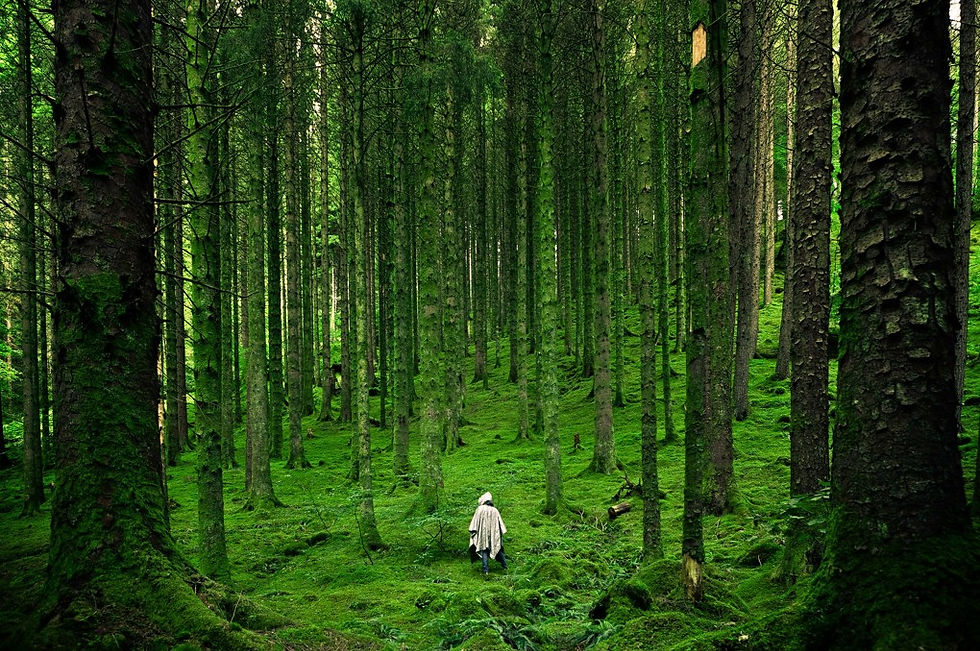
Cross the first hundred meters of a forest trail and something quietly shifts. Not in the trees, but in you. Breathing slows, the gaze softens, and the mental tabs you’ve held open all day start closing on their own.
Participants often ask me the same question: Why does my brain feel so different out here? It deserves a real answer. In Relational Forest Therapy™, the approach I practice through the Association of Nature and Forest Therapy (ANFT), we say that the forest is the therapist and guides open the door. But a door only matters if something real waits on the other side. So let’s look at what science, and a few older ideas, say is waiting there.
Your attention is tired, the forest is built to rest it
Psychologists Rachel and Stephen Kaplan called the problem directed attention fatigue. Every notification you ignore, and every decision you make, asks your brain to suppress distractions and stay on task. That effortful focus is a limited resource, and modern life drains it all day long.
Their Attention Restoration Theory proposes that natural settings let it recharge because they hold our attention gently and without effort. They named this soft fascination: moving leaves, shifting light, running water, birdsong. Things worth noticing that demand nothing back. A city street or a screen does the opposite, grabbing your attention and refusing to let go.
The Kaplans also described what makes a place restorative: a sense of being away, to the extent that it feels like a whole world, gentle fascination, and compatibility with what you need. A forest walk checks all four. Researchers still debate how precisely the theory can be tested, but studies have repeatedly found that people perform better on cognitive tasks after time in nature.
Your body hears it first: The cortisol story
Cortisol is your body’s main stress hormone, and it’s a useful window into what a forest does to you. In field experiments across 24 forests in Japan, researchers sent 280 young adults to walk in forest and city settings. The forest groups showed lower cortisol, slower pulse, and lower blood pressure, along with more parasympathetic activity (your rest and recover mode) and less sympathetic activity (your fight-or-flight mode).
To be fair, the evidence isn’t perfectly uniform. Some studies find weaker effects on cortisol or blood pressure. But reviews and meta-analyses keep pointing in the same direction: lower stress markers, a calmer heart rate, and less tension, anxiety, and low mood after forest bathing.
Your mind follows: The loop loosens
Rumination is the mental replay button: the same worries, the same self-criticism, round and round. In a 2015 Stanford study, 38 adults took a 90-minute walk in either a natural setting or beside a busy road. Only the nature walkers reported less rumination, and their brain scans showed reduced activity in the subgenual prefrontal cortex, a region linked to that kind of negative self-focused thinking.
Why does it work? Three older ideas
Biophilia. In his 1984 book Biophilia, biologist E. O. Wilson popularized the idea that humans carry an innate tendency to focus on life and lifelike processes. We spent nearly all of our history inside living systems, and cities are a blink in evolutionary time. Honesty matters here: biophilia remains a hypothesis, and Wilson himself said hard evidence was still early. But whether the pull is inherited, learned, or both, most of us feel it. Relational Forest Therapy takes the next step, from affinity to relationship: a two-way exchange rather than a one-way pull.
Satoyama. In Japanese, sato means village and yama means hill or forest. Satoyama describes a mosaic of woodland, farmland, ponds, and grassland where people and nature shape each other over generations. Villagers once coppiced trees and gathered fallen leaves for the fields, and in return, the landscape gave food, fuel, and shelter. Satoyama landscapes cover nearly 40% of Japan. I find it a helpful picture of what we invite on a walk: not the forest as scenery, and not as wilderness we only visit, but as a partner in a reciprocal relationship.
The liminal world. Liminal comes from the Latin limen, meaning threshold. In 1909, anthropologist Arnold van Gennep described rites of passage in three phases: separation, a middle phase, and return. Victor Turner later called that middle phase “betwixt and between”: you’re no longer who you were, and not yet who you’re becoming. A forest walk borrows that shape. You cross a threshold, leave your roles and schedules behind, and enter a space where the usual rules loosen. It’s why a guide’s work is to open a door. A threshold is where the journey inward begins.
What shifts in the body
Stress hormones settle: lower cortisol compared with city environments.
The heart calms: slower pulse and lower blood pressure.
The nervous system rebalances: more rest and recovery activity, less fight-or-flight.
Immune support (emerging): early research links tree compounds called phytoncides to higher natural killer cell activity.
What shifts in the mind
Attention restores: effortful focus rests while soft fascination takes over.
Rumination quiets: fewer looping, self-critical thoughts.
Tension and low mood ease: lower anxiety and heaviness after time in the forest.
Belonging returns: a felt sense of kinship with the living world and a new perspective on your own life.
The trip within
Nothing about this is magic, and that’s what I love about it. Attention restored. Stress chemistry settling. Loops of thought loosening. An old affinity remembered, a reciprocal relationship offered, a threshold crossed.
We do not hand you a new brain. We invite you to notice what yours was built for, and the forest does the rest. If you’re ready to embark, the door is open.
Read more from Juna Ting-Wei Chang
Juna Ting-Wei Chang, Forest Therapy Guide
Juna Ting-Wei Chang is a forest therapy guide and founder of Shinrin-Yoku Taiwan, now part of Green Shower. She is the first Taiwanese guide certified by the Association of Nature and Forest Therapy (ANFT) and also holds the Taiwan Forest Therapist Certificate. With a background in languages, cross-cultural experience, and landscape and recreation management, Juna brings science, tradition, and lived experience together in a warm, grounded way. Her work supports individuals, organisations, and international groups in cultivating emotional resilience, presence, and sustainable wellbeing through nature-based practices.
References:
Bratman, G. N., Hamilton, J. P., Hahn, K. S., Daily, G. C., & Gross, J. J. (2015). Nature experience reduces rumination and subgenual prefrontal cortex activation. Proceedings of the National Academy of Sciences, 112(28), 8567–8572.
Kaplan, R., & Kaplan, S. (1989). The experience of nature: A psychological perspective. Cambridge University Press
Park, B. J., Tsunetsugu, Y., Kasetani, T., Kagawa, T., & Miyazaki, Y. (2010). The physiological effects of Shinrin-yoku (taking in the forest atmosphere or forest bathing): Evidence from field experiments in 24 forests across Japan.
Environmental Health and Preventive Medicine, 15(1), 18–26.
Turner, V. (1969). The ritual process: Structure and anti-structure. Aldine Publishing.
Van Gennep, A. (1960). The rites of passage (M. B. Vizedom & G. L. Caffee, Trans.). University of Chicago Press. (Original work published 1909).
Wilson, E. O. (1984). Biophilia. Harvard University Press.