

Dear Millennial Healthcare Professional, Put the Cape Down
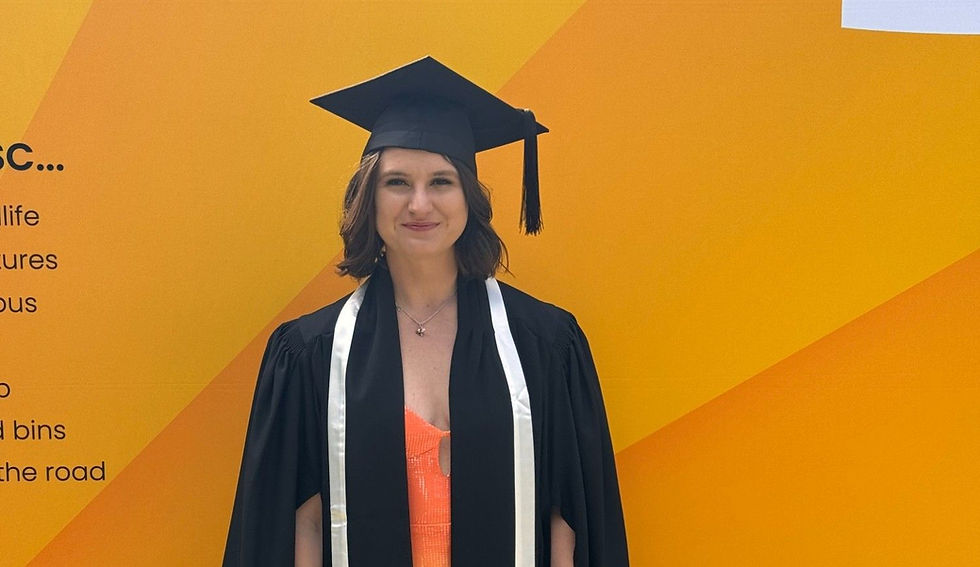
Written by Matilda Wayte, Neuroscientist
Matilda Wayte is a Clinical Exercise Physiologist and Neuroscience Researcher whose work sits at the intersection of trauma, brain health, and human behaviour. She brings both academic rigour and deep personal insight to everything she writes.

First things first, am I even a millennial? I was born in January 1997, which apparently puts me in that delightful grey zone where I’m either the world’s youngest millennial or the world’s oldest Gen Z, depending on who you ask. Either way, I’ve inherited the millennial tradition of catastrophising and the Gen Z tradition of oversharing on the internet, so here we are.
Now, let’s talk about you. You probably think you’re fine. You’re not, are you? You’re the person everyone calls when they’re not fine. You’re professionally trained to hold space for other people’s worst days, and you’re quietly brilliant at it. You make people feel seen, heard, understood. You go home, pour yourself something warm, stare at the wall for a bit, and then wake up and do it all again.
You’ve read the articles about not pouring from an empty cup. You’ve probably recommended those articles to clients. You nodded along knowingly. And then you went right back to pouring.
I see you. Because I was you. I am you.
The part where I embarrass myself for your benefit
I have always fancied myself a bit of a mental health guru. I’m a Clinical Exercise Physiologist with additional qualifications in neuroscience and mental health. I have spent years researching, studying, and synthesising the science of how the brain and body cope with adversity. I genuinely believed I had a handle on this whole thing.
Then, at 29 years old, I burnt out. Twenty-nine. Not even a respectable mid-life crisis. Just a very millennial, very undignified crash-and-burn at an age where I still get asked for ID occasionally. I can practically hear the baby boomers sighing from here.
Here’s how it happened: I’d been working in neurological rehabilitation, incredible, meaningful work that was quietly eating me alive. So, I made what I thought was a genius move and pivoted to workers’ compensation. Broken legs, I thought cheerfully. Easy peezy.
Except, because I am apparently my own worst enemy, I put all my qualifications on my resume: neuroscience, mental health, the lot. And of course, of course, I was immediately assigned a caseload of psychological claims because I was the most qualified. And I couldn’t say no, because what about the clients?
Four months in, the universe apparently decided I needed a more direct intervention. Enter: a traumatic brain injury. Nothing says “time to stop” quite like your own nervous system just completely walking off the job after a good ol’ head knock.
I took medical leave, involuntarily, emphatically, with zero room for negotiation. And when I eventually attempted to return, I was confronted with something I’d been very successfully avoiding: I had been utterly exhausted before the injury. The TBI hadn’t created the problem. It had just made it impossible to pretend the problem didn’t exist.
There’s a wonderful book called Blessed With a Brain Tumour by Will Pye, which makes the case that a neurological crisis can, in the strangest way, be a gift. I used to recommend it to clients. It turns out the universe had added it to my reading list too, and underlined it. With a highlighter. Repeatedly.
So here I am. Accepting, with great reluctance and only mild dramatics, that I need significantly more time to heal than my ego would like to admit before I return to clinical work, which I genuinely want to do. Unless, of course, this article takes off and I can simply talk to the internet about my problems and get paid for that instead. I’m open to either outcome, frankly.
Here’s what the research won’t tell you (but I will)
The neuroscience is clear: chronic stress dysregulates the hypothalamic-pituitary-adrenal axis, impairs prefrontal cortex function, and over time degrades the very cognitive and emotional capacities that make us good clinicians. We are not immune to the biology we study. We are not separate from the nervous systems we treat.
But you already know all that. You can cite it. You might have cited it this week.
What’s harder to sit with is this: knowing the science does not protect you from the experience. Insight is not a shield. And the particular brand of suffering that comes with being a highly competent, deeply compassionate healthcare professional is this: you are very, very good at convincing yourself and everyone around you that you’re okay.
Until you’re not.
The plot twist nobody tells you about
When I finally stopped, when I actually let myself fall apart, messily, unprofessionally, with zero clinical language to hide behind, something unexpected happened.
People weren’t disappointed. They weren’t less likely to take me seriously. They said, “We’re so proud of you. Thank you for asking for help.”
Turns out vulnerability doesn’t undermine credibility. It builds it. The work I do now, the research, the writing, the advocacy, is more grounded, more honest, and frankly more useful than anything I produced when I was performing wellness while quietly unravelling.
So here’s your call to action
Not a grand one. Just this, if something in this landed for you, if you read any line above and felt that particular feeling of, “Oh, that’s embarrassingly accurate”, I’d love to hear from you.
I write and post about neuroscience, trauma, nervous system regulation, and what it actually looks like to take this stuff off the page and into real life. Not from a place of having it all together, but from a place of being a clinician who has lived the research from the inside out, and is still going.
Follow along at @theneuro.ep and send me a DM. Tell me what resonated. Tell me what you’d like to explore further. Tell me I’m not the only one who thought workers’ comp would be relaxing.
We don’t have to keep doing this alone.
Read more from Matilda Wayte
Matilda Wayte, Neuroscientist
Matilda Wayte is a Clinical Exercise Physiologist and Neuroscientist specialising in rehabilitation, trauma, mental health, and the neuroscience of human behaviour. She holds a Bachelor of Clinical Exercise Physiology from QUT, a Graduate Certificate in Neurological Rehabilitation from ECU, and a Graduate Certificate in Mental Health and Neuroscience. Matilda's work is shaped by both her clinical experience across occupational rehabilitation and neurological settings, and her own lived experience of trauma, giving her a rare ability to translate complex science into something that feels genuinely human. She creates research-grounded content for broad public audiences through her platform @theneuro.ep on Instagram and LinkedIn.




