

Creativity as Controlled Psychopathy
- Oct 22, 2025
- 7 min read
Dr. Dragana Favre is a psychiatrist, psychotherapist, and seeker of the human psyche's mysteries. With a medical degree and extensive neuroscience education from prestigious institutions like the Max Planck Institute and Instituto de Neurociencias, she's a seasoned expert.

Creativity is often idealized as the highest expression of the human spirit, the mark of civilization’s progress, the gift that lifts imagination beyond necessity. Yet its psychological roots are rarely questioned in their entirety. Have we truly dared to look at all the ancestors, light and dark, of our cherished creativity? To say that creativity is born of the psychopathic core is to confront an uncomfortable idea, the same nucleus of the psyche that allows cruelty, transgression, and amorality also gives rise to invention, art, and the renewal of meaning. This “psychopathic core” is not pathology in itself. It is the original disinhibited source of psychic energy, pre-moral, exploratory, and beautifully anarchic. The creative act is the transformation of that energy into form.
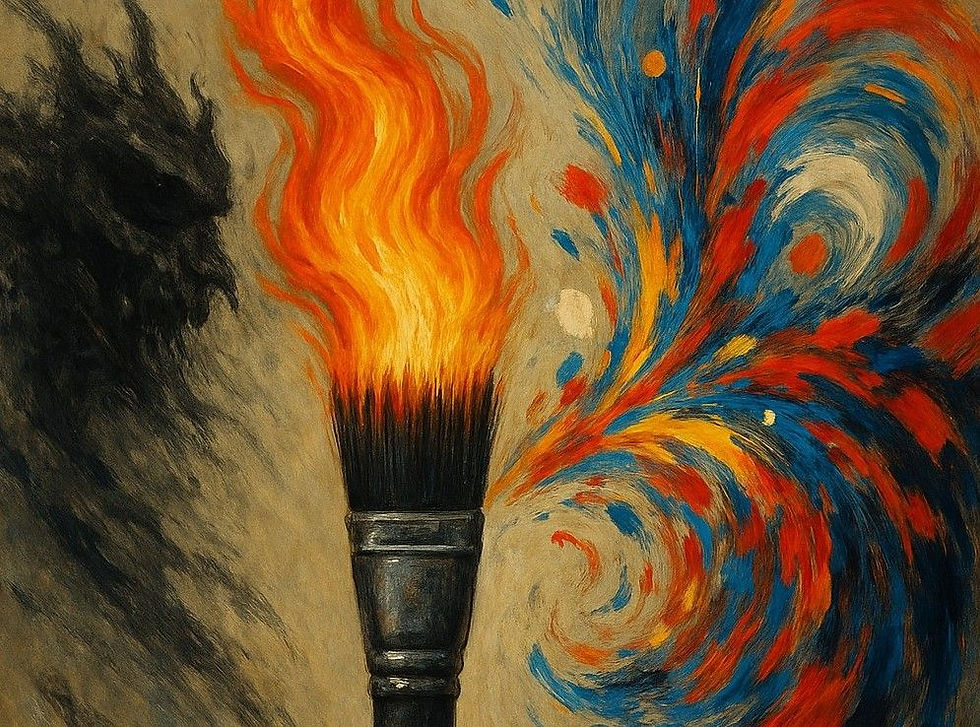
In Jungian language, this core corresponds to the shadow, the zone of instinctual life and disowned potential that lies beneath the mask of the civilized ego. Jung understood that the shadow was not merely evil but also the reservoir of vitality, curiosity, and imagination. It contains all that consciousness excludes, aggression, sexuality, but also the primitive spark of creation. In the spirit of man, art and literature, Jung wrote that art issues from the collective unconscious and is therefore autonomous, indifferent to moral, or rather a-moral, intent. The artist is seized by forces that exceed the ego’s control, compelled to give them shape. The same psychic power that can destroy, when contained, becomes revelation.
Empirical research now illuminates this ancient intuition. Studies on the “dark traits” of personality, narcissism, Machiavellianism, and psychopathy reveal partial correlations with creative achievement. Individuals high in boldness, risk-taking, and cognitive disinhibition often generate more original ideas. These traits are dangerous when unchecked, yet indispensable for novelty. Psychopathy, in its subclinical form, entails a reduced sensitivity to social sanction, a willingness to break patterns. The creative imagination requires exactly this breach, an ability to perceive beyond the sanctioned and to reconfigure the familiar. Neuroimaging supports the link. During creative flow, the prefrontal cortex, the seat of executive inhibition and moral judgment, partly relaxes, allowing freer associations. Later, regulatory systems return to refine and select. Creativity thus depends on the temporary suspension of inhibition, followed by re-engagement. The brain oscillates between chaos and order, the same dynamic that Jung saw as essential to psychic life.
From an evolutionary perspective, this capacity has deep roots. Early human groups needed both conformity and deviation. Those who preserved tradition ensured stability, and those who dared to imagine new tools or rituals enabled adaptation. Risk-taking and norm-breaking are costly yet occasionally vital. The persistence of psychopathic traits in the gene pool suggests that a minority of disinhibited individuals benefited the group by exploring untried paths. Creativity and psychopathy are divergent outcomes of this same evolutionary gamble, the drive to transgress boundaries. The creative mind represents the successful mutation, the individual who ventures into disorder but returns bearing usable novelty.
At the neurochemical level, this balance corresponds to the modulation of dopaminergic systems. Dopamine enhances curiosity, exploration, and associative thinking, too much yields impulsivity, too little rigidity. Evolution thus favored those capable of controlled disinhibition, of entering states of imaginative openness without losing functional control. In the psyche, this becomes the dance between instinct and reflection, Dionysus and Apollo. The psychopathic core provides the Dionysian intensity and consciousness. When mature, it supplies the Apollonian container.
Creativity, therefore, is not the triumph of control but the rhythmic interplay of surrender and return. The psyche maintains its equilibrium through compensation. When order dominates, imagination decays. When chaos floods, structure collapses. Health lies in the oscillation itself. Neuroscientific research mirrors this, creative thinking engages both the associative “default-mode” network and the executive control network, alternating between free generation and critical evaluation. The psyche, like the brain, sustains creativity through dynamic equilibrium. Jung’s vision of individuation already anticipated this, the ego must open to the unconscious yet not be swallowed by it.
Culturally, societies enact this rhythm through symbolic membranes, myth, art, ritual, ethics, and embodiment that channel the disinhibited impulse. Religion and art, for Jung, were safety valves for archetypal energies. They prevent the unconscious from overwhelming consciousness. In evolutionary terms, symbolic culture is a collective mechanism of inhibition, transforming potentially destructive instincts into creative imagination. The artist’s vocation is dangerous precisely because it requires entering the chaos that others avoid. He or she serves as intermediary, metabolizing the primitive fire into communicable form. The same is true in therapy. The analyst witnesses the patient’s descent into shadow and helps transmute raw affect into symbol.
This understanding reframes creativity as an ethical process, not a moral virtue, but a disciplined transgression. To create is to disobey. Every artistic or scientific breakthrough violates an established order. It dares to reconfigure reality. Yet without ethical containment, in the sense of the Other, transgression becomes nihilism. The creative act requires both the courage to cross boundaries and the humility to shape what is found. Jung compared the alchemist’s furnace to the human soul. The prima materia (dark, chaotic, often foul) must be cooked until a new order crystallizes. The psychopathic core is the prima materia, art is the alchemical gold.
If the psychopathic core is universal, why aren't all people creative, and vice versa? Evolution suggests that the distribution of traits within a population must remain uneven. Creativity is metabolically expensive and socially disruptive. Only a fraction of individuals can bear its instability without collapse. Societies need both innovators and stabilizers. When everyone becomes a breaker of rules, collective psychosis ensues. The maintenance of civilization depends on the coexistence of structure and deviation, obedience and rebellion. The creative minority renews the symbolic order, the majority sustains it.
A world in which everyone were fully creative might appear utopian, but would be ecologically and psychologically unsustainable. Creativity demands constant differentiation. Its energy depends on the contrast with convention. If every member of society sought radical originality, communication and coordination would dissolve. Jung warned that unmediated archetypal forces can possess individuals and entire collectives. When the primordial imagination floods consciousness without symbolic containment, chaos masquerades as freedom. The proliferation of unbounded self-expression in the digital age already demonstrates this endless novelty without depth, image without integration, a collective inflation of the creative ego.
Thus, inhibition, often regarded as repression, is in fact the ethical function that preserves relation. It allows empathy, temporality, reflection, and the capacity to delay action until meaning emerges. In brain terms, it is the prefrontal restraint that gives shape to impulsive energy, in psychic terms, the ego’s mirror to the id’s flame. True creativity depends on this internal governor. The task is not to suppress the psychopathic core but to educate it, to give it form, responsibility, and aesthetic purpose. The tension between instinctual drive and reflective inhibition becomes the crucible of individuation.
In evolutionary language, the same dynamic operates at every scale, mutation introduces variation, selection imposes order, and adaptation results from their dialogue. The creative psyche mirrors evolution itself. Disinhibition generates novelty, and inhibition refines and stabilizes it. At the neural level, dopamine excites, serotonin moderates. At the psychological level, the shadow erupts, the ego contains. At the cultural level, the avant-garde breaks tradition, society absorbs and metabolizes it. Chronos has its role. Evolution and creativity share this logic of controlled disequilibrium.
Recognizing creativity’s psychopathic roots also forces a reconsideration of morality. Moral systems evolve to restrain destructive impulses, yet complete moralization extinguishes imagination. The artist, like the trickster, renews morality by violating it from within. In mythology, the tricksters like Loki, Hermes, or Prometheus embody precisely this psychopathic core, cunning, amoral, playful, transgressive, yet indispensable to creation. He shatters stagnation and brings fire to humanity. Creativity is the continuation of this archetype in modern consciousness, an act of sacred mischief that prevents psychic entropy.
The balance between creation and destruction must therefore be continually renegotiated. Civilization depends on individuals who can carry the fire without burning the village. Jung described the Self as the totality that reconciles opposites. Individuation requires confronting one’s shadow and integrating it into a larger order. The same applies collectively, societies must integrate their creative-psychopathic minority rather than exile or idolize it. When disinhibited energy is repressed, it returns as violence. When celebrated without discipline, it decays into spectacle. The ethical challenge of our time is to sustain symbolic containers robust enough to hold the chaos of innovation without killing it.
To affirm that creativity is born of the psychopathic core is to dignify darkness without romanticizing it. It is to see that evolution endowed humanity with the power to break its own patterns, and that this power is double-edged. Without it, we would still inhabit caves, unrestrained, and we may destroy the planet. The future of culture and psyche alike depends on our capacity for controlled transgression, to open the doors of perception, yet close them again before the flood. So, can we resist the temptation(s)?
Creativity is the momentary reconciliation of two evolutionary imperatives, survival through conformity and adaptation through change. In each artist, scientist, or thinker, these forces contend. The psychopathic core whispers, “Break the law”, the symbolic order replies, “Transform it.” Between them lies the fragile interval where meaning is born.
Dragana Favre, Psychiatrist and Jungian Psychotherapist
Dr. Dragana Favre is a psychiatrist, psychotherapist, and seeker of the human psyche's mysteries. With a medical degree and extensive neuroscience education from prestigious institutions like the Max Planck Institute and Instituto de Neurociencias, she's a seasoned expert. Her unique approach combines Jungian psychotherapy, EMDR, and dream interpretation, guiding patients towards self-discovery and healing. Beyond her profession, Dr. Favre is passionate about science fiction, nature, and cosmology. Her ex-Yugoslavian roots in the small town of Kikinda offer a rich backdrop to her life's journey. She is dedicated to helping people find their true selves, much like an alchemist turning lead into gold.
References:
Beaty, R. E., Benedek, M., Kaufman, S. B., & Silvia, P. J. (2016). Default and executive network coupling support creative idea production. Scientific Reports, 6, 10964.
Book, A., Visser, B., & Volk, A. (2019). Unpacking “evil”: Claiming the adaptive significance of psychopathic traits. Personality and Individual Differences, 141, 109–118.
Batey, M., Chamorro-Premuzic, T., & Furnham, A. (2022). Psychopathy and openness to experience as predictors of creativity. Journal of Research in Personality, 98, 104229.
DeYoung, C. G., Peterson, J. B., & Higgins, D. M. (2005). Higher-order factors of the Big Five predict variation in brain dopamine function. Personality and Individual Differences, 39(5), 881–892.
Gabora, L. (2016). Honing theory: A complex systems framework for creativity. Creativity Research Journal, 28(2), 120–132.
Glenn, A. L., Kurzban, R., & Raine, A. (2011). Evolutionary theory and psychopathy. Aggression and Violent Behavior, 16(5), 371–380.
Jung, C. G. (1958). The Structure and Dynamics of the Psyche (CW 8). Princeton University Press.
Jung, C. G. (1959). The Archetypes and the Collective Unconscious (CW 9i). Princeton University Press.
Neumann, E. (1959). Art and the Creative Unconscious. Princeton University Press.
Reuter, M., Roth, S., Holve, K., & Hennig, J. (2006). Identification of first candidate genes for creativity: A pilot study. Brain Research, 1069(1), 190–197.
Reddy, I. R., Ukrani, J., & Indla, V. (2018). Creativity and psychopathology: Two sides of the same coin? Indian Journal of Psychiatry, 60(4), 397–404.


