

Can Online Sound Baths Work?
Written by Ben Miller, Sound Bath Educator
Ben Miller is the founder of Zen with Ben and an educator specialising in the musical foundations of sound bath practice. With a degree in Music Production and a lifetime of musicianship, his teaching focuses primarily on crystal singing bowls, helping facilitators work with harmony, technique, pacing and structure more intentionally.

I sometimes hear people argue that you cannot really have a sound bath online. To me, that is a little like saying you cannot properly experience music through a recording, that you only get something from it if you are standing in front of the band. Of course, the experiences are different. If you are physically in a room with a large gong, you are not simply hearing it. At sufficient sound levels, particularly with lower frequencies, there can also be a physical element to the experience. A normal pair of headphones is not going to reproduce all of that.
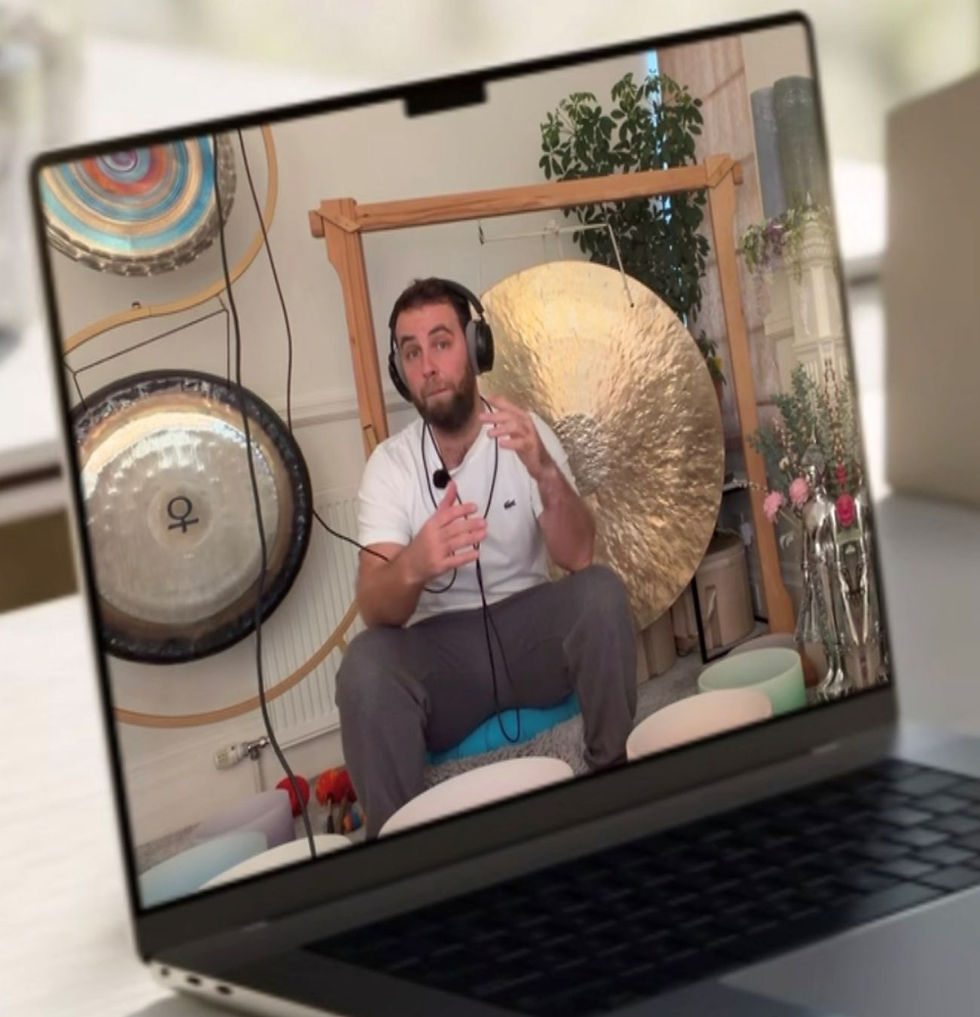
But recorded music does not need to recreate a live performance perfectly in order to move us. It can still be immersive. It can still evoke an emotional response. I see an online sound bath in much the same way.
The digital sound bath is its own medium. Once I started thinking about it that way, the question changed from “Can an online sound bath work?” to “What is the person at the other end actually hearing?”
When I first started exploring this, my instinct came from music production. Microphones, audio interfaces, equalisation (EQ), reverb, mixing. I was thinking about how to capture the instruments well. But the more I tested, the more I realised that capture was only part of the problem.
What I hear sitting beside crystal singing bowls, gongs and chimes is not necessarily what a microphone hears. What the microphone captures is not necessarily what the delivery platform sends. What the platform sends is not necessarily what finally reaches somebody’s headphones. That distinction changed everything for me.
A beautifully captured sound can still arrive badly at the other end. Between the instrument and the listener, there may be a microphone, an interface, processing, an online platform, an internet connection, a receiving device and, finally, headphones or speakers. Every stage can affect the experience.
One of the simplest lessons I learnt was also one of the most useful: move the microphone. Put it too close to one group of bowls and they may dominate. Move it farther away and the relationship between the bowls, gong, chimes and the room changes. Change its height or angle and the balance changes again.
A microphone does not simply capture “the room”. It captures the sound arriving at one particular position within it. So I increasingly think of the microphone as the participant’s ears.
Where do I want those ears to be?
That question can be more useful than immediately reaching for another microphone, another plugin or another piece of equipment.
Microphone placement is part of the mix
But good placement still only gives us the raw material. We then have to think about how that sound is shaped.
In a sound bath attended in person, the room itself is doing some of the work. There is distance between instruments, reflections from surfaces, depth, width and a natural acoustic space around the sound.
The person listening at home is not sharing that physical room. So if we simply put a microphone in front of the instruments, open Zoom and send a completely dry signal, we have removed part of the environment that helped those instruments feel immersive in the first place.
For me, that means some form of sound design matters
That does not mean drowning everything in effects. It does not mean every sound bath practitioner needs a music production degree. It means making intentional musical decisions.
EQ can help different instruments sit together more cohesively across the frequency spectrum. Stereo can help preserve width and position. Reverb can create or extend a sense of acoustic space.
But the principle is not simply “add processing”. It is: listen, adjust and ask whether the change genuinely improves the experience.
Bowls and gongs already sustain for a long time, so too much reverb can quickly turn into a wash where everything blurs together. Sometimes very little is needed. But equally, “natural” does not necessarily mean “completely unprocessed”.
When we record a singer, a band or an orchestra, we do not usually assume the raw microphone signal is automatically the finished listening experience. We make decisions about tone, balance, dynamics and space.
Why should sound bath instruments receive less consideration?
Once the listener is no longer physically in your room, you have to build enough of that room in their headphones. Then there is another part of the chain that is easy to overlook: the platform delivering the sound.
I used Zoom throughout my testing, and it demonstrated this perfectly. I could capture and shape a stereo signal at my end, but whether that stereo image reached the participant depended on how the session was being delivered and how they were listening.
Through the desktop application, with the appropriate settings, I could preserve that stereo presentation. Through other routes, that experience could change.
That highlights something important: I cannot control how every participant chooses to join. Somebody may use their phone. Someone else may listen through laptop speakers. Another person may use good headphones.
What I can do is make sure everything at my end is set up properly, recommend the listening method that gives them the best chance of hearing the experience as I designed it, and understand what the platform itself may be doing to the sound. That was one of the clearest lessons from my testing: capturing something beautifully is not enough if the delivery chain changes it before it reaches the listener.
That is also why listening from the participant’s side matters. Standing beside a gong and deciding it sounds beautiful tells you very little about what someone hundreds of miles away is actually receiving.
Monitoring the microphone locally helps, but it still does not tell you everything. The sound has yet to pass through the platform and arrive at the other end. So, where possible, I want to hear the live session from another computer, through headphones, as a participant would hear it.
It is slightly awkward in practice. You either need somebody else to play the instruments while you listen from the receiving computer, or somebody else to sit at the receiving end and listen critically for you. But it closes the loop.
Has the width survived? Is the gong overpowering everything else? Can you still hear the quieter chimes? Does the reverb create depth, or simply blur the sound? Does the finished result actually feel immersive through headphones?
Those are not really technical questions anymore. They are musical ones. This is where I think the conversation around equipment can easily go in the wrong direction.
You do not need ten microphones and a studio full of hardware to host an online sound bath. But equally, I do not think the answer is simply to point a phone at the instruments and assume the job is done.
The goal is not the simplest possible setup at all costs. It is not the most complicated setup you can afford. It is the simplest reliable system that allows you to create the experience you actually want your participant to receive. That is why I keep coming back to the same question.
What is the person at the other end actually hearing?
Because that matters more than how many microphones you own. It matters more than how impressive your setup looks.
Capture the instruments well. Shape the sound intentionally. Understand how it is being delivered. Then listen again from the other side.
So, can online sound baths work? I think they can. But not because they perfectly recreate being in the room. They work when we stop asking the digital experience to be identical to the physical one and start designing it properly as its own listening experience.
Different does not mean invalid
It simply means the medium has changed, and our approach needs to change with it. That is the principle I explore practically in the accompanying video, where I compare microphone positions, stereo and mono delivery, processing and the final online setup. But underneath all of the equipment is one very simple idea: start at the listening end, then build backward.
Read more from Ben Miller
Ben Miller, Sound Bath Educator
Ben Miller is the founder of Zen with Ben and an educator specialising in the musical foundations of sound bath practice. His teaching focuses primarily on crystal singing bowls, helping facilitators understand harmony, technique, pacing and structure. In his own sound baths, he draws on a wider palette of bowls, gongs, handpan, chimes and natural soundscapes. His articles offer practical, evidence-aware ideas for more intentional, musically informed practice.







