Can a Sexless Marriage Be a Happy One? Ours is
Lovisa Engstrand is a Nervous System & Stress Specialist and founder of The Exhale Collective, dedicated to helping high-functioning women rebuild their internal capacity and overcome chronic burnout. Combining psychology, breath science, and her own health recovery, she guides global clients to regulate their stress through her integrative framework and targeted lifestyle design.

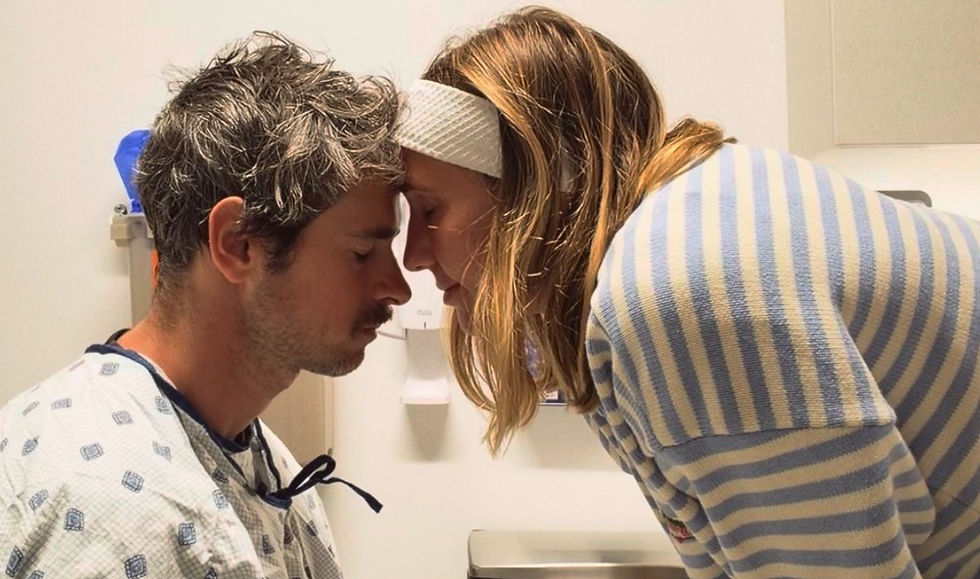
It is a Tuesday morning. I am crouched over my husband's groin with my reading glasses on, forensically examining the surgical stitches covering his penis. We have been married for nine months. My mother-in-law is leaning over my shoulder, she wants a better look too. Joel shuts his eyes. He does not flinch. "Looking good," I say, and I mean every word. This is what our first year of marriage looked like. It is the best thing that ever happened to us.
The man who lied about being 6 feet on Tinder
Joel and I met on a dating app in Sydney a decade ago. He lied about being six feet tall on his profile. On one of our very first dates, though, he told me the truth about something considerably more significant: he had been born with a condition called hypospadias, a urological condition in which the urethra does not sit where it should.
Multiple surgeries as a child had given him a functional life, but they had not held. By his late twenties, scar tissue had begun narrowing his urethra again, making it increasingly difficult to urinate. The childhood surgeries had failed.
What is hypospadias and why most men suffer in silence
For the next seven years, Joel sought eight different medical opinions. Some recommended reconstructive surgery, others urged him to wait. A full urethroplasty, a complete reconstruction of the urethra, was the only permanent solution. But with almost no surgeons experienced in complex cases, and almost no one publicly sharing what success and recovery looked like, he spent years feeling alone with his issue and postponing the inevitable.
Eight years of friendship before we became us
Although our romance did not take off in those early years, our friendship deepened. We regularly spoke from opposite sides of the world. In 2019, even though we had not seen each other in five years, I was the first person Joel called from a car park after an upsetting doctor's appointment. I did not think much of it at the time. In retrospect, it tells you everything about what we were to each other.
It was not until 2023, when I found myself single and completed a writing exercise describing the qualities I wanted in a partner, that I had a startling realization. I was not describing some imaginary future husband. I was describing Joel. We reunited in Los Angeles and fell back in love almost instantly. We married in June 2025 on a tiny Swedish island. Five months after our wedding, the surgery began.
What a sexless marriage actually looks like: From the inside
Conventional wisdom says a sexless marriage spells trouble. By that logic, Joel and I should have spent our first year bickering over the dishwasher.
Instead, we have never felt closer. We train together at the gym, tackle escape rooms, dance in the kitchen while making dinner. We kiss and cuddle with no expectation that it needs to lead anywhere else. If we are intimate, it is focused on my pleasure, which, I joke, has its perks. We have learned, through necessity, that penetrative sex is not the only way to have a fulfilling intimate life. There are more ways to be close to someone than the ones we typically default to when they are available.
But I want to be honest, because the honest version is more useful than the tidy one. This year has also genuinely been one of the most demanding of both of our lives. Joel has been through surgery, pain, fear, and the particular kind of loss that comes with having something taken from you, however temporarily, that is tied to identity, intimacy, and manhood. Because of the shame and silence that surround conditions like hypospadias, he spent years feeling completely alone in this experience. Until recently, he had never met another man who had it. He has since started an online support group, and hundreds of men have reached out to share stories they had never told anyone.
I have been his primary support through all of it, while building a business, navigating painstakingly slow visa processes, living out of a suitcase across three continents, and trying to process my own experience of a year neither of us chose. No version of this is easy. That's exactly why I want to talk about what made it navigable.
What chronic stress does to a relationship
Because of the work I do as a nervous system specialist, Joel and I spent more than two years before the surgery preparing, not just practically, but physiologically. Sleep, nutrition, breathwork, stress regulation. Not because any of it could change the surgery itself, but because it meant Joel went into it calmer, stronger, and more resilient than he would otherwise have been.
The window of tolerance and what happens when sustained stress narrows it
His nervous system was regulated enough to face something genuinely frightening without being completely destabilised by it. That groundwork has mattered more than I can adequately explain during the recovery itself. Here is why. When your nervous system is under sustained load, when cortisol has been elevated for weeks or months, when sleep is disrupted, when there is ongoing physical and emotional stress, your window of tolerance narrows.
Things you could previously absorb without reacting now land differently. Small irritations become arguments. Silences become loaded. The person you love most becomes, in certain moments, the person you are least patient with. This is not a character flaw.
Co-regulation: Why your partner's nervous system directly affects yours
It is physiology. It compounds, because nervous systems are contagious. This is what we call co-regulation: when one person in a relationship is dysregulated, the other person's system picks it up.
Two chronically activated nervous systems in a small space during a surgical recovery is not a formula for connection. It is a formula for two people who love each other saying things they do not mean and having to find their way back.
The most regulated person in the room has the most influence. I have come back to that sentence more times than I can count this year. Choosing, as often as possible, to be the one who responds rather than reacts, who comes back rather than escalates, is not suppressing your own experience. It is what makes the relationship a safe place when everything outside it is not.
Real teamwork is not always 50/50. This year it has sometimes been 80/20, occasionally 90/10. The capacity to carry more when your partner cannot, without resentment calcifying into the load, requires a regulated nervous system underneath the relationship. Without it, the imbalance becomes the story. With it, it is just a season.
What this year has actually taught us about marriage
It was not a surgeon who ultimately convinced Joel to have this surgery. It was our relationship, and knowing that whatever happened afterward, we would face it together. That is worth naming, because it speaks to the thing I believe matters most in a partnership: safety. Not romance. Not chemistry. The deep, cellular experience of knowing that this person is not going anywhere.
Judge your relationship by how you treat each other when things are hard, not when things are easy. Everyone has a good relationship when things are easy. The question is what you find when the ease is gone. What we have found this year, in its least glamorous, least Instagram-friendly moments, is that we genuinely like each other. We make each other laugh. We still choose each other every morning, including the mornings when choosing is a conscious decision rather than an effortless one.
This was not the first year of marriage I had imagined. It was something better, it was the year I learned what marriage actually is. Not candlelit dinners or honeymoon stages. Being in a king-sized bed at 9 am with reading glasses on, looking at surgical stitches covering a graft on a penis, and saying 'looking good' and meaning every word.
What nervous system regulation looks like when life is actually hard
Living through the hardest season of my own life has made the value of this work impossible to overstate. A regulated nervous system does not mean the hard things stop being hard. It means you have something to come back to when they are. That is the difference. I have never been more certain that it matters.
This work is available to you
If you want to become the most regulated person in the room and stay steady even when things are hard, I am opening two small cohorts: one for my Swedish community and one for my English-speaking community across the US, Canada, and Australia. Small groups, real support, a structured plan, and accountability across three months. This is not a course you do alone. This is a group of women moving through the work together, with me alongside them the whole way.
Swedish cohort starts on September 29: Apply here!
English cohort (US/Canada/Australia) starts on October 3: Apply here!
Both are by application only. Enroll before September 15 for an early bird discount. Learn more about the framework and programme here. You can follow Joel's and my journey on Instagram.
Visit my website for more info!
Read more from Lovisa Engstrand
Lovisa Engstrand, Nervous System & Stress Specialist
Lovisa Engstrand is a Nervous System & Stress Specialist and breathwork practitioner working at the intersection of psychology, physiology, and behaviour change. She specialises in helping high-functioning women who feel exhausted, overstimulated, anxious, or stuck in survival mode. Her work is grounded in her own lived experience of training, eating well, and still waking up anxious, bloated, and depleted - until she understood her nervous system. Through her Regulate & Restore Framework, Lovisa addresses stress regulation, sleep, movement, nutrition, and identity to help women rebuild capacity from the body up. She lives between Australia, Sweden, Canada, and the USA and works with clients globally through 1:1 containers & online programs.
Please note: This article reflects personal experience and is for informational purposes only. It is not a substitute for medical or psychological professional support. Hypospadias and urethroplasty are complex medical conditions - if you or someone you know is affected, please seek guidance from a qualified urologist.
Related articles: