Being Competitive Isn’t Enough and What Motor Racing Taught Me About Business
Steve O’Brien is CEO and director of SEO at Woya Digital and founder of Fleet Street News. With 20 years of experience in search engine optimisation (SEO) and digital marketing, he helps businesses build authority, trust and visibility across Google, AI search platforms and the wider digital ecosystem.

I have always enjoyed competition. Give me something to aim for, someone to measure myself against and an opportunity to improve, and I am interested. That instinct has shaped my working life. It also took me into motorsport, where I discovered that wanting to win is something almost everyone brings with them. What separates people is how they prepare, how they work with others and the decisions they make when things stop going to plan.
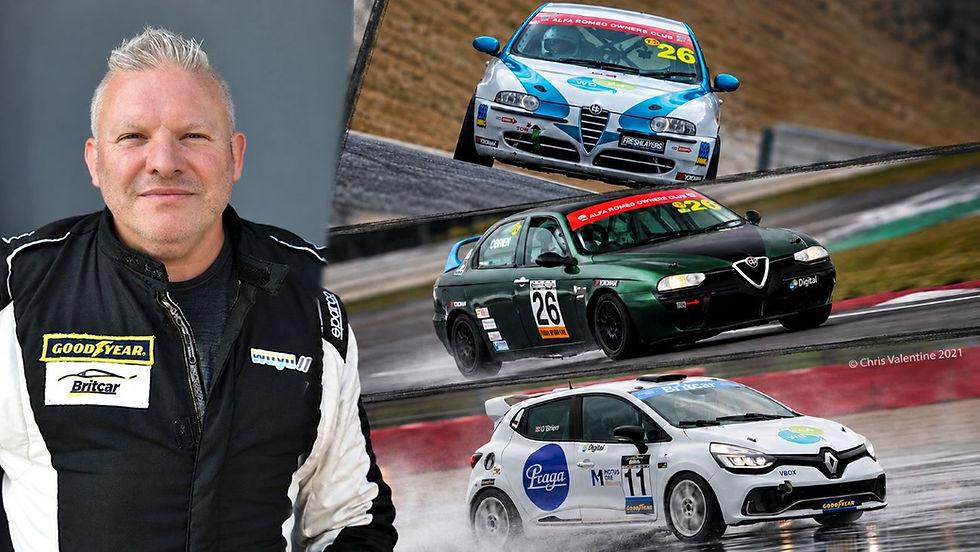
My racing started in my twenties with the RAC Endurance Championship, a European karting championship for teams with races lasting up to 24 hours. Later, I moved into car racing around the United Kingdom (UK), competing in the Alfa Romeo Championship and Britcar Trophy. I raced Alfa Romeo 147s and 156s, followed by a Clio Cup car in Britcar, at circuits including Silverstone, Brands Hatch and Donington Park.
These were different experiences. Endurance karting demanded a shared effort over many hours. Car racing brought its own technical, physical and mental challenges. Both gave me friendships, memorable weekends and an intense escape from the demands of work.
My involvement extended beyond driving. Woya supported the Alfa Romeo Championship and later worked as its official marketing team.
Our motorsport work also included a marketing partnership with TCR UK, a touring car racing championship, plus sponsorship of and exposure to the British Touring Car Championship (BTCC) race team Team Hard, with both Jake Hill and Bobby Thompson as drivers. Those racing and sponsorship experiences fuelled the fire but taught me lessons that have stayed with me as a business owner.
Everyone wants to win, but preparation makes the difference
At a race meeting, you are surrounded by people who want to perform well. They have committed time, money and energy to being there. Your desire to succeed gives you very little advantage on its own. You still need to arrive prepared.
That becomes particularly clear when a team is taking on an endurance race. With races lasting up to 24 hours, there is much more to consider than how quickly one person can drive. The team needs to organise itself, look after its equipment and sustain its effort.
Business ambitions require the same attention to what will make them achievable. Growth targets are easy to write down. Building the capacity to deliver them takes more thought. Do you have the right people? Does everyone understand the work? Can the business maintain its standards as demand increases?
I have worked in search engine optimisation (SEO) since 2006, and I have seen businesses invest heavily in attracting customers while leaving problems in the customer journey unresolved. More visibility has limited value if people cannot easily enquire, or if the service struggles once they do.
The preparation can feel less exciting than chasing the next opportunity. It is also what gives you a realistic chance of making that opportunity count.
Your performance is part of a team effort
Team endurance karting gave me an early appreciation of shared responsibility. In a long race, your contribution sits alongside everyone else’s. Other people take over the driving. Decisions and mistakes can affect teammates who have put just as much into the event as you have. It gives you a practical reason to think beyond your own performance.
Car racing reinforces that dependence in a different way. The driver is visible, but preparation, mechanical expertise, organisation and support all contribute to what happens on the circuit.
Running an agency has made that lesson increasingly relevant. A prospective client may first encounter Woya Digital through me, an article I have written, a podcast appearance or a conversation we have had. Their ongoing experience then depends on the wider team, from research and technical work to content, account management and reporting.
My responsibility includes giving those people the clarity and support to do their jobs well. Personal ambition only takes the company so far. The business needs a shared understanding of what good delivery looks like.
That is one reason we developed The Woya Way, our proprietary SEO 2.0 methodology behind every Woya Digital package. It connects the different parts of our work and provides a common framework for delivery, training and quality assurance. The team needs to understand how its individual contributions support the client’s overall objective.
You improve faster when you can admit what needs work
Competition can be uncomfortable because it exposes the gap between how well you hoped to perform and what actually happened. There are always external factors. Equipment, conditions and other competitors can all influence a race. Sometimes they determine the outcome.
Even so, you need to be willing to examine your own contribution. If every disappointing result becomes someone else’s fault, you leave yourself very little room to improve.
I think this is particularly relevant to founders. We put so much of ourselves into our businesses that questioning a process or decision can feel personal.
Experience can make that harder. When something has worked for years, it is tempting to assume it should keep working.
Rebuilding parts of Woya has meant looking closely at how we describe, sell and deliver our services. Some knowledge needed to be documented more clearly. Some decisions needed to be standardised. Other areas needed room for specialist judgement. That process requires honesty about where the business can improve, even when you are proud of what you have already built.
Consistency matters more than one impressive moment
There is something especially revealing about a competition that continues for hours. A strong individual performance is valuable, but the team still needs to sustain its effort. Concentration, reliability and sensible decisions keep mattering long after the initial excitement has worn off.
Clients experience a business in much the same way. A good pitch creates an expectation. The months that follow show whether you can meet it. Clients notice whether communication stays clear, whether agreed work happens and whether the quality remains dependable.
That thinking has influenced how we have productised Woya. Defining packages requires us to be specific about scope, deliverables and support. The Woya Way sets out how the work is approached, while the package defines what the client buys.
It also makes us think carefully about capacity. A service needs to be deliverable consistently by the team responsible for it. That means being clear about boundaries as well as possibilities. The aim is to give clients a more understandable service and the team a dependable structure within which to apply its expertise.
Competitors are useful reference points
Being competitive naturally makes you interested in what other people are doing. That can help you learn, spot weaknesses and raise your standards.
It can also become a distraction. In business, a competitor launches a service, appears in a publication or starts talking about a new technology, and there is an immediate temptation to follow. Before reacting, you need to consider whether it makes sense for your own customers and commercial objectives.
Their budget may be different. Their business model may be different. You may be seeing a small part of a strategy whose results are still unknown.
This is particularly relevant in SEO and artificial intelligence (AI) search, where there is a constant supply of new tactics and confident predictions. Staying informed is part of the job. Choosing which developments deserve action requires judgement.
I want to understand the competition, but I also need to know why we are making our own decisions. Otherwise, someone else ends up setting the direction of the business.
Stepping away can be a considered decision
My car racing ended after a substantial rollover in the Clio at Donington Park in 2022, just before Coppice corner. After recovering, I decided to stop competing and focus on work and spectating. I still miss it and I am a terrible spectator.
That was a personal decision following a serious incident. It also made me reflect on how difficult changing direction can be when an activity has become part of your identity.
There is always another event you could enter. There is always the time, money and effort you have already invested.
Business owners face their own versions of that attachment. A service, project or way of working can become difficult to reconsider because of everything that has gone into it.
Persistence is valuable, but it needs to remain open to judgement. Sometimes you should continue and work through the difficulty. Sometimes the better decision is to change your approach or put your energy elsewhere. Being competitive does not remove the need to make that choice carefully.
What I brought back to business
Motorsport gave me an outlet for my competitive instinct, but it also placed demands on it. I had to prepare, contribute to a team and accept that enthusiasm alone would never be enough.
Those lessons remain useful as I develop Woya Digital and the digital public relations (PR) platform, Fleet Street News. Clearer packages, a documented methodology and shared standards are practical ways of helping a team perform consistently.
I still enjoy having ambitious goals. I also have a greater appreciation of the work required to make them achievable, and of the people whose contributions make progress possible.
Some of my strongest memories of racing are about the experience itself: the concentration, the friendships and the pleasure of doing something challenging. The business lesson I keep returning to is how much depends on what you do before the moment when everyone is watching.
Read more from Steve O'Brien
Steve O’Brien, CEO & Director of SEO at Woya Digital
Steve O’Brien is CEO and director of SEO at Woya Digital and founder of Fleet Street News. With 20 years of experience in search engine optimisation (SEO) and digital marketing, he has worked through major shifts in search, from early algorithm updates and local SEO to digital PR and AI-driven discovery. Steve helps businesses build online authority, improve visibility and strengthen trust across Google, AI platforms, media coverage and the wider digital ecosystem. His writing explores SEO, AI optimisation, digital PR, reputation signals and how businesses can adapt as the way people search, compare and choose brands continues to change. His mission is to help businesses become more visible, more trusted and better positioned for growth in the AI era.