

AI Can Plan Your Perfect Week, But is It the Week You Want?
Written by Carmel Shami, Holistic Time Management Mentor
Carmel is a time management mentor, author, and former social worker who helps overwhelmed professionals and individuals with demanding lives break free from burnout and constant overload. Using a holistic productivity and time management framework, she helps them regain clarity, balance, control, and live intentionally.

AI can organize your calendar, manage your priorities, and make your week look perfectly productive. But what happens when the perfect schedule doesn't feel like the right life? I did what everyone seems to be doing lately. I asked AI to build my ideal week. It scheduled my deep work, organized my errands, and color-coded my priorities. Everything looked beautifully planned, and I was genuinely excited to see how much easier my week would feel.
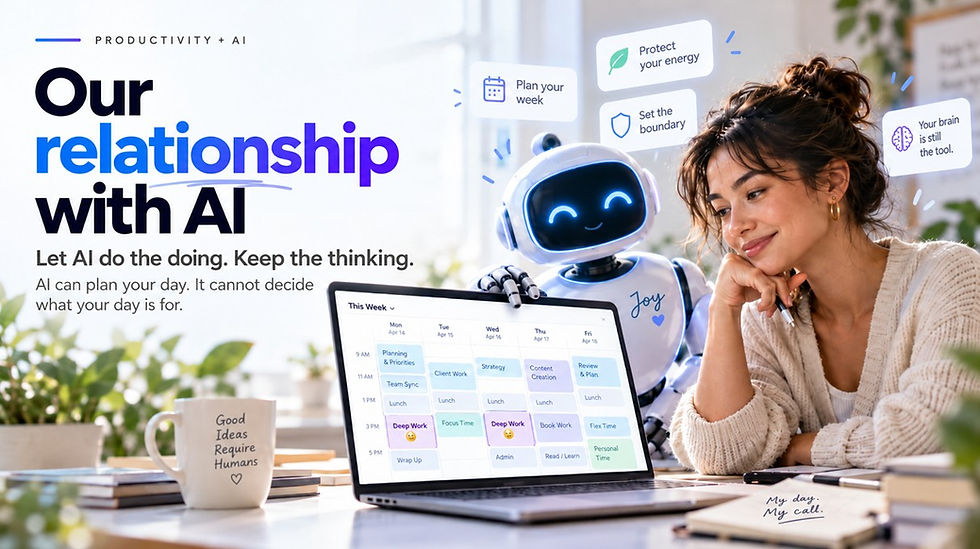
But by Wednesday, I was more scattered than before I started. I was following the schedule, moving between tasks, and getting things done, yet somehow I felt less in control of my time.
The plan looked perfect on paper, but living it was a different experience. I am beginning to think this is happening to more of us than we realize.
New research from the ActivTrak Productivity Lab, released on October 29, 2026, examined the digital work patterns of 9,140 knowledge workers. The findings showed that AI users had workdays up to 90 minutes longer than non-users, while heavy users switched between applications approximately 15 percent more often and experienced shorter periods of uninterrupted focus.
The research does not prove that AI causes longer workdays, but it raises an interesting question. If we now have technology that can help us complete so many things faster, why are we not necessarily feeling less busy?
The efficiency paradox
AI is incredibly useful at handling tasks. It can write a draft, organize information, plan a project, and build a schedule in seconds. Naturally, we expect that when these things take less time, we will have more time available for ourselves. But I have noticed something interesting, both in my own life and in my work with overwhelmed professionals. When people find ways to complete tasks faster, they often use the extra space to take on even more.
An hour opens up in the calendar, and another meeting finds its way in. We finish emails more quickly, so we respond to more of them. We become more efficient at managing our responsibilities without questioning whether all those responsibilities should be there in the first place.
Of course, AI can genuinely save time. A 2025 study published by the National Bureau of Economic Research found that workers using a generative AI tool spent less time on email and reduced some of their after-hours work. There are real benefits to using these tools, and I experience them myself. But saving time and experiencing more freedom are not necessarily the same thing.
I think this is where we need to rethink our relationship with productivity. We have become so focused on how quickly we can accomplish things that we sometimes forget to ask whether those things deserve our time at all.
2 decisions that still belong to you
I use AI regularly in my own work, and I appreciate how much it helps me. It supports my research, helps me organize ideas, and takes care of tasks that would otherwise consume valuable time. But the more I use it, the more I realize there are two decisions I need to remain actively involved in.
The first is deciding what my time is actually for. Before I plan my week, I need to understand what matters most to me right now. Sometimes that means making progress on an important project, while other weeks it means being more available for my family, taking care of my health, or creating some breathing room after a demanding period.
These priorities do not always appear on a task list, and they are not necessarily the things that look most urgent. Yet they are often the things that make a week feel meaningful.
The second decision is knowing what is enough. AI can help us discover more efficient ways to organize our days, and it can suggest additional tasks that fit into the available time. But just because another task fits into the calendar does not mean it belongs there.
This is where boundaries become such an important part of time management. We need to decide when the workday ends, what we are willing to commit to, and what needs to wait, even when there is technically enough time to squeeze something else in.
I also recognize that not everyone has complete control over their schedule. Work demands, family responsibilities, and organizational expectations can make boundaries difficult to maintain. But even within those limitations, becoming more aware of what we need and communicating those needs where possible is an important place to begin.
AI may know your patterns, but does it know your priorities?
You might be thinking that AI already knows quite a lot about you. It can learn your habits, recognize your routines, and analyze how you typically spend your time. With enough information, it can even suggest a schedule that closely matches your usual behavior. But there is an important difference between knowing how someone spends their time and understanding how they actually want to spend it.
AI might recognize that you regularly answer emails at night, but that does not mean you want your evenings to revolve around work. It might notice that you rarely take breaks or that you consistently put your own needs last, without knowing whether these habits reflect your values or simply the demands you have become accustomed to. Sometimes we do not even recognize these patterns ourselves until we stop and reflect on them.
This is why I believe awareness needs to come before strategy. Before we try to make our routines more efficient, we need to ask whether those routines are supporting the life we want to live.
AI can absolutely help us explore those questions, especially when we share our priorities and values with it. But the answers should come from our own reflection, not simply from the patterns a tool has identified. Because our habits are not always a reflection of our priorities. Sometimes they are simply a reflection of what we have been trying to keep up with.
Your best hours deserve your most meaningful work
Another important part of time management that is easy to overlook is our energy. We often plan our days as though every hour has the same value, but anyone who has tried to do demanding work when they are mentally exhausted knows that this is not true.
There are times during the day when our minds feel clearer and we can think, create, solve problems, and make decisions with greater ease. There are other times when we have much less capacity, and even relatively simple tasks require more effort.
I learned this about myself a long time ago, yet AI once scheduled my deep work for 3 p.m., which is exactly when my brain tends to lose its sharpness. From a scheduling perspective, the time slot was perfectly logical. It was available, uninterrupted, and long enough for the task. But it was not the right time for me.
That experience reminded me that a well-organized schedule is not necessarily a schedule that works for the person living it.
When we understand our energy patterns, we can make more intentional decisions about where different kinds of work belong. Our clearest hours can be protected for the tasks that require real thought and attention, while routine activities can be placed at times when our energy is naturally lower.
Of course, our energy does not always follow a predictable pattern. A difficult conversation, a poor night of sleep, a stressful family situation, or simply an emotionally demanding day can change what we are capable of doing.
This is why a calendar needs to leave room for human reality, rather than becoming a rigid set of expectations we feel obligated to meet.
The schedule is a draft, not a contract
One of the things I encourage people to remember is that a schedule is supposed to support their lives, not control them.
When AI creates a plan, it can be a wonderful starting point. It can organize the logistics, identify available time, and help us see how our commitments fit together. But we still need to look at that plan through the lens of our values, our energy, and what is happening in our lives.
Sometimes a task needs to move because we are not mentally ready for it. Sometimes an appointment needs to be reconsidered because the day has become too full. Sometimes we need to leave space in the calendar without immediately finding something productive to put there.
I think many of us have become uncomfortable with that empty space. We see an available hour and assume it is an opportunity to accomplish something else, when perhaps what we really need is a little time to recover, reflect, or connect with someone we love.
Rest should not have to wait until every task is completed, because there will almost always be something else that needs our attention. Learning when to stop is just as important as learning how to plan.
3 questions to ask before AI plans your week
In my work with overwhelmed professionals, I often meet people who are already very capable of getting things done. They know how to work hard, manage responsibilities, and solve problems. What they struggle with is deciding what deserves their limited time and energy when everything feels important.
This is why I encourage people to spend a few minutes reflecting before they begin organizing their week.
First, what matters most to me this week? Instead of starting with every task that needs to be completed, identify one or two things that would make the week feel meaningful. That might be progress on a project, time with your children, attention to your health, or simply having a little more room to breathe.
Second, when do I have the energy to give those things my best attention? Think about the times of day when you naturally feel more focused and capable, and consider how you can protect some of that time for what matters most. Even small adjustments can help you work with your energy rather than constantly pushing against it.
Third, what do I need to protect or say no to? This might mean leaving an evening free, reducing unnecessary meetings, postponing something that is not urgent, or deciding when work will end. Boundaries are not simply about limiting what we do. They help us make room for the things we have consciously chosen.
Once you have answered these questions, AI can become a much more useful planning partner. Instead of asking it to fit as much as possible into your week, you can ask it to build a realistic schedule around the priorities, energy patterns, and boundaries you have identified.
The difference may seem small, but it changes who is making the decisions.
A relationship, not a shortcut
I am not against AI, and I certainly do not believe we should avoid using tools that can make our lives easier. I use AI myself, and I think it offers wonderful opportunities to reduce unnecessary work and create better systems. But I also believe we need to be careful not to confuse having a more efficient system with living a more intentional life.
Time management, at least the way I see it, has never been just about getting more done. It is about understanding what matters to us, recognizing our limits, managing our energy, and making choices that reflect the life we want to live.
These are skills we can develop, and technology can support us in practicing them. But it cannot make those personal decisions on our behalf.
So the next time AI presents you with a beautifully organized week, take a moment to look beyond how well everything fits.
Ask yourself whether the schedule reflects what matters to you, whether it respects your energy, and whether it leaves space for the people and experiences that make your life meaningful. Because the goal is not to create a perfect week on paper. It is to create a week that feels right for the person living it.
AI can help you manage your time. But the life you want to make time for is still yours to choose.
Read more from Carmel Shami
Carmel Shami, Holistic Time Management Mentor
Carmel is a time management expert who helps people rebuild clarity and balance in demanding lives. She is the founder of It’s About Time, a holistic productivity practice rooted in mindset, structure, and energy management. Drawing on her years of work with the elderly and families facing grief, she developed an approach that considers the whole person, not just their schedule. Witnessing how often people reach the end of life with unspoken regrets shaped her mission to help others choose intentionally how they live. As she often reminds her clients, no one dies finished. Choose what matters.
References:







