

7 Questions to Ask Before Regenerative Medicine Treatment
Kathleen Legaspi is an Enterpreneur, Published Author, and regenerative medicine educator with 17 years of experience in the Medical Industry, spanning executive leadership, professional education, and patient engagement. Through her writing, she hopes to bring education, clarity, and the importance of distinguishing scientific evidence.

Regenerative medicine is changing the conversation around chronic disease, aging, and long-term health. But how can patients tell promising scientific advances apart from treatments that have not yet been proven safe or effective?
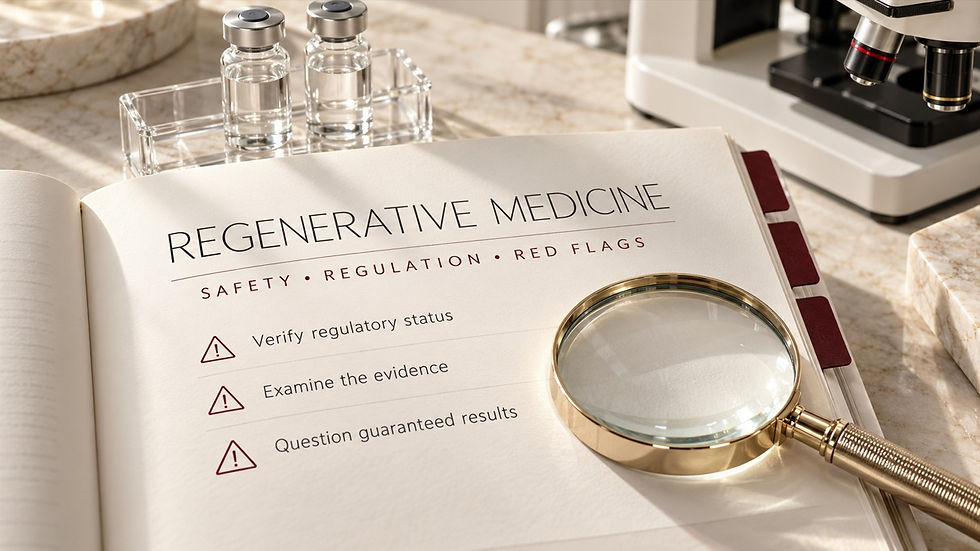
After 17 years in the regenerative medicine industry, I believe the most important conversation is not only about what these therapies may accomplish. It is about how patients can make informed decisions. Here are seven essential questions every patient should ask before considering treatment, along with the red flags I tell everyone to watch for.
What regenerative medicine is, and what it is not
Regenerative medicine is an evolving field that investigates ways to repair, replace, restore, or support the function of damaged cells, tissues, and organs. Researchers are exploring stem cells, tissue engineering, cellular therapies, and cell-derived biological materials.
Some established therapies, including certain blood-forming stem cell transplants, already play important roles in treating specific conditions. Many other applications remain experimental. Researchers are studying whether some approaches may help preserve tissue function, reduce symptoms, or slow the progression of particular diseases, but those outcomes have not been demonstrated for many commercially marketed treatments.
Slowing disease progression is not the same as reversing disease, and feeling better does not necessarily mean underlying tissue damage has been repaired.
Why patient safety matters more than ever
As the field attracts more attention, patients are seeing more advertisements for stem cell procedures, exosome products, and other biological interventions. Some describe treatments as revolutionary or promise benefits across unrelated conditions.
A treatment can show encouraging results in the laboratory without producing the same results in people. A small, promising study may still need years of investigation before its effectiveness and long-term safety are known. One principle continues to guide my work: medical innovation should never move faster than our responsibility to educate and protect patients.
7 essential safety questions to ask before treatment
Is the treatment FDA-approved for my condition? Not every procedure marketed as regenerative medicine has undergone Food and Drug Administration (FDA) review for safety and effectiveness. FDA establishment registration does not mean every treatment a clinic offers is FDA-approved, and some procedures are regulated differently depending on how biological materials are collected, processed, and administered. Ask the provider to explain the regulatory status and document any claim of approval.
What scientific evidence supports the treatment? Ask whether the treatment has been evaluated in human clinical trials, whether those studies used appropriate comparison groups, and whether the results were published in peer-reviewed journals. Testimonials do not establish effectiveness. ClinicalTrials.gov lists registered studies, but registration does not mean FDA approval or proven success.
Who is performing the procedure? Verify the physician’s license, relevant training, and experience. Ask who performs and supervises the procedure, who handles complications, and whether the facility has appropriate emergency capabilities. A responsible provider welcomes these questions.
Where do the stem cells or biological products come from? Ask about donor screening, manufacturing, testing, storage, and handling. Products marketed as stem cells or exosomes can differ greatly in composition and biological activity, so never assume that similarly named products are equivalent.
What are the potential risks and complications? Depending on the intervention, risks may include infection, inflammation, immune reactions, tissue injury, and other serious complications. Ask about known risks, what remains uncertain about long-term safety, and the plan for managing adverse events. Guaranteed outcomes or claims of zero risk warrant caution.
Can this treatment actually slow disease progression? A treatment may temporarily improve symptoms without changing the course of a disease. Claims that a therapy slows progression require reliable measures, comparison groups, and sufficient follow-up. Ask for evidence that applies to your specific condition.
What happens after the procedure? Ask about follow-up visits, monitoring, how complications will be managed, and whether you will receive complete medical records, including the exact products administered. This is especially important if you travel internationally for treatment.
Here are the 6 red flags to investigate before a stem cell procedure:
Red flag 1: The clinic cannot verify its laboratory or product source
Ask the clinic to identify the laboratory or manufacturer supplying the product. Where FDA establishment registration applies, verify it independently and search for FDA warning letters or enforcement actions. Registration does not equal approval, and the absence of warning letters does not prove safety or compliance.
My guidance: Verify the laboratory yourself and understand what its registration does and does not mean.
Red flag 2: The provider will not supply a Certificate of Analysis
For manufacturer-supplied biological products, request the Certificate of Analysis (COA) or lot-specific quality documentation. Confirm that it matches the exact product and lot and includes appropriate identity, sterility, and endotoxin testing. A COA does not establish FDA approval or clinical effectiveness.
My guidance: If the clinic cannot explain where a product came from or how it was tested, get more information before proceeding.
Red flag 3: The clinic promises a cure or guaranteed results
Be cautious of promises of complete healing, disease cures, tissue regeneration, or guaranteed recovery. Early research cannot establish those outcomes for a marketed treatment.
My guidance: Medical credibility comes from evidence, not promises.
Red flag 4: The clinic claims a clinical trial but cannot provide data
Ask for the National Clinical Trial (NCT) number and look up the study on ClinicalTrials.gov, including its sponsor, locations, status, and eligibility. If the clinic claims positive results, ask for published or publicly reported outcomes and safety findings. Legitimate ongoing trials may not have results yet, and a clinic should say so.
My guidance: Ask for the evidence behind claimed results, not just a registration number.
Red flag 5: The clinic pressures you or discourages second opinions
Watch for high-pressure sales tactics, unrealistic guarantees, demands for large nonrefundable payments before a proper consultation, or resistance to an independent medical opinion.
My guidance: Treatment decisions should be based on informed consent, not urgency.
Red flag 6: The clinic cannot document an active IND when one is required
In the United States, investigational stem cell and other biological drug products generally require an Investigational New Drug (IND) application to be in effect before they are administered in a clinical investigation, unless an exemption applies. Not every regenerative procedure requires an IND. Some approved therapies and qualifying human cell or tissue procedures follow other pathways.
An IND allows a regulated clinical investigation to proceed. It does not establish FDA approval, safety, or effectiveness, and it does not permit unrestricted commercial marketing of an unapproved product.
My guidance: Ask whether an IND is required for your specific treatment. Where it is, request the IND number and FDA acknowledgment, and confirm that the physician, product, and proposed use are covered. Some FDA correspondence is confidential, but a clinic should still be able to substantiate its regulatory claims.
Are stem cell and exosome therapies safe?
Stem cells are being investigated for roles in tissue repair, immune regulation, and the treatment of specific diseases. Exosomes are extracellular vesicles involved in cellular communication and are also being studied for therapeutic use. Safety and effectiveness depend on the product, the condition, and how it is administered.
The FDA has warned consumers about unapproved regenerative medicine products marketed for orthopedic, neurological, and other conditions and has stated that no exosome products have received FDA approval. These warnings underscore why patients must distinguish established care from experimental therapy.
Considering treatment abroad
Patients often travel internationally for therapies that are unavailable, restricted, or more expensive at home. Regulations vary by country. Verify physician credentials, facility licensing, product sourcing, infection control standards, and regulatory status, and arrange follow-up with a qualified clinician at home. A treatment being legal elsewhere does not prove it is safe or effective.
Informed consent must come before treatment
Informed consent is more than a signature. You should understand the proposed intervention, potential benefits, known risks, scientific uncertainties, reasonable alternatives, and costs. Patients living with chronic or progressive disease deserve compassion and accurate information, not exaggerated promises. Education should always come before persuasion.
The future depends on responsible innovation
I remain optimistic about advances in cell biology, tissue engineering, biomaterials, and clinical research. Some future therapies may help preserve function, improve quality of life, or slow the progression of specific conditions. But optimism must stay grounded in evidence. The credibility of this field depends on responsible research, ethical practice, regulatory compliance, and honest communication.
Before committing to any procedure, ask questions. Verify the laboratory. Request product documentation. Review the clinical evidence. Understand the risks. Consider an independent medical opinion, and never allow promises to replace science.
The greatest achievement of regenerative medicine will not simply be discovering what science makes possible. It will be ensuring those possibilities reach patients responsibly and ethically, with safety as the highest priority.
Read more from Kathleen Legaspi
Kathleen Legaspi, Author, Business Strategist & Wellness Entrepreneur
Kathleen Legaspi is an entrepreneur, published author, and regenerative medicine educator with 17 years of industry experience. Her background spans executive leadership, professional education, and patient engagement. She writes about regenerative medicine, peptides, wellness, beauty, and patient safety, making complex subjects accessible to readers. Her work explores treatment risks, informed consent, and the importance of distinguishing scientific evidence from marketing promises. Through her writing, Kathleen encourages readers to ask thoughtful questions and make informed decisions about their health.
References:
Disclaimer: This article is intended for educational purposes and does not constitute individualized medical advice. Patients should consult appropriately licensed healthcare professionals before making treatment decisions.







