Your Holiday Has Been Optimised – Try Getting Lost
Written by Babak Fakhamzadeh, Guest Writer
Imagine arriving in, say, Lisbon for a long weekend. You have done your research. Your phone has found a cute small café, tucked down a side street, where you can, you believe, experience the city just like a local.
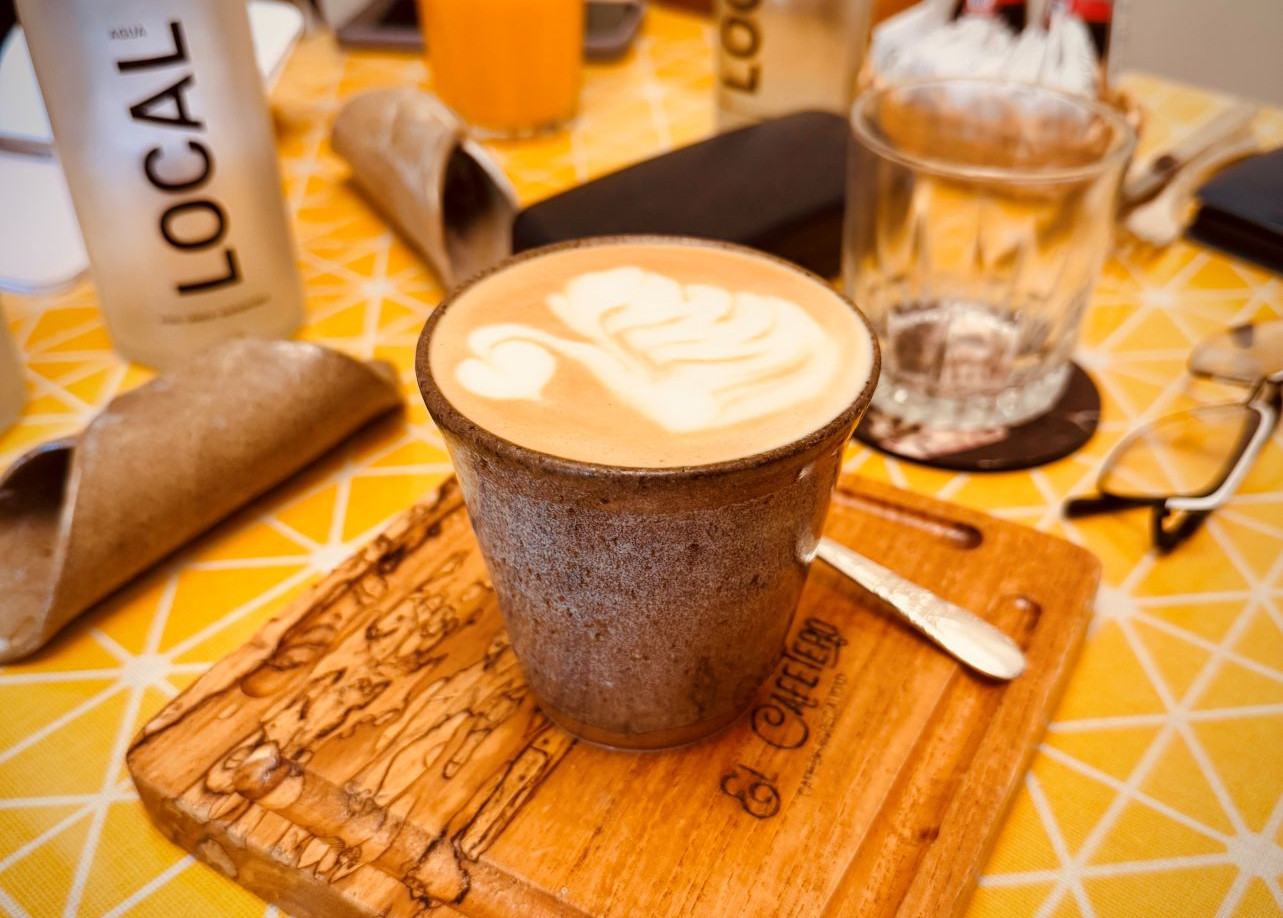
You arrive, and find that there is a queue outside. The queue is mostly foreigners like yourself, and everyone appears to have received the same advice.
Not discouraged, you join the line and, when you make it to the front of the queue, order the coffee and pastry you saw in the online feed you had scrutinised, then take a photograph of your own.
Later, your preferred app for navigating the city directs you to a viewpoint where you wait for a gap between other visitors to capture the impression of having the place to yourself.
Nothing has gone wrong: the coffee and pastry are good; the view is beautiful. Yet your carefully researched escape has begun to feel strangely familiar. You wanted to discover something different, something new. Instead, you are only confirming that your experience looks pretty much the same as it does in the pictures.
Everyone gets a different version of the same holiday
In Strategies for Subverting the Tyranny of the Corporate Map, I explored how digital travel tools funnel us towards similar experiences; ask similar questions in similar circumstances and the same highly visible places keep appearing. The map even supplies the always identical route between them.
Personalisation promises a way out. Tell a system that you prefer architecture to shopping, quiet streets to nightlife, and it can, at least in theory, assemble a trip that feels more specifically yours. Generative AI can go further, explaining a neighbourhood in the language of your interests.
But a personalised account of a place is still built from whatever information the system can access. Many apparently different services depend on overlapping mapping databases, business listings, and online accounts of local history. A fancy new interface does not automatically unlock new sources, or a different understanding of what matters.
Consider an old warehouse. Its conversion into a boutique hotel may be well documented, reviewed and photographed. The workers who once organised there might survive in a local archive, a family story, or a language poorly represented online. Asking an AI for an unusual perspective cannot reliably recover what its sources leave out. Yet, it might still produce a convincing story, based on incomplete information, without even realising its sources only cover a portion of relevant history.
Following this, I argued more recently in Walking Against the Map that we can have considerable variety on the surface while continuing to fish from the same pond of data. The personalised holiday risks becoming a private arrangement of familiar material, papering over the same gaps that reside beneath it.
Who benefits from the perfect itinerary
We might not know what we don’t know, but, when interested in going beyond the obvious, these gaps in knowledge matter, and they might matter a lot. But whether a platform has any incentive to address these gaps is another question. A missing business listing likely represents a potential commercial opportunity. On the other hand, a missing account of a neighbourhood’s labour struggles may offer little financial return, and certainly is represented by a much messier story than the opening times of a bakery.
So, a richer understanding of a place is valuable only insofar as it serves the, probably financial, objectives of the platform.
Of course, a useful service can also be profitable; I want accurate directions when I am late for a train. But when a platform earns from advertising, bookings, or keeping us on the platform, helping us encounter a place on our own terms is not its overriding obligation. You are probably aware that Google Maps sells advertising within the map itself. Commercial influence is part of the product.
Personalisation can make that influence more effective. Understanding what appeals to us helps a system decide how to sell to us. And so, I hope you’ve started to wean yourself off Facebook and TikTok.
Yet, the arrow of technological change points towards the interests of those financing it, unless we make deliberate efforts to direct this arrow elsewhere.
I see Big Tech as an heir to the mercantile capitalism of the seventeenth century, specifically the British East India Company and the Dutch East and West India Companies. These trading companies sought wealth through control over access and exchange, backed by monopolies and colonial violence, externalising cost in the service of capital gains for the few.
Today’s platforms don’t quite exercise the same kind of power. But they do organise access to markets, information and attention. And although literal slavery is, formally, outlawed, in practice the precariat in the Global North and the horrible labour conditions in parts of the Global South speak to a reality that draws parallels with past abuse of the lower classes. What remains is a comparison in the ambition to become an intermediary on which everyone else depends, with the returns flowing to those controlling the market, an elite with little care for the man-in-the-street, except as a source of labour.
And so, our holidays become another opportunity to turn that dependence into revenue. We can choose from among thousands of experiences while leaving the terms of that choice largely in someone else’s hands.
The pleasure of an unnecessary turn
Psychogeography offers ways of interrupting this arrangement. Broadly, it asks how places influence our feelings and behaviour. The Situationists, who developed the practice in the 1950s, treated the city as a place where commercial interests shaped everyday life, including how people moved through it.
Their practice of the dérive, or drift, invited people to break with familiar purposes and let the surroundings and encounters influence their route. A slope, a change in atmosphere, or simple curiosity might determine the next turn.
While on holiday, putting this into practice can be remarkably modest: you leave a free afternoon genuinely free; you notice a passageway without first checking whether anything worthwhile is at the other end; you sit somewhere because you like being there.
There is no guarantee of a revelation; you may find an ordinary street and buy an ordinary sandwich. But that is, quite exactly, the point; it’s, after all, exactly where the locals buy their ordinary sandwich, too.
It’s not the case that every turn must deliver something exceptional: we do not have to succumb to the pressure of the exclusive itinerary.
And, of course, you don’t have to take ‘getting lost’ to an extreme: you can keep the map in your pocket and use it when needed. Perhaps to get back to your apartment at the end of the day.
What you should consider suspending is the demand to know, in advance, why the next half-hour will be worth your time.
Making technology leave room for us
I build digital tools, specifically tools that function in the public space, and help, in one way or another, our understanding of what happens around us. AI, the latest hypercapitalist toy, creates a particularly awkward opportunity.
The same technology being used to automate persuasion can lower the threshold for building something with a very different purpose. Coding assistants helped me rebuild Dérive app, a tool that helps to get you lost, more quickly. Small teams can now produce tools that previously required more time, money and programming support than they could afford. Maintenance and judgement still matter, but more peculiar ideas can become usable software.
A range of walking apps illustrates the variety of experiences developers are exploring. MIX offers audio stories to walk through. Unterra reveals a covered map as you move through the world. Lore makes walking part of a murder mystery. These are different invitations to move through the built environment, even though their existence alone tells us neither how they were built nor whether they escape commercial pressures.
AI can also help adapt an experience to a person’s chosen needs. Someone might want prompts about trees, a short outing, or an exercise to share with their children. Customisation does not inherently require advertising, selling personal information or directing people towards purchases. We can build tools around an explicitly chosen purpose and collect only what that purpose needs.
Yet, a service that responds perfectly to our preferences can become another enclosure. We may encounter only what it predicts we will enjoy. And so, a more useful design leaves openings for surprise, disagreement, and other people. The technology should be able to offer a starting point and then relinquish control.
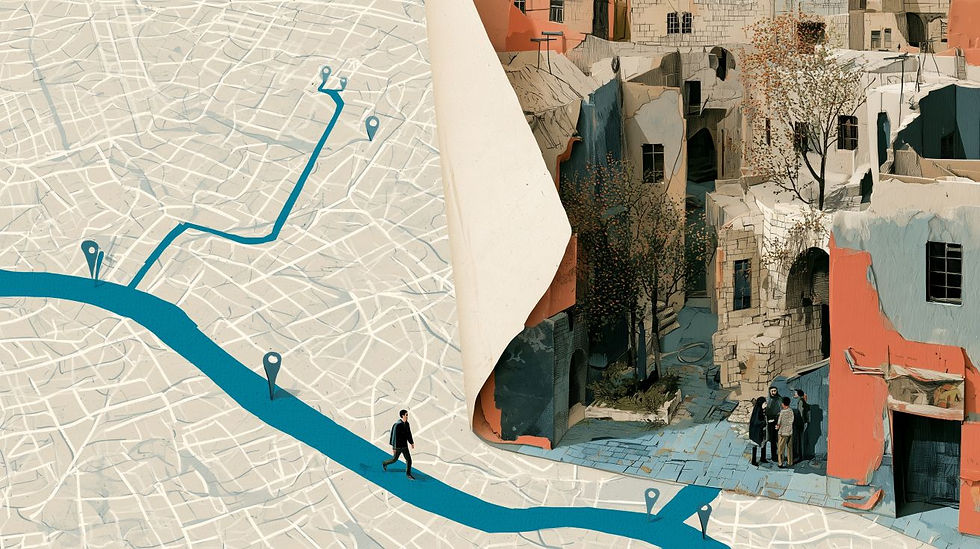
Give the afternoon a different instruction
The aforementioned Dérive app, which I first co-created back in 2012, offers loose prompts rather than a route to complete. A task might invite you to find something that reminds you of your childhood, or to follow someone wearing a hat. You decide what counts, where to look, and when the task has served its purpose. The app also offers AI-generated prompts that can take your location and interests into account.
There is a contradiction here: I am asking people to escape instructions by giving them instructions. In workshops, I have found that small groups are particularly good at loosening the app’s authority and building individual agency. One person might see childhood in a playground; another might notice a doorway like their grandmother’s. They have to discuss, and find a compromise, as to where to go next. The walk grows from their interpretations, with the prompt becoming one contribution among several.
Dérive app, and the few other apps that have come, and some gone, can be a handy framework for this different kind of experience, but you can try this on your next holiday with no app at all.
Before leaving your accommodation, write a few invitations on scraps of paper. Look for somewhere people linger without buying anything. Notice where an old use of a building remains visible. Choose a street because of something you can hear.
If you are travelling with someone, take turns choosing a prompt and interpreting it together. Let yourselves change the rules. Alone, you might follow one question for half an hour: where is there shade, and who gets to use it? A question that begins with your own comfort can lead you towards a different understanding of the city.
Keep the experiment within your access needs and ordinary safety judgement. The people who live there are getting on with their lives; their homes and routines are not attractions owed to you. Curiosity should make us more attentive to those boundaries.
Back at that cute café in Lisbon, you can still join the queue. There is no virtue in refusing a good pastry or coffee merely because someone recommended it. But afterwards, leave something undecided. Perhaps don’t return the way you came, but venture deeper into that side street, simply because you can discover what is just around the corner.
You do not have to know whether it will make a good story before it happens.
Babak Fakhamzadeh, Guest Writer
Babak Fakhamzadeh is a creative technologist based in Brazil, co-founder of walk · listen · create and co-creator of Dérive app. His work combines walking, location-based storytelling and digital tools to explore how people encounter places and whose stories get heard. He leads Placecloud and has developed projects with cultural organisations, NGOs and independent newsrooms across five continents. His work has won three World Summit Awards. Drawing on psychogeography and a critical interest in technology, he attempts to build tools that give people more agency over their experiences.