Your Brain is Wired to Overdecorate
Written by Inbar Lee Hyams, Feng Shui Consultant
Inbar Lee Hyams is a Black Sect Tantric Buddhist (BTB) feng shui practitioner based in Haifa, Israel. She reads clients’ homes and writes Shui-ish, a newsletter that mashes up feng shui with the weekly portion of the Hebrew Bible. She spent twenty years as a copywriter in Israel’s startup world and holds a Master of Arts in creative writing.

When a room starts to feel wrong, most of us go shopping for a new lamp, a bigger plant, or a throw for the sofa. It almost never occurs to us that the room might be asking for less. Drawing on psychology, Jewish wisdom, and feng shui, Inbar Lee explores why adding feels so instinctive and what happens when we resist the urge to fill every gap. The experiment can start with a single shelf, where taking a few things away might help you see what you already love.
Why does the brain tell us to add more when a room needs less?
In 2021, a team of researchers at the University of Virginia published a paper in Nature titled “People systematically overlook subtractive changes.” Across eight experiments, they asked participants to improve all kinds of things, from a LEGO structure to an essay, a recipe, a travel itinerary, and a miniature golf hole. Most people added something. Taking a piece away was often the simpler and better fix, and most people missed it, especially when they were rushed or distracted. When the instructions reminded them that removing something was an option, they found subtractive solutions more easily.
The researchers' explanation is that ideas for adding come to mind quickly, while ideas for subtracting take more effort. Every time we solve a problem by adding, the habit gets a little stronger.
A home is close to a perfect test case. When a room feels off, the first fix that comes to mind is usually one you can buy. Taking something away feels like a loss or like doing nothing at all.
A creation story that begins with making room
I'm not religious, and I'm learning Jewish thought as I go, often by way of my own home. So I was surprised by how much one idea from Isaac Luria, a kabbalist who taught in the 16th century in the hill town of Safed, not far from where I live now, had to say about my living room. Luria was trying to solve a puzzle that sounds simple until you sit with it. If God is infinite and fills everything, where is there room for a world? His answer was tzimtzum, a Hebrew word for contraction. Before anything could be created, he taught, God withdrew, drawing the infinite light inward to leave an empty space, the chalal hapanuy. It was in that space that the world came to exist.
What stays with me is the order of events. In Luria's account, the empty space comes first, before light, land, or living things, and everything that follows depends on that space being there. Most of us look at the empty parts of a room as the spots we haven't gotten around to filling yet, and it's a small but real shift to start seeing them as what lets everything else in the room be seen at all.
Why closeness needs a little distance
Rabbi Jonathan Sacks, the late chief rabbi of the United Kingdom and one of the most widely read Jewish thinkers of our time, found a similar pattern running through the story of Abraham. Abraham's journey begins when he's told to leave his father's house, and near its end he's asked to part, in painful and very different ways, from each of his two sons. Sacks reads these separations as the hard birth of a new way of thinking about people, and he connects them to the way the Bible describes creation itself. God first divides day from night, the waters above from the waters below, and the sea from dry land. Only then does he let each domain be filled. “First separate, then connect,” he writes. “That seems to be the Jewish way.”
His point is that real relationships need the same order. Before two people can truly meet, each has to be fully someone, and that takes a certain amount of distance, which is easy to confuse with coldness but is closer to respect. Healthy space in our homes supports healthy space in our relationships. When a home has none, people feel cramped. That feeling slides into irritability, which, given enough time, hardens into resentment.
There's some research that points in the same direction. In a 2010 study, psychologists Darby Saxbe and Rena Repetti asked couples in which both partners earned an income to give video tours of their homes, then tracked their moods and stress hormones over the following days. Wives who described their homes using words like “cluttered” or “unfinished” had daily cortisol patterns associated with chronic stress, while those who described their homes as restful showed healthier rhythms. The study found an association, and the same pattern didn't show up in the husbands. Still, it matches what many of us feel walking into a room where every surface is asking for attention.
The element of editing
Feng shui gives this pattern a name of its own. In the theory of the five elements, which feng shui uses to describe how energy moves through a space and through a life, metal is the element of autumn, the season when trees drop their leaves without any sentiment about it. Metal is linked to the lungs, to breath, and to the quality of discernment, which is the ability to tell what matters from what doesn't and to let the rest go. When a home has plenty of metal energy, it tends to feel clear and easy to breathe in. When metal is missing, everything gets to stay, and before long everything looks equally important.
You can usually spot a metal deficiency before you can name it. Shelves and surfaces fill up, including the ones you promised yourself you'd keep clear. Things get shuffled from one corner to another without ever leaving the house. New purchases arrive with nothing going out to make room, and the objects you love most slowly disappear among everything around them. The same pattern tends to show up in life as trouble deciding, saying no, or finishing what you started, and as boundaries blurry enough that it's hard to tell where your needs end and someone else's begin.
What a metal deficiency teaches is that keeping everything is its own way of avoiding a choice. A room full of things nobody chose to remove is a room where no decision has been made, and those unmade decisions weigh on whoever lives with them.
Why the things you love are the hardest to edit
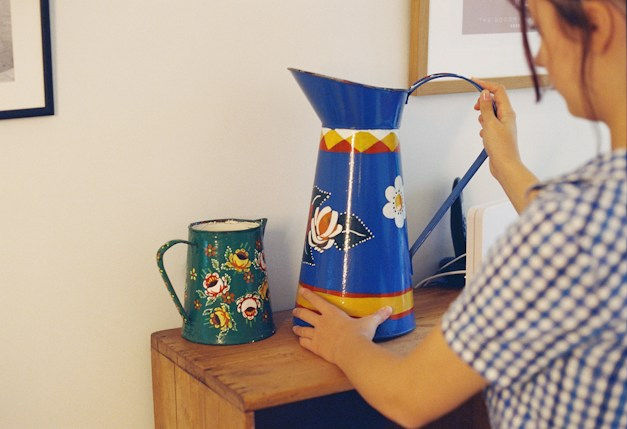
I've moved 27 times across several countries, and every home along the way has been a kind of laboratory for me, but the experiment I come back to most often happens on one wall of my living room. It's lined with open shelves where I keep the things I love most, and it's my favorite place to play. A new find comes home, an old piece rotates back in from a drawer, or something gets nudged along to make room. A few weeks ago, the wall started to feel heavy, so I did what I'd tell any client to do and took some things down. Some beautiful painted pottery came off the shelves, along with a ceramic vase and a few candles, and I put nothing in their place. The whole wall came to life. I've known this for years, and I still relearn it every time, which tells me something about how strong the pull toward adding really is.
What made it hard was that I loved every piece I removed. Clearing out things we don't care about is easy enough, and most decluttering advice stops there. The harder and more useful practice is letting a favorite step back for a while for the good of the whole, the same way a person sometimes steps back so a relationship has room to breathe. Nothing has to be gone for good. The pottery is wrapped in a drawer, and when the shelf is ready for a change, some of it will rotate back in and something else will take a turn resting. Rotation lets you keep what you love without asking every beloved object to be on display at once.
How to make room without stripping the place bare
If you'd like to try this yourself, start small. Pick one shelf, mantel, or surface you see every day, ideally one that already holds things you love, since that's where the practice teaches the most.
Clear it completely. Take everything off and wipe the surface clean so you can look at it empty for a moment before you decide anything.
Put back fewer pieces than you took off. Choose the ones you most want to see, and leave real gaps between them instead of spreading them out to cover the space.
Rest what's left over. Some of what stays off will be things you genuinely love. Wrap them and tuck them into a drawer or cupboard where you can find them again, and plan to rotate them back in when the surface is ready for a change.
Leave the gaps alone for a week. The urge to fill an empty spot is strong, especially if you think you have something better to put there, so give yourself seven days before you add anything.
Notice what changes. Each time you pass, pay attention to where your eyes land now and how the room feels when you walk in. It's also worth noticing whether anyone else in your home comments on the change before you mention it.
There's no universal answer to what “balanced” looks like. Only you can tell what's too little, too much, or just right for your space at any given moment, and that answer will shift as your life does.
Making room
Our brains may be wired to reach for more, but some of the oldest ideas we have point the other way. When Luria imagined the beginning of everything, he didn't start with light pouring out or worlds taking shape. He started with a withdrawal, an infinite presence making itself smaller so that something else could exist. If that's where creation begins, then a few empty spaces on a shelf seem like a reasonable place for the rest of us to start, and the people we share our homes with may be the first to feel the difference.
Want more ancient practices for designing a home that holds the life you want today? Inbar Lee's weekly newsletter brings together feng shui and Jewish wisdom because when your space changes, your life changes. Subscribe to my website.
Visit my website for more info!
Read more from Inbar Lee Hyams
Inbar Lee Hyams, Feng Shui Consultant
Inbar Lee Hyams moved twenty-seven times before she turned thirty and got very good at making a space look and feel good, fast. Then came apartment #28, where life lived, and the chi didn't, a place she now describes as funk shui. She went looking for an explanation and found one in feng shui. She trained in the BTB tradition with Amanda Gibby Peters and now reads clients' spaces. Her weekly newsletter mashes up feng shui, the weekly portion of the Hebrew Bible, and whatever happened in her own house that week, so readers can learn to read their own homes and change what isn't working.