Why Your Prayers Aren't Being Answered, An Ifá Perspective
Written by Dr. Asanee Brogan, Ori Alignment Coach
Dr. Asanee Brogan is an Ori alignment coach, Ifá educator, and author. She is the founder of Asanee 44, a spiritual brand rooted in the Ifá tradition that offers lineage-based guidance and support through Ifá divination, Odu Ifá wisdom, and Ori-centered ancestral work. She is also the host of the African Spirit Reintegrated + Reimagined podcast.

You prayed, and then you prayed again. You even had family and friends pray with and over you, but nothing changed. Many of us grew up with a few ways of explaining this. Some were told that God had said no or asked them to wait. Others heard that the problem was their faith because they didn’t believe or pray hard enough. Many were taught that God’s reasons are beyond human understanding and that the faithful response is to accept the silence and keep going.
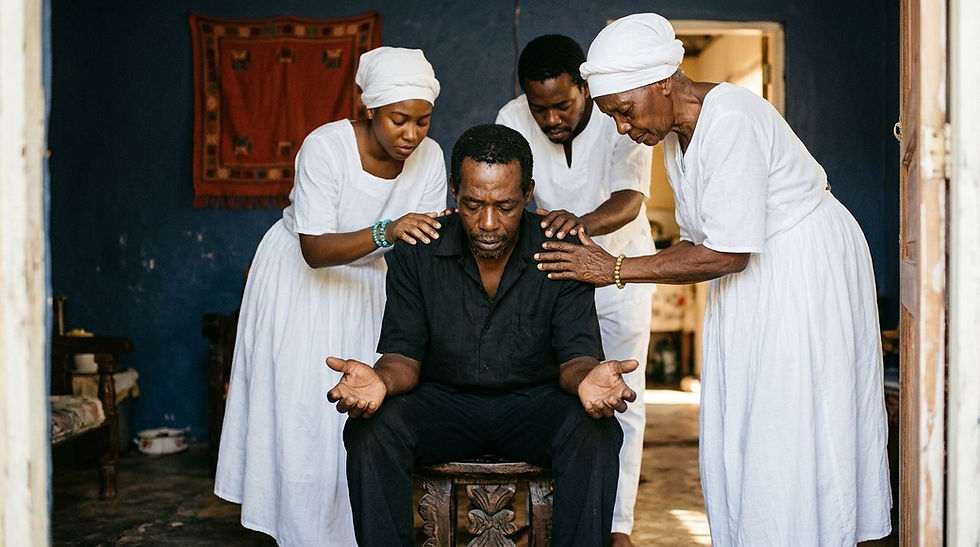
These notions bring comfort to some. They ask the believer to trust, to endure, and to leave the outcome in God’s hands. Yet they also leave the person with very little inner understanding of prayer and results. When the reason is hidden, you can’t confront what’s behind your unanswered prayers.
But in traditional practices like Ifá, requesting divine assistance or guidance is approached from a different perspective. In this tradition, prayer doesn’t stand alone. It is part of a comprehensive system that includes Ori and destiny alignment, sacrificial offerings (ebo), iwa pele, individual effort, and divine timing. When one part of that system is out of order, unanswered prayers take on a different meaning and call for a different resolution.
That makes unreciprocated requests a source of information. They are a sign to investigate, not simply a mystery to accept. Through divination, an Ifá priest or priestess can reveal where the blockage lives. It may be in the request itself, in an unfulfilled promise or obligation, or in a person’s lifestyle or behavior.
Most importantly, Ifá places the individual inside the outcome. You aren’t standing outside a closed door, hoping someone opens it. You have a role in the request, and there is work you can do to understand and possibly change the outcome.
So why might your prayers go unanswered? Ifá points to several common reasons. Each one gives you deeper insight into possible solutions for reconciling your unresolved requests.
Ori has not consented
In Ifá, Ori is considered your inner head and Higher Consciousness. It is the seat of your destiny and guides you toward the path you came here to live. Ifá teaches that no Orisa, ancestor, or other divine force can bless you without your Ori’s agreement. So when you pray for a new job, a partner, healing, or more, your Ori has to support that request.
Ori may withhold its support for several reasons, including issues with your alignment, connection, or behavior. One reason may be that you are out of alignment. When you stray from your path, your Ori may hold back blessings until you return to balance.
Another reason your prayers may go unanswered is that you aren’t properly connected to your Ori. Many have never honored or tended to their inner head. In Ifá, ibori improves this connection through a ceremony that feeds your Ori. It better aligns you with your inner head so you can receive its messages more clearly.
What’s more, you could be ignoring your intuition. Your Ori speaks through your inner knowing. It may have been urging you to go to certain places, make specific changes, or walk away from certain people. When you repeatedly ignore that guidance, your Ori may withhold blessings until you follow through.
The prayer is not aligned with your destiny
Ifá teaches that before you were born, you chose your destiny. That path determines your purpose, along with the lessons, relationships, and lifestyle meant to support it. Your Ori continually guides you toward your destiny.
Some prayer requests sit outside that path. You may pray for years for a certain partner, a specific job or career, or a home in a particular area and still not receive what you asked for. Your prayer may seem beneficial or even noble, and your desire might be sincere, but it might not be part of your destined path.
In these cases, understanding the reason doesn’t change the outcome, as the prayer will likely remain unanswered. Instead, the change must happen within you. Once you understand that the request isn’t meant for you, you can resolve to stop asking for it, grieve it if you need to, and turn your energy toward achieving alignment.
The prayer goes to the wrong force
In Ifá, the Orisa are divine forces or emissaries. Each has authority over certain aspects of the cosmos and plays a specific role in each person’s life. Some people choose to pray to a specific Orisa based on the problem they’re facing. When they’re facing a legal battle, they may go straight to Shango, the Orisa associated with justice. When they’re struggling in love, they might go to Oshun.
The challenge is that the Orisa don’t always work in the ways we expect. A legal battle may be encoded within an unknown spiritual battle. In that case, you might need the support of Ogun, who defends us in physical and spiritual battles. The Orisa work within their authority, but sometimes we don’t realize a problem or concern falls within their domain.
Some people also take every request to their head or guardian Orisa, who guides their path. But sometimes the request actually needs to go to their Ori, ancestors, or a different Orisa altogether.
Even skilled practitioners can’t always tell which force a situation calls for just by examining the signs and symptoms. That’s why Ifá divination is sometimes necessary to determine which force your prayer requests should be directed to. By seeking help from and honoring the proper Orisa, you can often resolve your request.
Ebo was ignored or dismissed
Prayer often works alongside ebo, a sacrificial offering made to the divine forces. Ebo is an energetic exchange. Your offering opens the way for the divine forces to support your request.
During divination, an Ifá priest or priestess may identify a specific sacrificial offering needed to address your situation. Some people receive feedback from their reading and never complete the ebo. Others delay it, try to alter it, or decide it isn’t necessary. When the exchange is left incomplete, the prayer may remain unanswered.
Your own effort is missing
Ifá teaches that work is the cure for poverty. Divine support doesn’t replace our effort because the two go hand in hand. Praying for a new job without applying anywhere leaves little opportunity for divine forces to answer your prayer.
Healing is one of the most common examples. Many people pray for healing and expect it to arrive as an instant miracle. For some, healing is a progressive pathway, even in traditional practice. Instead of a quick fix, the divine forces that support your path may lead you to a specific doctor, treatment protocol, lifestyle change, or other remedy.
However, some dismiss or ignore these open doors because they expect their healing to occur purely through divine intervention. Their prayers were in the process of being answered. Yet they missed the answer because they expected a different response.
Iwa is out of order
Gentle or balanced character, referred to as iwa pele, is the foundation on which our blessings rest. It manifests in how you treat people, whether you keep your word, and how you manage your behavior. When your character is out of balance, you may push away blessings you would otherwise receive or lose the ones you currently have.
Iwa also includes honoring your taboos. These sacred restrictions can involve foods to avoid, colors not to wear, and specific behaviors, situations, places, or people to avoid. Each one protects your path. Breaking them, even unknowingly, can close doors that prayer alone may not reopen. For newcomers, this is another reason divination is so valuable. It can reveal taboos you might be unknowingly violating or warnings you might have missed.
The timing has not arrived
Sometimes a prayer hasn’t gone unanswered. The answer simply hasn’t arrived yet. Ifá regards patience as a vital virtue. The tradition teaches us to wait on divine timing because, in doing so, we can receive the fullness of our blessings without unnecessary blockages or delays.
A blessing may be meant for you but not for this season of your life. You may need to grow, heal, or prepare before you can receive it. A promotion that arrives before you’re ready to lead or a relationship that comes before you’ve healed from the last one can turn a blessing into a burden.
But waiting doesn’t mean doing nothing. Instead, we’re meant to use these periods to develop our character and properly prepare ourselves to receive and maintain our blessings and opportunities. This is likewise why divination can help us discern the reason for delays or blockages along our path.
Turning unanswered requests into resolve
An unanswered prayer can be difficult to process or understand, especially after years of asking. Ifá offers another perspective. Instead of accepting the silence as a mystery, you can better understand the root cause of your unresolved request.
Ifá practitioners seek divination to examine these situations. Sometimes it reveals a path to resolution. Other times it shows that a request isn’t meant for you, so you can release it and move toward your path. Either way, you don’t have to keep praying in the dark.
If you’re new to the tradition, start by learning how Ifá divination works and the role it plays in a person’s life. Learn more about Ifá divination on Asanee 44.
Read more from Dr. Asanee Brogan
Dr. Asanee Brogan, Ori Alignment Coach
Grounded in years of study and practice within the Yoruba-based Ifá tradition, Dr. Asanee Brogan creates accessible learning resources. These tools guide individuals toward ancestral reconnection and Ori alignment. Through Asanee 44, she provides Ifá divination, rituals, products, courses, and more that honor African spirituality with authenticity and cultural integrity.