Why Trainers Should Embrace Technology
Written by Brendon Kawondera, Personal Coach
Brendon Kawondera is a London-based personal trainer and educator on a mission to elevate the fitness industry. With a thriving in-person business, he helps trainers master their craft and build successful careers. Passionate about real-world coaching over online trends, he focuses on skill, confidence, and professionalism to set trainers apart.

There is something quite strange about using a piece of gym equipment that makes you question whether it could eventually do your job better than you. I have always been fascinated by how gym equipment works. A few years ago, whilst working at Fitness First, I attended mandatory training on EGYM technology and became genuinely interested in how intelligent equipment could personalise training, record performance, and guide people through their workouts.
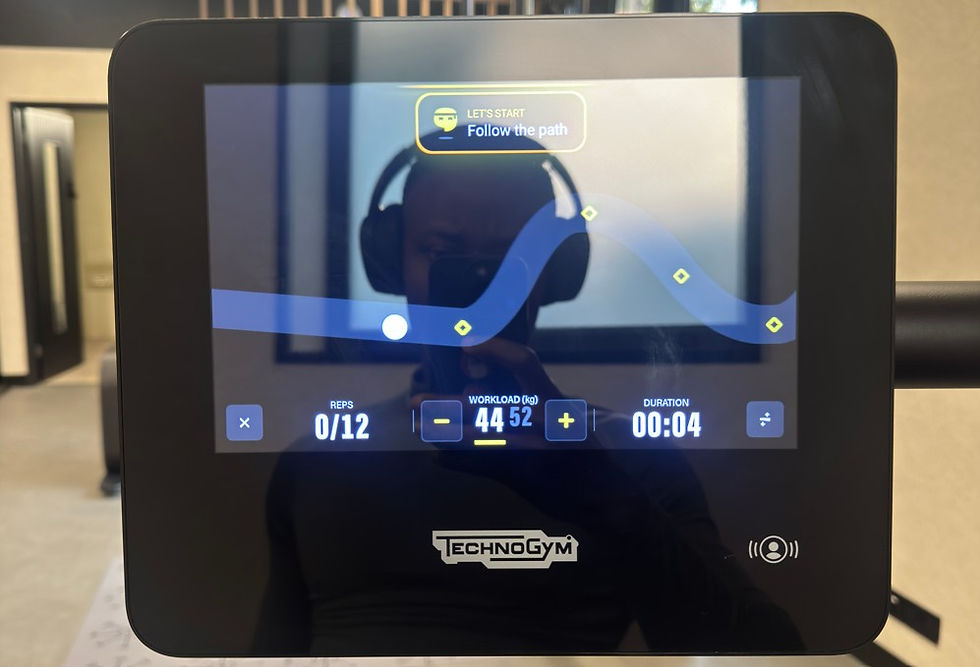
Fast forward to today, and I am using Technogym BioStrength REV equipment with some of my own clients. The technology is impressive. It is also difficult not to wonder how far it will go. When a machine can programme, track, count, adjust, and monitor a client's training, you start asking yourself some uncomfortable questions about the future of personal training. But interestingly, my first instinct hasn't been to avoid the technology. It's been to understand it.
The machine is getting smarter
Think about what modern intelligent gym equipment can already do. It can help users select appropriate training loads, guide them through exercises, record their performance, monitor progress, structure sessions, and encourage consistency. For someone who has never trained before, that can be an incredibly valuable experience.
The technology removes some of the uncertainty. You don’t necessarily have to walk into the gym wondering what to do, how many repetitions to complete, or whether you are progressing.
The system can provide a framework. As technology develops, that framework will become increasingly sophisticated. Artificial intelligence (AI), data, connected equipment, and personalised training systems are likely to become even more integrated into the fitness industry.
I don’t see that as a bad thing. In fact, I find it exciting. My concern isn’t that the technology is advancing. It’s that we, as fitness professionals, could fall behind by refusing to understand it.
What happens when the machine can do our job?
This is where the conversation becomes uncomfortable for some personal trainers. If a machine can prescribe exercises, count repetitions, monitor performance, track adherence, and provide feedback, what exactly are we being paid for?
If our entire service consists of writing a programme, counting repetitions, and telling someone when to start or stop, then we should probably be asking ourselves some serious questions. Because those tasks are becoming increasingly easy to automate.
I don’t believe we should ignore this reality. We should acknowledge it. Technology will continue to improve, and some of the tasks traditionally performed by personal trainers will inevitably become less valuable. That doesn’t mean the profession has no future. It means the value of a personal trainer must evolve. We must become better at the things that make us genuinely valuable.
The things a machine cannot experience
I still believe there is something special about coaching another human being. The conversations that happen between sets. The confidence you build in someone who initially feels intimidated by the gym. The ability to recognise when a client is having a difficult day, even when they tell you everything is fine. Knowing when to push, when to pull back, when to challenge someone, and when they simply need you to listen.
A machine can collect data about performance. But coaching people is about understanding the person who is doing the work.
Two clients can complete the same workout and have completely different experiences. One might be motivated, confident, and ready for more. Another might be battling anxiety, a lack of sleep, personal challenges, or a fear of failure.
The numbers don’t always tell the whole story. A good personal trainer learns to read the person, not just the programme.
Our ability to communicate, build trust, create enjoyable experiences, adapt in real time, and genuinely care about the people we work with will become even more important as technology takes over more of the technical and administrative tasks. That is where I believe human coaching has enormous value.
Curiosity is better than fear
I have always been fascinated by how gym equipment works. I enjoy understanding the mechanics, the technology, and how these systems can make training more accessible, structured, and effective.
So why would I want to avoid something that could potentially make me a better coach? If the equipment can handle some of the repetitive tasks, perhaps that gives me more time to focus on my clients. If technology can help track progress more accurately, perhaps I can make better decisions. If it can improve the training experience for beginners, perhaps more people will feel confident enough to start exercising.
Instead of looking at intelligent gym equipment as competition, I see an opportunity to learn. I want to understand how it works. I want to know what it does well, where its limitations are, and how I can incorporate it into my own coaching. The worst thing we can do is dismiss technology simply because it makes us uncomfortable.
The future belongs to trainers who adapt
I have written previously about why AI won’t replace great personal trainers but will change them. I still believe that. But I think this conversation goes beyond AI software, online programmes, or apps. It is happening right in front of us on the gym floor. The equipment itself is becoming smarter, more connected, and increasingly capable of delivering a personalised training experience.
The question isn’t whether technology will change personal training. It already is. The question is whether personal trainers are willing to change with it.
We don’t need to become engineers, programmers, or technology experts overnight. But we should be willing to learn how the tools available to us work and how they can improve the service we deliver.
I would rather be the trainer who understands the technology, uses it confidently, and knows when to step in than the trainer who avoids it because they are worried about being replaced.
Human connection is not becoming obsolete
People have access to more information, more apps, more programmes, and more technology than ever before. Yet having access to information doesn’t necessarily mean knowing what to do with it, having the confidence to start, or possessing the discipline to continue.
That is where human interaction matters. People still want to feel understood. They want encouragement, accountability, connection, and someone who genuinely cares about their progress. They want to celebrate achievements with another person, not just see a notification on a screen.
Technology can make training more efficient. It can make it smarter. It can make it more accessible. But I don’t believe that the desire for human connection is going anywhere.
As a personal trainer, I’m not afraid of what the next generation of gym equipment will be capable of. I’m fascinated by it. I intend to keep learning. Because if technology can help us deliver better training, and our ability to coach, communicate, and connect with people makes that experience even better, then perhaps the future of personal training isn’t human versus machine. Perhaps it is what happens when the two work together. I think that’s a future worth being part of.
For more information, go here.
Read more from Brendon Kawondera
Brendon Kawondera, Personal Coach
Brendon Kawondera is a London-based personal trainer, educator, and entrepreneur committed to raising the standard of the fitness industry. With years of hands-on coaching experience, he has built a thriving in-person business by focusing on real results rather than trends. He helps personal trainers develop the skills, confidence, and professionalism needed to excel in their careers. Unlike many industry voices pushing online coaching, he believes the gym floor is where great trainers are made. Through his coaching, courses, and educational content, he empowers trainers to refine their craft and build sustainable, high-value businesses.