

Why Fitness Should Fit Your Life, Not Control It – An Interview with Richard Bennett
Richard Bennett of Calibre Performance Coaching is a Strength & Conditioning Coach and Personal Trainer delivering sessions from Athena Performance, Redditch. He has over 15 years' experience and has trained people of all backgrounds, from professionals looking to improve their health & fitness to pro athletes, including Dylan Norman, Simon Ibekwe & Jay Van Gelder, who all added Strength and Conditioning (S&C) to improve their performance inside the boxing ring.
Whilst many fitness coaches follow fads and sell aesthetics, Rich believes in sustainable performance-related training to get long-term benefits.
In this interview, Rich breaks down his approach to fitness, what people misunderstand about strength training, and the practical skills anyone can use to get results more efficiently.

Richard Bennett, Personal Trainer, Strength & Conditioning Coach
What led you from combat sports into building a career in strength and conditioning and personal training?
I started training in the gym when I was kickboxing and boxing. I first went to develop my strength and add power to my strikes, and then added fitness and conditioning into my training too. Although I was certainly not training optimally at the time, I enjoyed the benefits that I felt both in my sport and outside in day-to-day life. My strength & fitness improved, and so, after passing my boxing coaching qualification, I pursued further qualifications in the fitness industry, primarily to add to my knowledge.
This later led me down the path of continued development until my role became a Personal Trainer (PT) and Strength and Conditioning (S&C) coach. Following on from my Personal Training qualification, I completed my Level 4 Strength & Conditioning Qualification and completed many other vocational qualifications and mentorships. Academically, I continued my development by studying a Diploma of Higher Education (DipHE) in Sport & Fitness. I am currently finishing a Bachelor of Science (BSc) in Strength, Conditioning & Sports Nutrition. I now get to see the application of years of study and practice through coaching my many clients and athletes, including professional fighters, helping them with goals both similar to and different from my own previous goals.
After more than 15 years of coaching, what has most changed the way you assess and programme for a client?
Early on, I leaned heavily on what I’d learned on courses and applied fairly standard programming based on this. Over time, and especially through mentorships and networking with elite coaches, I moved away from generic commercial gym PT programs and bodybuilding-style plans towards programming that follows key principles rooted in science, looking at how someone actually moves, what their life outside the gym demands of them, and what their body can currently tolerate, rather than what everyone else is doing at the gym. Performance testing and objective data, such as velocity-based training, have also changed things. I can now combine this with autoregulation and track how a client or athlete is actually responding in real time and adjust things, rather than simply guessing.
Another shift has been recognising that someone's life outside the gym matters as much as anything I put on them in a session. Stress levels and poor recovery can have a huge impact. Any programme that ignores this isn’t as effective, no matter how good it looks on paper.
How does coaching everyone from complete beginners to professional boxers influence the way you think about effective training?
The diversity of my current and previous clients keeps me honest about what actually matters. Coaching beginners has forced me to base sessions on the fundamentals and have a deep conviction about why any exercise prescribed has earned its place. At the other end of the spectrum, the professional boxers I work with (Dylan Norman, Simon Ibekwe & Jay Van Gelder) need more precision. Their sport already demands huge training volumes, so anything I add in the gym has to reap rewards without costing them much-needed recovery for their sport-specific sessions.
I learnt from mentors that "the methods are many, but the principles are few." When coaching at both ends of the spectrum, the underlying principles don’t actually change, only the scale and context do. Progressive overload, key movement patterns, adequate recovery, periodisation, and an understanding of clients' needs are key when training anybody. If anything, working with elite athletes has taught me to strip things back to basics further.
This is because the margins are smaller and there is less room for wasted effort. That translates directly into simpler, more effective programming for everyone I work with.
Why do you favour minimal effective doses over the idea that more training automatically produces better results?
The ability for anyone to recover is finite, and for most of my clients, training is one part of a much bigger life. They all have a lot to manage: a job, a business, family & partners. Other stresses have an impact. Piling on more and more volume until someone hits a point they can't actually recover from doesn’t yield better results; it produces burnout, injury, and people quitting.
I see this also with the athletes I work with. Their sport already demands hours and hours of training, so my job as their S&C coach is to stimulate, not annihilate. I need to add enough to get the specific stimulus we are looking for to improve their performance without causing overtraining. This same logic actually applies to a busy professional client: give them the right dose they can manage consistently, and they get real, lasting results without their life having to revolve around the gym.
Going against the grain of many people in the fitness industry here, but more isn’t better – better is better. That’s a key principle I programme around, whether I’m working with a beginner or a fighter heading into a big fight.
What do you think the fitness industry gets wrong when it prioritises trends, aesthetics, and novelty over performance and quality of life?
Training for aesthetics or bodybuilding often prioritises short-sighted vanity gains at any cost and ignores long-term health. This can lead to many issues: poor self-image, unrealistic expectations, disordered eating, and Performance Enhancing Drug (P.E.D.) use. My approach is to focus on performance and then, by default, as well as moving better and feeling better; when training is combined with sustainable, healthier lifestyle choices, they will look better too.
Novelty for its own sake is a big problem in the fitness sphere. Exercises are often chosen because they’re impressive on film rather than because they serve an actual outcome that meets a goal.
I build programmes around repetition and progression of key movements, and I use strength and conditioning programming to improve how someone moves, in sport or in life, and how they feel day to day. This holds up over months and years, and still lets them enjoy their training rather than dread smashing their bodies. This is a far better return than any "transformation programme" built to impress by malnourishing someone for six weeks.
What does an efficient training programme look like for a busy professional who wants meaningful results without living in the gym?
The most important decision I ask a client to make upfront is a realistic commitment to the frequency of training. To start, we often build a programme with only a couple of sessions a week. A client can actually sustain this, rather than asking for too much on an idealised schedule they won't adhere to.
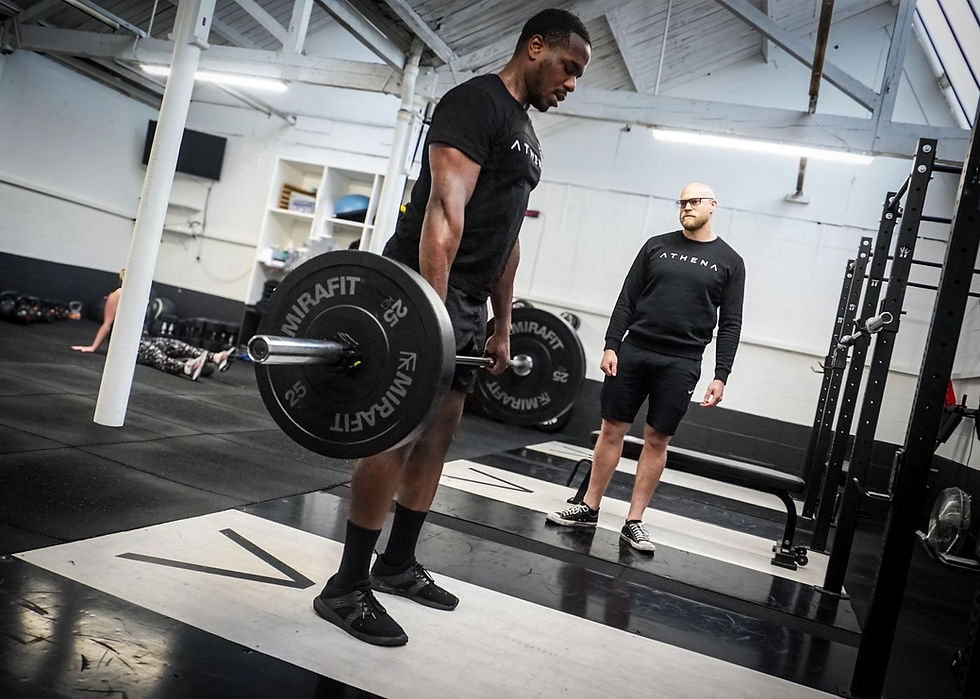
Compound movements make up the "skeleton" of any good programme, and when time is a factor, we strip things back to these movements: Push, Pull, Hinge, Squat, Rotate, etc. These movements will carry over into real-life strength. A great tool is supersets, where exercises share a rest, as they are a great way to get more exercises into an hour of lifting.
I then sprinkle in efficient conditioning that is appropriate for the client's starting fitness level for heart health and day-to-day fitness. Enjoyment comes into this too, as it can increase adherence and buy-in to the process. Some clients enjoy boxing pad work, so I offer this as a service too.
I track a small number of metrics rather than overcomplicating things with loads of data, and then I factor in what’s happening outside the gym because that determines how much a client can actually do. Efficient does not mean lazy training. Efficient means everything that's in the session has a justification, and the plan fits someone’s life rather than life having to fit around the gym.
How do you decide which exercises and training methods genuinely deserve a place in a client’s programme?
After assessing if they have any existing injuries or medical conditions that may inform me of movements to avoid, I assess their current movement quality on lifts whilst being conservative with load and using Rate of Perceived Exertion (RPE) to adjust the load. From there, I can regress or progress movements as required to find the best option for the client in front of me. Thinking on my feet is part of the initial process, as I assess as we go and adapt appropriately. Another quote from a S&C mentor of mine, "train the adaptation, not the exercise," is insightful here.
Exercises are selected for what they will do for the person in front of me, with a clear rationale to address something specific, not because it is trending or looks impressive. The exercises selected must sustainably fit into that person’s long-term plan, not just this week’s session. Whether it's a strength exercise, a conditioning plan, or a boxing drill, this should always be the case in my opinion. If I can’t explain clearly why something is in a programme, it won't go in the plan.
There is no such thing as a bad exercise; however, not every exercise deserves a space in anyone's programme. Context is key.
What does training for performance and quality of life mean to you personally as a coach?
This links back to the first question. I started in the gym to improve my performance in combat sports. This then led to me feeling better in everyday life: more resilience, more energy, and feeling capable rather than focusing on simple vanity measures about looking a certain way. That is what I want for my clients too, wherever they started and wherever they are on their journey.
For a professional boxer, performance is obvious; it’s visible in the ring. But for a general population client, whilst less visible, it's just as real: being strong enough for whatever life throws at them, recovering well, and not being limited by their own body. Coaching people towards that, rather than towards a short-term aesthetic goal, is what makes this work meaningful to me. Watching a client carry that strength and capability into the rest of their life is a far bigger reward than any before-and-after photo.
If someone is choosing a coach for long-term results, what should they look for beyond qualifications and impressive workouts?
Solid credentials matter, but they only ever tell you half the story. Letters after your name may demonstrate knowledge but don't show application, adaptability or a person-centred approach. A deeper understanding of the principles of training and awareness of scaling exercises to your body and your goals would be best. A coach or personal trainer should be able to explain their process and how things will progress along the journey, focusing on the long-term results with realistic commitment.
I would advise people to avoid "transformation coaches' with large client turnovers and a focus on quick, Instagrammable results, as well as any trainers not staying in their lane and acting like nutritionists, life coaches, or gurus in anything they are inadequately qualified or experienced in. An ongoing coaching relationship matters more than how tough a solitary session is if you want results that endure. If that sounds like what you’re looking for, you can find me for 1-1 coaching at Calibre Performance Coaching, or at Athena Performance if group personal training suits you better.
Read more from Richard Bennett


