Why Do Concussion Symptoms Persist? Looking Beyond the Diagnosis of Post-Concussion Syndrome
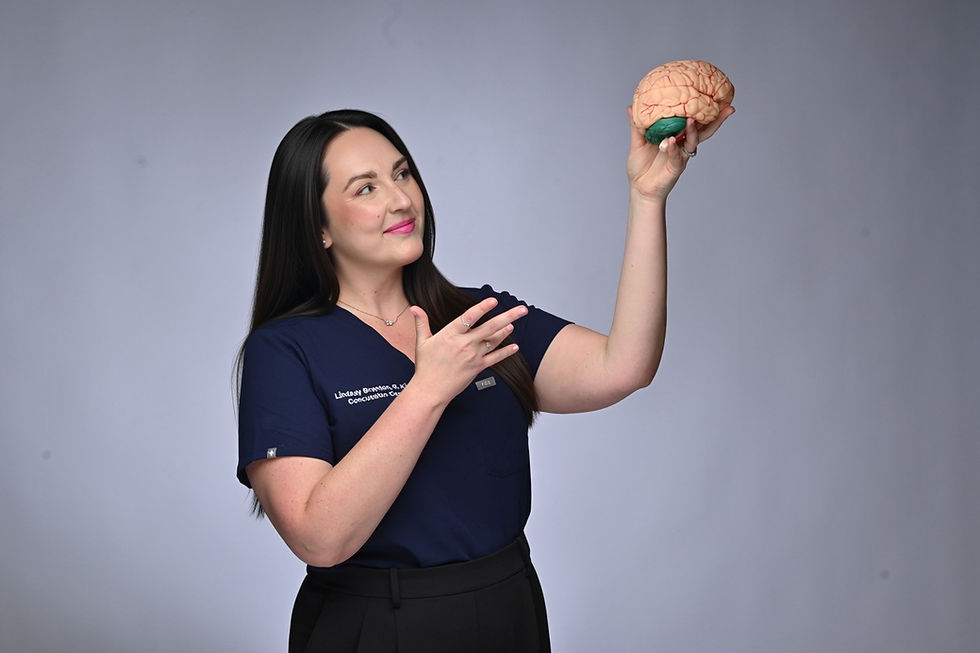
Lindsay Marie Branton is a Registered Kinesiologist specializing in complex concussion assessment and rehabilitation. Her work explores how the brain and body adapt after injury, identifying compensations, capacity limits and patterns that emerge under load to help guide individualized rehabilitation.

Persistent post-concussion symptoms are an outcome, not a mechanism. Someone may be told they have post-concussion syndrome (PCS) because they continue to experience headaches, dizziness, cognitive difficulties, visual symptoms, fatigue or other problems long after a concussion. But that label does not tell us why those symptoms are continuing. Persistent symptoms are not necessarily a direct readout of persistent brain injury.
Early symptoms may be driven by genuine concussion-related impairments. Later, however, symptoms may reflect a changing mixture of unresolved impairments, cervical or vestibulo-ocular dysfunction, autonomic changes, behavioral responses, learned compensations, avoidance, sleep disturbance, psychological factors and other contributors.
This is why good concussion rehabilitation requires us to keep reassessing what is limiting a person now, rather than assuming that the thing that originally caused a symptom is still the thing maintaining it today.
First: Are there still impairments that haven’t resolved?
Most people improve substantially after a concussion, but a meaningful minority experience symptoms that persist beyond the expected recovery period. Estimates vary depending on how persistent symptoms are defined and the population being studied, but research suggests that roughly one in six to nearly one in three adults may continue to experience symptoms months after a mild traumatic brain injury.[1]
For these patients, the first step is determining whether there are still identifiable impairments or other conditions contributing to their symptoms. Depending on the individual, these may include:
vestibular dysfunction
oculomotor or visual dysfunction
cervical and proprioceptive deficits
balance or sensory-integration difficulties
exercise intolerance
autonomic dysfunction
cognitive difficulties
headache or migraine
sleep disturbance
psychological or behavioral factors
Some of these areas can be particularly easy to misunderstand.
For example, visual motion sensitivity does not necessarily mean that someone simply needs more and more visually provocative exercises. Balance problems may involve difficulty integrating information from the visual, vestibular and proprioceptive systems rather than a straightforward weakness in one system. Autonomic dysfunction may also contribute to symptoms such as exercise intolerance, dizziness or orthostatic symptoms, but it can be difficult to recognize and quantify.
This is one reason a comprehensive assessment matters. When a patient with persistent symptoms arrives in my office, I want to identify which measurable impairments are still present and address them when appropriate. But there is another important distinction:
An impairment and a symptom are not the same thing.
A symptom does not tell us its cause
A headache is a symptom. Dizziness is a symptom. Eye pain is a symptom. None of these, by itself, tells us the mechanism producing it. Five people could tell me that reading gives them a headache, and there could be very different factors contributing to that headache in each person. This is why we cannot treat every patient with persistent post-concussion symptoms the same way.
To make things even more complicated, what contributes to a symptom may also change over the course of recovery. The impairment that initially caused difficulty may improve, while some of the responses or compensations that developed around that impairment remain.
What happens when the original problem improves, but the compensation remains?
Imagine that reading is genuinely difficult after a concussion because a patient has impaired visual or vestibulo-ocular function. Over time, they may adapt to that difficulty. They might squint or tense their face while reading. They might brace their jaw or neck. They may become highly attentive to the first sign of symptoms. They might begin avoiding reading because they have learned that reading reliably makes them feel worse. Initially, some of these responses may be understandable attempts to cope with a genuinely difficult task.
But what happens if the original impairment improves and some of those responses remain?
Behavioral, cognitive, motor and physiological responses can interact with the original injury and, in some people, may become part of the larger picture maintaining symptoms. This does not mean that persistent symptoms are imagined, psychological or the patient’s fault.
It means that the nervous system is adaptable. The same ability that allows us to learn useful strategies can also allow patterns that were once protective or necessary to persist after they are no longer helpful.
Compensation can take different forms
Using reading as an example, compensatory responses might include:
Behavioral and emotional: Avoiding reading, becoming fearful of provoking symptoms, catastrophizing symptoms or beginning to associate symptoms with harm.
Motor: Facial tension, jaw or cervical bracing, altered head movement or other changes in how the body performs the task.
Physiological: Increased arousal or stress responses associated with an activity that has repeatedly produced symptoms.
Cognitive and attentional: Closely monitoring the body for symptoms or anticipating that symptoms are about to occur.
These categories can also interact with one another.
Fear and avoidance can become part of the recovery picture
Fear avoidance is one area where research is beginning to help us understand this process. The Toronto Concussion Study followed adults after mild traumatic brain injury and found that people whose fear-avoidance behavior remained elevated from two to eight weeks had more severe post-concussion symptoms at eight weeks, while people whose initially elevated avoidance decreased tended to recover better.[2]
A 2025 prospective study also found relationships between persistent post-concussion symptoms, catastrophizing, fear avoidance and depressive symptoms, suggesting that the fear-avoidance model may help explain persistent symptoms in a subgroup of patients.[3]
This should not be interpreted as evidence that symptoms are “just anxiety” or that patients are causing their own symptoms.
If an activity has repeatedly caused dizziness, pain, nausea or cognitive exhaustion, becoming apprehensive about that activity is understandable. But avoiding activities can also reduce opportunities to rebuild tolerance and confidence. In some patients, rehabilitation therefore involves carefully and progressively demonstrating to the brain and body that an activity can once again be performed safely.
Could the body learn a physiological response to a symptom-provoking activity?
This is an area where my clinical experience has raised questions that the research does not yet fully answer. I sometimes work with patients whose original visual, vestibular or other measurable impairments have improved, but certain activities continue to reliably provoke symptoms. This is especially true in my Complex Concussion Consultation work. In some of these patients, I have observed that changing their physiological or regulatory state while keeping the provoking activity the same can significantly change their symptoms.
For example, a patient may continue reading the same material at the same visual demand, but an intervention intended to influence autonomic regulation changes how well they tolerate the task.
Why does this happen? I don’t think we have enough evidence to say.
One hypothesis I consider clinically is whether an activity that repeatedly produced symptoms for months or years can eventually become associated with a physiological response that persists even as the original impairment improves.
In simpler terms: if reading reliably made your body feel terrible for years, could your body eventually begin responding to reading differently even after some of the original reasons it was difficult have improved?
I want to be clear that this is a clinical hypothesis, not an established mechanism of persistent post-concussion symptoms. There is evidence that autonomic function can be altered following traumatic brain injury, including changes in measures such as heart-rate variability. A 2024 systematic review of 89 studies found that TBI was associated with reduced heart-rate variability and that physiological changes may sometimes persist beyond symptom resolution or return to play.[4] However, this research does not demonstrate that the nervous system specifically learns that an activity such as reading is “dangerous” and subsequently produces persistent concussion symptoms through that mechanism.
It also does not mean that autonomic dysfunction explains every persistent concussion symptom. For me, the clinical value is not in claiming that we know why this happens. It is in recognizing the observation and using it to generate another question that we can test. If changing a patient’s regulatory state changes their symptoms while the activity itself remains essentially the same, that tells me something important:
I may need to reconsider whether the original impairment is still sufficient to explain what the patient is experiencing.
When the original hypothesis no longer fits
One of my patients illustrates why this process matters.
She came to me after experiencing multiple concussions over approximately a decade and was struggling with persistent symptoms that significantly affected her life. Initially, she had measurable visual and vestibular impairments that provided a reasonable explanation for many of the symptoms she experienced with reading and other visual activities. We rehabilitated those impairments and her objective performance improved. Her vertigo resolved and her ability to tolerate increasingly complex visual activities improved substantially.
But reading could still produce symptoms. That forced me to ask a different question, "If the impairment we thought was causing the symptom has substantially improved, why is the symptom still occurring?"
Through continued testing, we began finding some unusual clues. Changing her regulatory state could change her tolerance to reading without changing the visual task itself. We also noticed that she consistently squinted, furrowed her brow and tensed the muscles around her eyes while reading. When she deliberately changed that facial pattern, her symptoms changed.
We later noticed that horizontal eye movements were accompanied by jaw tension. Interestingly, research in healthy humans has demonstrated that horizontal eye movements can be accompanied by activation of facial and masticatory muscles. We began experimenting with ways of changing that motor response while keeping the eye movement itself the same. When we changed what her mouth and jaw were doing, the jaw tension disappeared. When we incorporated similar strategies into reading, her symptoms also improved.
This does not prove that facial or jaw bracing caused her persistent reading symptoms. What it did was give us enough evidence to question whether the oculomotor impairment that originally contributed to her symptoms was still the primary factor maintaining them.
Our hypothesis changed. Because our hypothesis changed, her rehabilitation changed too.
Rehabilitation should be hypothesis-driven, not protocol-driven. Rather than simply giving her more reading or increasingly difficult eye exercises, we temporarily simplified the task. We returned to horizontal visual pursuits while pairing the eye movement with strategies that prevented the habitual jaw tension from appearing. The goal is then to progressively remove those strategies and eventually return to normal reading without her having to consciously think about any of them.
At the time of writing, her reading symptoms have resolved in session, but her case remains a work in progress. That is important. This is not evidence of a universal mechanism or a treatment that should be applied to everyone with reading difficulty after concussion. It is an example of why continued reassessment can matter when a patient improves in some areas while particular symptoms remain.
Watch the accompanying case study on YouTube: Why Reading Can Still Cause Concussion Symptoms After Visual Function Improves.
Treat the person in front of you, not just the original diagnosis
Persistent post-concussion symptoms can be complicated because there may not be one single factor responsible for everything a patient experiences.
Some patients still have identifiable impairments that need targeted rehabilitation. Others may have migraine, cervical dysfunction, vestibular or visual problems, autonomic dysfunction, sleep disturbance, psychological factors or other conditions contributing to their symptoms.
In some cases, the original impairment may have improved while responses that developed around that impairment continue to influence function.
That is why the findings from the initial assessment should not become a permanent treatment plan. We need to assess. Treat. Reassess. When the evidence no longer fits our original explanation, we need to be willing to change our hypothesis. As recovery progresses, the question should not only be, “What was injured?” We also need to keep asking, “What is limiting this person now?”
Persistent symptoms do not necessarily mean recovery has stopped. Sometimes they mean we need to ask a different question.
Remember, persistent doesn’t mean permanent.
Read more from Lindsay Marie Branton
Lindsay Marie Branton, Complex Concussion Clinician
Lindsay Marie Branton is a Registered Kinesiologist and Director of Brain Health & Concussion Care at EPIC Health & Movement, specializing in complex and persistent concussion cases. Her approach looks beyond isolated deficits to understand how the brain and body have adapted after injury, including compensations, capacity limits and patterns that emerge under load. Her goal is to uncover meaningful patterns that can guide more individualized rehabilitation. At the heart of her work is a simple message: Persistent doesn’t mean permanent.
References:
[1] McIntosh SJ, et al. Factors Associated With Persisting Symptoms After Concussion in Adults With Mild Traumatic Brain Injury: A Systematic Review and Meta-Analysis. JAMA Network Open. 2025.
[2] Toronto Concussion Study. Prospective research examining the relationship between fear-avoidance trajectories and recovery following mild traumatic brain injury.
[3] Hecker et al. Prospective research examining relationships among post-concussion symptoms, catastrophizing, fear avoidance and depressive symptoms. 2025.
[4] Talbert et al. Systematic review examining traumatic brain injury and heart-rate variability. 2024.
[5] Tsai et al. Research examining gaze-associated activation of facial and masticatory muscles during horizontal eye movements. 2022.