Who We Are When the Work We Love Ends – An Interview with Mindy Yanish
Mindy Yanish, a grief and loss specialist and life coach, found her calling after closing Offerings, the gallery she ran for thirty years, and discovering how much of her identity lived there. She earned her certification as a grief and loss educator through David Kessler’s program, was ordained as a minister for people of all faiths, trained with Nancy Levin, and studied with psychiatrist and trauma expert Dr. Frank Anderson.
Mindy now accompanies others through grief, retirement, and life’s hardest transitions. She also founded the Creative Alliance Project and produced the ballet Got My Wings. In this interview, Mindy shares with honesty and heart what loss has taught her about identity, freedom, and connection, and why the most meaningful chapter of a life is ongoing.
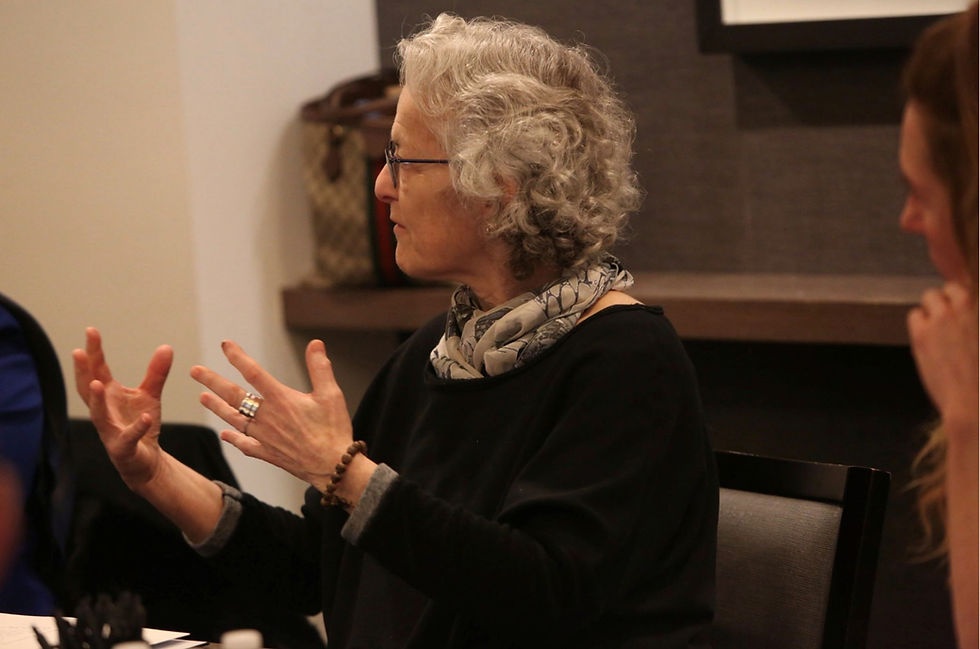
Mindy Yanish, Grief and Loss Specialist & Life Coach
What led you from thirty years in the art world to helping people navigate grief, loss, and major life transitions?
My gallery, Offerings, was an intimate community hub where people knew they would be seen and valued. Even though I chose to close it, I painfully discovered how much of my identity and belonging lived there. The following year, my mother died. Her last words were, “Why are you leaving me now?” I had to leave because I was sick and felt I was dying with her, and I could not tell her. The guilt clung to me like Velcro. Shortly after her death, I found David Kessler’s grief educator program, a step toward understanding a lifetime of grief I had unknowingly buried. Experience continues to teach me that grief is a natural response to any loss, not only death.
As I studied trauma and attachment theory, the guilt loosened, and my path became clear: to keep offering the gifts that were growing within me to others silently struggling with grief, by naming a loss and letting it be witnessed. My efforts to make a difference once seemed like separate bits of light. Now I see one beautiful galaxy, each light joined to the others by love, and by a purpose I cannot fully articulate.
When you closed your gallery after three decades, what did that experience teach you about the connection between work and personal identity?
Closing my gallery taught me that work had given me a sense of importance, but it never defined who I am. The role gave my voice and talents a stage; it did not create them. But when the stage was gone, I felt I had lost myself, and only gradually did I find the essence beneath my persona. I closed in March 2020, before the pandemic shutdown. The decision was mine, yet I lost the community and daily meaningful conversations.
Doubt took over; I believed I had made a mistake. Yet an inexplicable inner prompting continued to guide me, as it always had. Without noticing it, my confidence returned as the need to connect compelled me to invite people over. That spring, with no one meeting indoors, my backyard became the gathering place, one person at a time, more than fifty, my own version of Johnny Appleseed. Something was begging to be born, though I had only a feeling. Those who related to it helped me shape a vision that became the Creative Alliance Project, a nonprofit for the arts. The stage had radically changed, but my voice was still intact.
How has your background in art, storytelling, and community advocacy shaped the way you support people through difficult life changes?
My work has always been about creating places where people feel seen. In the 1990s, I started Kids for a Living Earth, an art show inviting young people, K-12, to share their feelings about the environment. I made it clear there would be no jurying; if you made the effort, you were in. People who are told they are not creative often squash a piece of themselves, yet I have come to feel that everyone who breathes has a creative spark. Hundreds came. Some of the most powerful pieces came from the young people who believed they were not creative.
During COVID-19, I spearheaded Art In Store to fill our town’s empty storefronts, with quilts by women of color, including women incarcerated at Bedford Hills. Soon after, every storefront was rented.
Each of these projects grew from one belief: that every person has something worth sharing and needs only a welcoming place. That belief is the foundation of my work in grief and loss today. I don’t claim to have answers, for I know each person has their own. I offer a place where their story, challenges, or heartache can be witnessed, so they may find their own way through.
Why do you believe retirement and career transitions can bring a sense of grief, even when someone has chosen to make that change?
Our culture tells a fictional story about retirement: the golden years of travel, golf, and endless leisure, as if everything will be wonderful and laid out for us. The illusion does not hold for everyone, or for very long. Little truth-telling exists about the challenges retirement holds, so we are rarely prepared for what can be a profound sense of loss: of role, place, community, and more. I truly believed my identity was not merged with my work.
I had a painting studio, writing to return to, and other things I knew would make me happy. I felt thoroughly prepared. I also know of someone with a distinguished career who chose to retire, then stayed two extra years to mentor younger colleagues. He and his wife had tickets to the Philharmonic, the ballet, and the opera, museum memberships, and plenty of money to travel. He was certain he would be fine, yet after his last day, he began to drink, and it did not end well. Choosing a change does not spare us from grieving what we leave behind.
You’ve written about staying busy as a way of avoiding difficult emotions; what are some signs that productivity has become a form of emotional avoidance?
One of the clearest signs is when the love and joy go out of what we do, and we keep doing it anyway.
About fifteen years into running Offerings, a stranger asked me the secret of my success. Without missing a beat, I said one word: love. So when the love began to diminish, I felt it. Some mornings I arrived a little late, because the energy that had always buoyed me when I unlocked the door was fading. It saddened me that fewer people came in; buying had become the click of a button. I masked my sadness with anger.
Another sign is denial. For me, it meant staying busy on autopilot while holding an unspoken judgment of others: I believed I was not one of “those people” who numb difficult emotions with a glass of wine the minute they get home. But I did.
You produced a ballet, Got My Wings, inspired by That Bird Has My Wings, the Oprah’s Book Club memoir by Jarvis Jay Masters, who is incarcerated in San Quentin, and you spoke with him directly. What did that experience teach you about freedom and connection?
My brief but profoundly moving conversation with Jarvis, on death row in San Quentin, deepened my belief that freedom is something we uncover within ourselves. What we call freedom – walking on a beach, eating when we’re hungry, going where we choose with whomever we choose – is meant to be a right for all beings, though so many have never known it. Yet these are the trimmings of good fortune, not the expansive breath of freedom. A person walking on a beach can feel imprisoned, while Jarvis, behind bars, touched the experience of freedom, not as a location but as a hard-won deep dive into his soul.
Nor is connection contingent on proximity. When I thanked him for changing my life, I knew he felt it. He said, “That means a lot to me to just know that I can always think about being in someone else’s presence at this time.” A recorded voice suddenly announced that our call would be monitored or recorded, yet we connected. Connection relies on a willingness to expose our truth, not our persona. When we are willing to be seen, we can then see one another, and witnessing with open hearts gives meaning to our days.
What helps people move through feelings of guilt or unresolved grief without putting pressure on themselves to heal quickly?
Moving through guilt takes longer than we might want because guilt can feel like shame. Shame can be unbearable, something we push so deeply inside. In my work with clients, I see how many of us struggle with the underpinnings of not being good enough. The pressure to heal quickly stems from that old wound. But there is no healing under pressure, which is antithetical to self-compassion. Gradual and steady, the work invited me to come to love myself. The more I love who I am, the more I can help my clients find their way to loving themselves.
I can also find compassion for myself, even for leaving my mother’s side before she died. When I look back, I do so with an open heart, appreciating my willingness to honor hard emotions, which makes them far easier to be with and to process.
For me, moving through guilt without pressure began by asking for help, and not being ashamed to need it. Allowing the right help in releases the pressure and lessens the sense of urgency.
Your forthcoming memoir, Turning Your Feathers to Wings, explores acceptance, faith, awareness, and release; what is the most important lesson you hope readers take from your journey?
Rather than a single lesson, I hope readers take heart. Whatever has ended, whether a career, a role, or someone we love, no one should have to face loss without support and understanding. No one should fear that aging means losing identity and purpose. Even when we doubt it, we are held by love, and I recognized that gentle truth through my own unexpected fall.
I hope readers hear what their hearts are truly asking of them: a willingness to look beneath the surface of appearances, to soften the attachment to how things should be, and to embrace with tender gratitude what they may find.
Most of all, I hope readers remember they were born with wings. Feathers are living energies from our lived experience that, through loving attention, can reawaken our essence. They turn to wings as we love ourselves more deeply, no matter the circumstances of our lives. Since we each contain the answers that give meaning to this extraordinary journey, what each reader uncovers is theirs alone.
What would you say to someone who feels that the most meaningful chapter of their life is already behind them?
I would say that there is no such thing as one chapter being more meaningful than any other. I am growing into an awareness that chapters are really moments. How I show up to each sacred instant of this precious, mysterious unfolding is the very best of life.
My accomplishments and accolades mattered while they were happening. They were the room I built at the time, and I have since moved into a bigger one, still part of the same building, the same life. I can alter how I occupy those younger rooms by what I bring to them now. The moments, days, or more that I did not occupy fully are no longer walls of regret. How I look at them, frame them, and speak of them has turned them into inflection points that continue to give meaning to the chapters that led me here. How am I occupying this moment? How do I occupy the ones before? How will I occupy those to come?
When I hear messages of our culture implying that the best of a life has already been lived, I choose instead to embrace the wisdom of those who have gone before me: the most meaningful chapter is ongoing, not a static time or place, and we write each chapter as we go, by the meaning we find along the way.
Read more from Mindy Yanish