When the Past Keeps Sounding the Alarm and How the Psycho-Sensory Approach Switches It Off
Written by Sabio Janiak, Founder of Mastering Harmony
Sabio Janiak is a psycho-sensory specialist and human behaviourist, and founder of Mastering Harmony. He guides individuals to rewire stress-driven neural patterns, resolve trauma, and restore emotional balance using cutting-edge neuroscience and holistic methods, empowering lasting clarity, resilience, and high-performance living.

What if recurring reactions are signals from past experiences rather than personal failings? This article explores trauma, memory, and how psychosensory approaches may support a safer relationship with difficult memories.
A glass of clean water
I like to explain trauma with a simple picture.
Each of us comes into this world like a glass of clean water. Then comes birth. We leave the warm, dark, weightless world of the womb, the only world we have ever known, where everything was given and nothing was asked. Suddenly we are pushed out into light, cold, noise and gravity, with no way of understanding what is happening. The baby's body floods with stress hormones during this passage. Nobody remembers it, and no one can say for sure what it leaves behind. But I think of it as the first drop of ink in the glass.
Then life adds more drops. A fright in the dark. Nights without sleep. Nightmares. A harsh word. A parent who drank. A moment of being lost or left alone. Each drop is small, and many dissolve by themselves, because a healthy nervous system processes most stress and lets it go. But the drops it could not finish processing stay in the glass.
From the outside, the water still looks clear. Then, years later, we start to wonder what is wrong with us. Why does nothing work? Why can I succeed at work but not in love, or the other way round? Why do I keep ending up in the same place?
The answer is in the ink.
The signal behind the memory
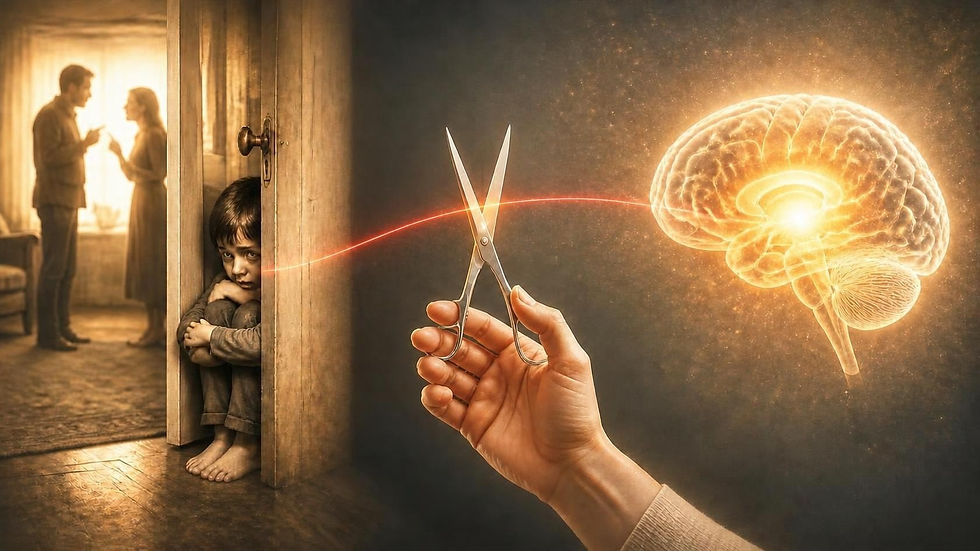
When something overwhelming happens, the brain does not only store what happened. It stores the alarm too.
Deep in the brain sits the amygdala, a small almond-shaped structure that works as our threat detector. In moments of fear, helplessness or shock, it tags the experience as dangerous. The tag is not imaginary. It is a physical change: a set of connections between nerve cells that becomes stronger and can stay that way for decades. The sights, sounds, smells and body sensations of that moment get locked into that pathway.
I call this a maladaptive neurosignal. Once, it protected us. Now it fires when there is no danger. A smell, a tone of voice, a date on the calendar or a passing thought can set it off, and the body reacts as if the old event is happening again: the heart races, the breath gets shallow, attention narrows. That is what each drop of ink really is.
This also explains a paradox I see all the time. The system exists to stop us from repeating danger, yet people are often drawn straight back to it. A child who grew up with an alcoholic parent may end up with a partner who drinks. Why? Because the brain treats what is familiar as predictable, and what is predictable as safe. A child who had food, a bed and a school alongside the abuse survived by accepting the whole package. The familiar became the template for safety. From the outside it can look like a choice, even an addiction to pain. It is not the person's fault. From the inside, it is a nervous system doing exactly what it was trained to do.
Calming the water is not removing the ink
People try many ways to clear the glass: willpower, positive thinking, prayer, breathwork, yoga, retreats, plant medicine, etc. I am not against any of these. There are very powerful transformational tools. Many of them calm the body, and calming the body is valuable. It often makes deeper work possible.
But calming the water is not the same as removing the ink. When fear fades simply through time or repeated calm experiences, the brain usually does not delete the old alarm. It builds a second, "safe" memory on top of it, and the old one stays in place. That is why fear so often comes back under stress, in a new situation or after a few months. The ink has settled at the bottom of the glass, and the next shake stirs it up again.
The pathway is biological, and biology is stronger than will, hope or imagination. If we want to change it, we have to work with the biology itself. That is where psychosensory modalities come in.
What psychosensory modalities are
Psychosensory modalities use the senses to change how the brain holds an experience. Touch, eye movement, sound, rhythm, breath and attention become the tools.
Most therapy works from the top down, through words and insight. That has its place. But the alarm lives in older parts of the brain that do not speak in words. Psychosensory work goes from the bottom up, through the body, which speaks their language.
The methods I draw on include:
Havening, developed by Dr. Ronald Ruden. While the person recalls a disturbing memory, they receive slow, gentle touch on the upper arms, palms and face, along with simple distractions such as counting or humming.
EMDR, where the person holds a memory in mind while following side-to-side eye movements.
Deep Brain Reorienting (DBR), which slowly tracks the very first split second of a shocking event, felt as tension around the eyes, forehead and neck, before any emotion arises.
Tapping, on set points on the face and body while focusing on a difficult feeling.
Somatic and attention work, tracking breath, body sensations and the felt sense of safety here and now.
They all share one principle: bring the memory up, then give the nervous system a new message through the senses at the same time.
Disconnecting the signal
For a long time, scientists believed that once a memory was stored, it was fixed forever. We now know that is not the whole story. When a memory is brought back to mind, it becomes open for a short time before the brain saves it again, like opening a document, editing it and pressing save. This is called memory reconsolidation, and it is the window psychosensory work uses.
I think of it in three steps:
Activate. The person brings the memory up, with its feelings and body sensations. This opens it.
Depotentiate. While the memory is open, the senses deliver a new message: soothing touch, distraction, a feeling of safety in the body. In Havening, this is believed to weaken the connections that hold the danger tag in the amygdala, a process called depotentiation. The pathway loses its charge.
Re-pattern. The brain saves the memory again, now linked with calm and safety instead of danger.
First we disconnect, then the brain reconnects differently. The facts stay. The alarm does not. In my practice, clients often describe it in almost the same words: "I can still remember it, but it feels far away." "It's just something that happened." The memory is not erased. The signal is disconnected, and the body is free to move on.
Why I combine modalities
Every drop of ink sits in many layers at once: the first jolt of shock, the images, the words, the body, the beliefs about ourselves, our habits and our relationships. One technique might reach the image but miss the tension in the shoulders. Another might calm the body but leave the belief "it was my fault" untouched. The signal survives in whatever layer was not reached.
That is why, in my work with clients, I combine. DBR meets the shock that comes before any emotion. Havening calms the alarm. Eye movements or tapping loosen a stubborn image. Attention to breath and body tells us whether the signal is really gone or only quieter. Conversation helps the person make sense of what has changed.
The skill underneath all of this is connecting the dots. That needs knowledge, experience and an open mind. Holding on to one method as the only truth is itself a restriction.
The mind as the sixth sense
We are taught that we have five senses. I believe we have six, and much older traditions, Buddhism among them, agree. The sixth is the mind. It perceives thoughts, memories and emotions the way the eyes perceive light. That is the psycho in psychosensory. A memory arriving in the mind is a sensory event, and the body answers it exactly as it answers the outside world.
I find it helpful to think of the brain like an AI. An AI is trained on huge amounts of data, and then answers our questions from that training. The brain is trained on a lifetime of experience. Every moment, it predicts what is about to happen, prepares the body for it, checks the prediction against the senses and corrects itself. Signal out, signal back, correction, again.
Trauma corrupts the training data. The brain learns to predict danger, so it keeps preparing the body for danger even when life is safe. Psychosensory work feeds new data into the system at the exact moment the old memory is open, so the prediction can finally update.
Attention points and multiple truths
Every lived experience is true for the person living it, even when two experiences contradict each other. For someone carrying trauma, going back to familiar pain is the truth of their experience. For someone without that history, it makes no sense. Both are honest. Understanding this cannot stay in the head. It has to be felt. Only then can we meet a person where they really are, without judgment.
Our attention is also spread across many attention points at once: the body, food and shelter, family, work, the car, the dog, the bills. Most of this runs in the background, without our awareness. If you want to see someone's attention points, don't listen to what they think about themselves. Look at what they do.
Modern life multiplies these points endlessly. Scrolling, notifications and news pull our attention away from the one place where healing happens: the senses, here and now. The past is a story. The future is a hypothesis. Only the present can be sensed, and psychosensory work brings us back to it.
What is possible
Any memory that keeps firing an old alarm can be worked with, not only big traumas:
fears and phobias, such as flying, dentists or public speaking
painful memories of loss, rejection or humiliation
anxiety tied to specific triggers
patterns that keep repeating in relationships
stress the body keeps holding long after the event
I won't promise miracles. Some of these methods, like EMDR, are well researched; others, like Havening and DBR, are newer and still being studied. What I can say from my own practice is that the principle holds: we work with mechanisms the brain already uses, and we test every result against the client's own experience.
Restoring the original settings
Under all that ink, the water is still there. Beneath every maladaptive neurosignal is a nervous system that knows how to rest. Psychosensory work does not install anything new. It removes what was blocking the original settings.
Awareness grows in stages. First we are unconscious of being unconscious, living on autopilot. Then we start noticing our patterns. Then we learn to stay present, at first with effort. Finally, presence becomes the default.
The word cybernetics, the science of feedback, comes from the Greek word for the steersman of a boat. I love that, because that is what this work is. A captain does not control the sea. A captain reads the signals, corrects course and learns the water. A captain with only one technique will hit the rocks sooner or later. A captain who reads the wind, the currents and the stars can steer through almost any storm.
The past stays what it was. But the signal it sends can change. When it does, we stop walking in the fog and start steering.
An invitation
If you have read this far, perhaps you recognise some ink in your own glass. A memory that still tightens your chest. A pattern that keeps returning, however hard you try. A part of your life that never seems to work, even when everything else does.
You don't have to keep carrying it, and you don't have to figure it out alone. This is the work I do at Mastering Harmony, where I am a qualified practitioner. Together we find the signals that keep you stuck, and we use psychosensory modalities to gently disconnect them, at a pace that feels safe for you.
The water underneath is still clear. It always was. If you feel ready to find your way back to it, I would be glad to help you take the first step.
Read more from Sabio Janiak
Sabio Janiak, Founder of Mastering Harmony
Sabio Janiak is a psycho-sensory specialist and human behaviourist, and the founder of Mastering Harmony. Over the past two decades, he has worked in 88 countries as a therapist, musician, and workshop facilitator, exploring the connections between sound, art, the nervous system, and human behaviour. He specialises in trauma resolution and nervous system regulation, helping individuals rewire stress-driven neural patterns and restore emotional balance. Using holistic modalities and applied neuroscience, Sabio empowers people to cultivate resilience, emotional clarity, and self-regulation. He continues to evolve the Mastering Harmony Method through individual sessions, group workshops, and practical training programs.
This article shares my perspective for education only and is not medical advice.