

What Do Rainbows Have To Do With Trauma Recovery?
Updated: Nov 22, 2022
Written by:Jessie RM Pandya, Executive Contributor
Executive Contributors at Brainz Magazine are handpicked and invited to contribute because of their knowledge and valuable insight within their area of expertise.

For many, and for me, an answer is that rainbows have a spiritual and religious meaning. They are signs of ‘blessing’, ‘good fortune’, ‘new beginnings’, ‘a promise of better things to come’. Rainbows are often deep symbols of ‘hope’.
In my experience, as an Integrative Somatic Trauma Therapist, I have discovered that ‘good memories’ are ‘rainbows’ of great safety and stability which can be catalysts for growth, change and healing. These ‘good memories’ are present in the lives of my clients and also myself. When I reflect during traumatic events, those stormy and darkly clouded days, when my thoughts and feelings are overwhelming and the ordinary distractions of daily life do not provide healing, the rainbow has helped.
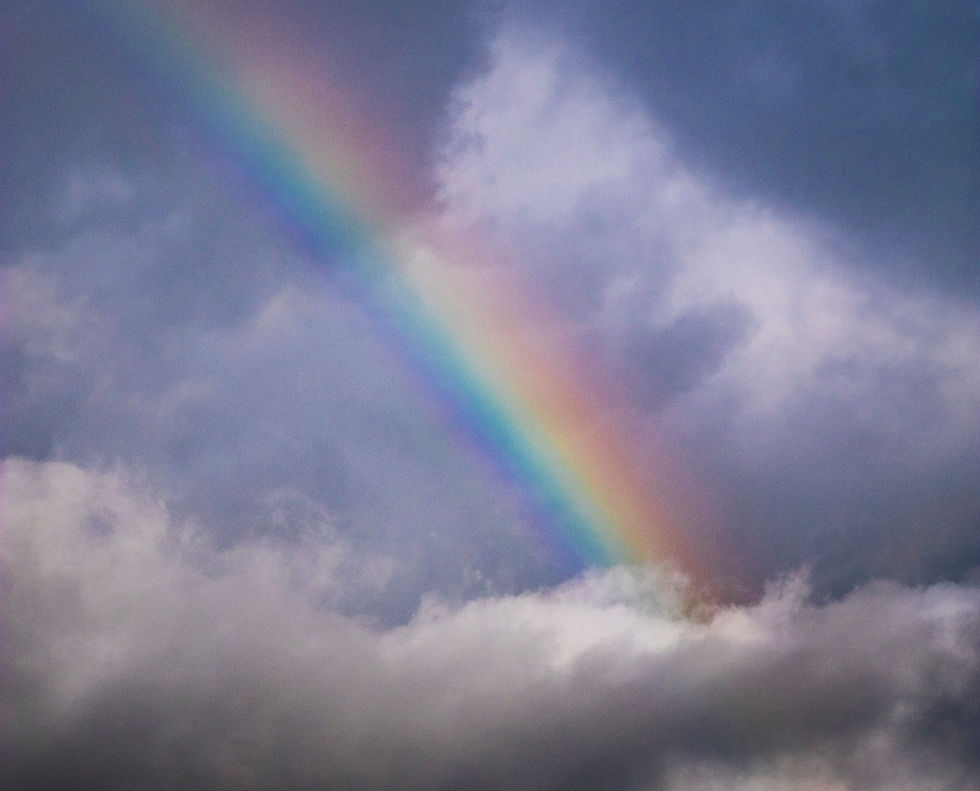
My last memory of a rainbow was faintly glimpsed though my living room window. My body felt heavy, my cheeks were wet with silent tears and my heart was empty with grief. My cousin, who was only 53 years old, had died of cancer. I cannot say I was close to my cousin but the news of his death struck me hard. Perhaps my feelings were provoked because he was only 7 years older than me and he was the first family member to have died from cancer since I had had my own double-trauma of cancer during the last 5 years. My thoughts and emotions were coming at me thick and fast – death anxiety, survivor’s guilt, anger and hopelessness in praying for his recovery and it not happening. I also yearned for a sign he was at peace.
That is when the rainbow appeared. It was faint, but it was there. Its arrival brought with it a kaleidoscope of ‘good memories’ about my cousin. How he undertook a daily hour’s train journey with his mum to console and comfort my family during the 14 customary days of Hindu mourning when my dad died 17 years ago. I did not remember what we talked about but could hear his distinct accent and his meaningful way of saying my name and asking me if I was ‘alright’. What he did I felt deeply and the rainbow reminded me of this ‘good memory’ and his impact on my wellbeing. I also remembered the last time we met, 2 years before his cancer diagnosis and during my own cancer recovery. “We don’t like keeping up with the Jones’s do we?” he joked. I found myself smiling as I remembered the last time I was with him.
One of my favourite clips about ‘good memories and rainbows’ is a short clip from an hour-long interview on a series called Masterclass (2011) for the Oprah Winfrey Network (OWN) television channel. I was first introduced to it during my intensive trauma training with world-renowned somatic trauma therapist and specialist educator, in the treatment of trauma and P.T.S.D, Babette Rothschild. The short clip, which can be found on YouTube shows the late Dr. Angelou sharing about how she bouys herself up, prior to undertaking stressful demands upon her life, by drawing upon the good memories of “everyone who has ever been kind to her”. Dr. Angelou recites a few lines from the nineteenth-century African-American song by Andrew Jenkins: When it look like the sun wasn’t going to shine anymore / God put a rainbow in the clouds. She further shares how she’s had many clouds, traumatic events, in her life but also experienced many rainbows. She then professes that she always has help because “I’ve had rainbows in my clouds”.
Everyone experiences the cloudy, rainy, stormy traumas of life. However, those are the moments that our minds, bodies, hearts and souls can remember and then be drawn gently and safely back into present wellbeing by the ‘good memories’, by the ‘rainbows’.
Visit my website for more info!
Jessie RM Pandya, Executive Contributor Brainz Magazine
Jessie RM Pandya, is a U.K. registered Integrative Somatic Trauma Therapist & Coach (MBACP), with over 25 years of experience in the Health, Wellness & Lifestyle industry. Jessie is a dedicated Trauma specialist, with a background in Nursing and Coaching. She is passionate about helping clients to address the root causes of Anxiety, Depression, Burn out, P.T.S.D, and Stress, which might be the result of a past or current traumatic event. Jessie has helped many clients to break free from the Trauma cycle and live to their fullest potential, without years of therapy. Jessie has undertaken further intensive Somatic Trauma Therapy training with world renowned author and trainer in the field of trauma Babette Rothschild. Jessie is passionate about transforming lives, through healing Trauma.







