The Ribcage-Pelvis Connection and the Missing Link in How You Move
Cristina Max is the founder of 110 Yoga and creator of the 110 Method, a movement re-education approach challenging the outdated belief that stretching is the answer to tightness and pain. She teaches people to restore the relationship between their ribs and pelvis to address the root cause of movement dysfunction, not simply chase the symptoms.

Have you ever wondered why you can stretch consistently, strengthen your muscles, and practice yoga regularly, yet still feel restricted in your movement? Sometimes the answer isn't in the muscles you're trying to stretch or the joints you're trying to mobilize. It may be in something much more fundamental: the relationship between your ribcage and your pelvis.
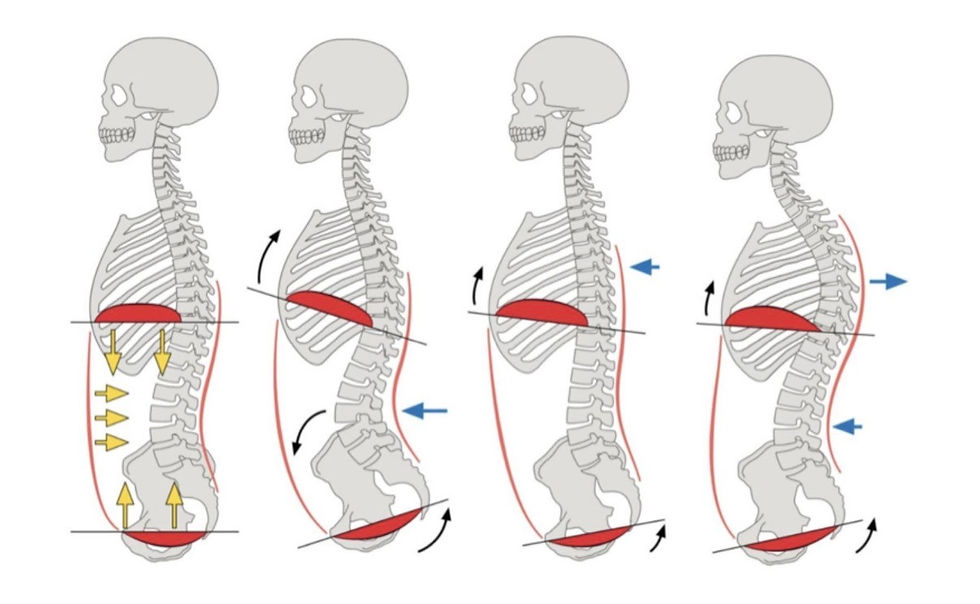
This relationship influences how we breathe, how we stabilize ourselves, and ultimately, how efficiently we move. Yet it's one of the most overlooked foundations of movement.
Why does the relationship between your ribcage and pelvis matter?
Think of your ribcage and pelvis as the two primary structures that organize your trunk. Between them sits your diaphragm, surrounded by the muscles that contribute to breathing and postural stability.
Ideally, these structures work together rather than independently.
When the ribcage becomes positioned excessively forward or upward relative to the pelvis, the body may rely on compensatory movement patterns to maintain balance and produce stability.
This can influence everything from how we stand and walk to how we perform familiar yoga poses.
The goal isn't to force the body into a rigid posture. It's to create a more functional relationship between these structures so the body can move with greater efficiency.
What does breathing have to do with alignment?
More than most people realize.
The diaphragm is both a respiratory muscle and an important contributor to trunk stability. Its position and relationship with the ribcage influence how pressure is managed throughout the abdominal cavity.
When we breathe, the diaphragm descends during inhalation and returns upward during exhalation. This coordinated movement works alongside the abdominal wall and pelvic floor.
However, if we're constantly relying on excessive spinal extension or lifting the ribcage to breathe, we may be limiting our ability to use the diaphragm efficiently.
Learning to breathe with a more organized ribcage and pelvis can help establish a foundation for better movement control.
It's not simply about taking a deeper breath. It's about understanding how the breath supports the body.
Why can poor positioning affect mobility?
Here's where things get interesting.
Mobility isn't determined by flexibility alone. It's also influenced by the position from which we attempt to move.
When one area lacks stability or control, another area may compensate by creating additional movement.
For example, someone who struggles to maintain pelvic and ribcage positioning during an overhead movement may compensate by extending through the lower back.
They might interpret this as a shoulder mobility restriction when the issue may involve how their trunk is organizing the movement.
This is why simply stretching the shoulders or lower back doesn't always change the underlying pattern.
Sometimes, the body doesn't need more range. It needs a better foundation from which to access the range it already has.
How can you begin changing the way you move?
Start by paying attention to your relationship with your breath. Try lying on your back with your knees bent and feet on the floor.
Gently exhale and allow your lower ribs to soften downward rather than pushing your chest toward the ceiling. Notice how your pelvis responds.
Take a quiet inhale, allowing your ribcage to expand without losing that relationship between your ribs and pelvis.
You aren't trying to flatten your back aggressively or force yourself into a particular position. You're exploring how breathing and positioning can work together.
From there, begin introducing movement while maintaining that connection.
This is the foundation of what I teach through alignment-based yoga at 110 Yoga: establishing stability before asking the body to move through more complex patterns.
The bigger picture: Movement starts with organization
One of the biggest misconceptions in fitness and yoga is that more movement, more flexibility, and more stretching automatically lead to better movement.
But movement quality isn't simply about how far we can go. It's about how well we can organize our bodies while getting there.
The relationship between the ribcage and pelvis is just one piece of that equation, but it's an incredibly important one.
When we begin to understand how breathing, positioning, and stability influence movement, we can move beyond simply chasing flexibility and start developing something much more valuable: a body that moves with intention, control, and efficiency.
Because ultimately, the way you move matters.
Learn more about alignment-based yoga
At 110 Yoga, we bridge yoga and movement science to help people develop greater awareness, stability, and mobility through intentional movement.
Read more from Cristina Max
Cristina Max, Founder of 110 Yoga & Creator of the 110 Method
Cristina Max is the founder of 110 Yoga and creator of the 110 Method, an alignment-based approach to movement re-education. After years of teaching and personally experiencing the cycle of stretching, injuries, and recurring tightness, Cristina began questioning the conventional approach to tightness and pain. Her work focuses on restoring the relationship between the ribs and the pelvis, building stability, and improving breathing mechanics rather than stretching tight areas. Through the 110 Method, she helps people understand the root causes of tightness and pain rather than chasing symptoms. She wants to help change how people understand their bodies so they can perform better and feel their best.