The Grief No One Names – Collective Trauma in the Iranian Diaspora
Updated: Jan 13
Sogol Johnson is an award-winning experience designer who left her Fortune 500 career on a mission to break generational cycles of trauma for the next generation. Founder of the Cycle Breakers Lab, Author of Wiggles McGee – The Magic Within, is an educator and somatic practitioner empowering individuals to reset and rewire their nervous system in order to thrive instead of survive.

I feel it as a tight, bottled-up anger that has nowhere to go, and at the same time, a strange dissociation. I scroll. I pause. I scroll some more, part of me dysregulated and part of me numb. My body is bracing for impact even though I am thousands of miles away. This is the paradox many of us in the Iranian diaspora are living right now. We are safe, yet not settled. Away, yet deeply entangled. Watching our homeland erupt while our nervous systems oscillate between rage, grief, guilt, helplessness, and even skepticism. Is this finally happening? Is this the final uprising?

What we are experiencing is not just empathy. It is collective trauma, unfolding alongside what is now the Iranian Revolution 2026, a moment marked by nationwide protests, internet shutdowns, mass arrests, and profound uncertainty about Iran’s future.
The loss that preceded the headlines
Before the protests, before the politics, before the global attention, there was already loss.
Loss of growing up with our relatives. Loss of cousins who became strangers. Loss of being shaped by grandparents whose love arrived through phone calls and stories instead of daily presence. Just up until March of last year, I had a perfectly wise and healthy grandmother, someone who lived long enough to meet her own great-grandchildren, a rare and beautiful position in a time when people are having children later in life. I missed her not only when she passed, but in every developmental moment she was absent. She met those great-grandchildren only through FaceTime, a flickering screen standing in for touch, scent, and shared air. A modern miracle and a quiet tragedy, compliments of the regime.
Diaspora loss is rarely recognized because it is quiet. There is no ceremony for the childhood that might have been. No language for the cultural intimacy that never fully formed. No acknowledgment that separation itself is a relational wound. Naming this loss is not meant to compete with or eclipse the bravery of those still inside the country. It is meant to give voice to those who suffer silently from afar, holding grief without visibility while others risk everything in plain sight.
Many of us grew up outwardly successful, educated, and resilient, yet internally unrooted. I wonder how much of the extraordinary achievement of Iranians we see outside the country is driven by an unspoken need to prove ourselves worthy, to finally be seen and heard.
We carry imposter syndrome on both sides, never fully immersed in either culture. From an early age, I learned that language itself could become a place of exile. I was ridiculed for speaking broken Farsi, for not knowing how to read or write it fluently, and yet still marked by an accent when I spoke English. Belonging, for many of us, becomes a moving target, elusive no matter which direction we turn.
Over time, it softens. Slowly, we find ourselves more fully immersed in a place that begins, at last, to feel like home. Yet something lurks inside, keeping an eye on the motherland, holding quiet hope from the edges. We do this because we know the country’s potential and the depth, intelligence, and beauty of its people.
Iran is not an empty or broken place. It is ancient, educated, artistic, and intellectually rich. Yet many in the diaspora grew up explaining ourselves, softening our pride, carrying grief and bone-deep empathy that does not belong to us personally, but to the circumstances imposed by the regime.
When the nervous system can’t look away or look anymore
As protests escalate across Iran in this revolution, those of us in the diaspora are witnessing events in fragments. Videos disappear. Accounts go silent. The internet is shut down, not just as a political tactic, but as a psychological one, severing connection and amplifying fear.
I once heard someone describe it this way. It is as if we are watching a gruesome show on television. At first, we are glued to the screen. Then our bodies cannot tolerate it anymore. So we pick up the television and throw it into the ocean.
But the show does not end. We know it is still playing. We know what we saw was real. And we cannot unsee it.
As collective trauma teacher Thomas Hübl reminds us, trauma does not disappear when we turn away from it. What is not consciously witnessed, metabolized, and integrated does not simply fade. It continues to live in the collective field, shaping our emotions, reactions, and sense of time, even when we believe we have disconnected.
When the nervous system is overwhelmed and powerless to intervene, it chooses distance. We disconnect, limit exposure, grow skeptical, or go numb. Not because we do not care, but because staying fully present feels unbearable.
Collective trauma lives beyond the individual
Collective trauma does not only live inside individuals. It lives in families, communities, cultures, and the relational space between us. When overwhelming events are not metabolized together, they create fragmentation, silence, and a shared sense of stuckness.
For diaspora communities, this trauma is compounded. We are emotionally tethered to a collective nervous system that is actively under threat while physically removed from the places where grief, protest, and mourning are happening. The result is a persistent sense of inertia, activated, alert, and yet unable to move.
Why anger, guilt, and dissociation coexist
Anger is often the most honest response. Anger at injustice. Anger at silence. Anger at repetition. But anger without agency overwhelms the nervous system. When action feels impossible, the body shifts toward numbness, intellectualization, or withdrawal. That’s where I am. Withdrawal.
This is not apathy. It is protection.
Trauma teaches us that what overwhelms us without support becomes embedded. Distance does not shield the nervous system when identity, attachment, and memory are involved. Safety is not only physical. It is relational and emotional.
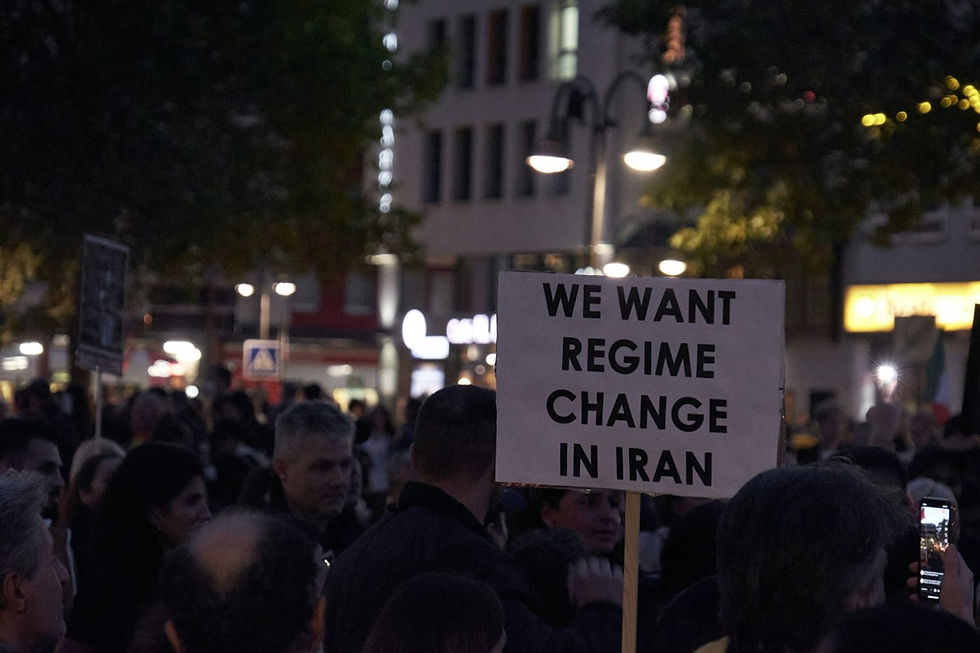
What we do to escape the feeling of inertia during the Iranian Revolution, 2026
When the body senses prolonged helplessness, it will reach for anything that restores a sense of movement or control. And right now, that helplessness is sharpened by not knowing. By the brutal regime shutting down Starlink. By messages that stop delivering. By gaps in information that force the imagination to fill in the worst possibilities.
We refresh feeds that no longer update. We wait for check-ins that do not come. We live with the unbearable ambiguity of not knowing who is safe, who has been arrested, who is injured, or what is truly unfolding on the ground.
So we try to move the energy somehow.
We work harder. We overanalyze. We argue online. We donate, repost, organize, withdraw, binge, scroll, numb, or intellectualize.
None of these behaviors is wrong. They are attempts to regulate a nervous system caught between responsibility and powerlessness, between deep attachment and total lack of control.
The problem is not that we want to feel better. The problem is that we are trying to resolve a collective wound individually, while the collective itself is under siege.
Healing collective trauma does not mean forcing constant engagement or pretending there will be a clean resolution. It does not come with a clear ending or a reassuring narrative. There is no guarantee of how this will feel healing in the end, or when.
What it asks instead is the capacity to stay present without collapse. To grieve without certainty. To hold fear, hope, and love at the same time.
That may look like grieving the family and culture you never had. Allowing anger to inform values rather than consume the body. Choosing conscious action instead of compulsive reaction, even when answers are scarce.
Being in the diaspora does not disqualify your pain. It contextualizes it.
We carry our homeland in our nervous systems, not because we choose to, but because attachment does not dissolve with distance. The work now is not to disconnect, but to ground. To metabolize grief without becoming immobilized by it.
Anger can become clarity. Grief can become a witness. Loss can become remembrance without despair.
And grounded presence, even from afar, is not passive. It is how collective healing begins, even when the outcome is still unknown.
Read more from Sogol Johnson, MA, TICC, ACC
Sogol Johnson, MA, TICC, ACC, Author and Founder of the Mental Gym Program
Sogol Johnson, an award-winning designer with a master’s in Human-Centered Design, left her Fortune 500 career as a strategist to focus on breaking the cycle of generational trauma. Now an educator, writer, and advocate for healing childhood trauma, she combines her expertise in Neuro-Linguistic Programming (NLP), Somatic Therapy, and trauma-informed coaching to empower parents and communities through self-parenting and healing practices.