

The Future of Work isn’t a Tool, It’s a Team
Written by Harriet Bodö, Executive Coach & Mentor
Harriet Bodö has spent years on both sides of the relationship, as a client and today as an executive coach and mentor, across programs in leadership, business development, and change management. That vantage point shaped Coach Me & More, where she is also a certified board member, advisory board member, and keynote speaker.

Hybrid work, AI, and four generations under one roof are reshaping how we work, and many of us have quietly lost the habit of working together. Here is why the teams that invest time in each other, in person or online, will lead what comes next.
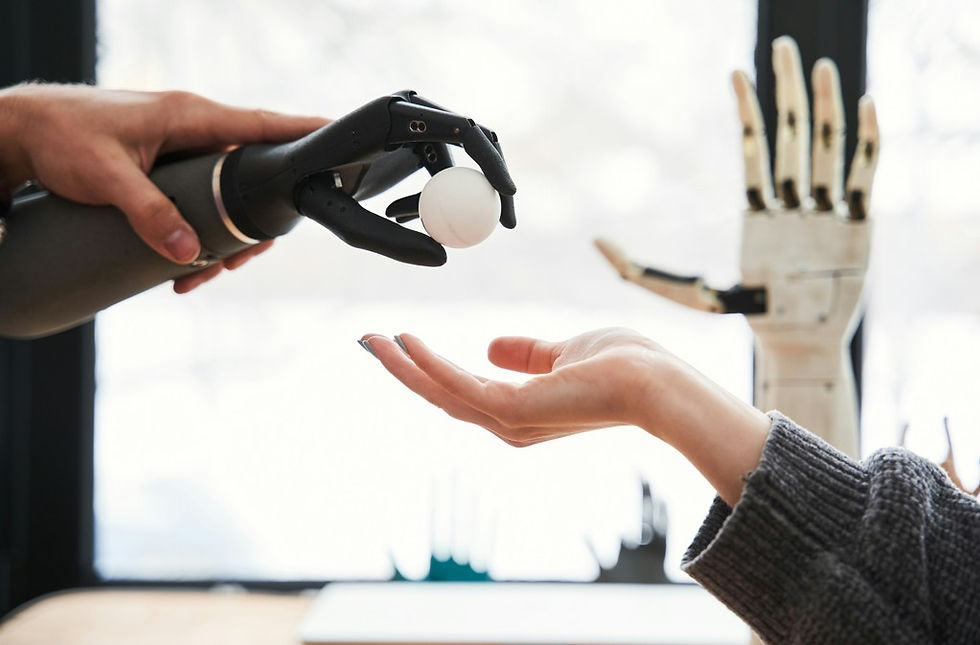
Earlier this month, I spent three hours with professionals from a range of industries, alongside students about to enter working life. Some of us were in the room, while others joined online, and the subject was the future of work. I opened with a simple question for pair discussion. What has changed most in your work over the past two years? Within seconds, the conversation was flowing, in the room and on screen alike. Hybrid work. Four generations under one roof. AI moving from distant vision to everyday colleague. Constant interruptions. People joining and leaving faster than ever. Everyone had a story, and nobody needed long to find it.
The future of work is no longer something we are preparing for. It has already arrived. After more than 700 hours of coaching, having mentored over 200 leaders and worked with more than 100 teams and management groups, one question keeps surfacing: whether I am working with leadership teams and boards, coaching individual leaders, or mentoring them. When everything is changing, what really matters?
None of us has all the answers. What I am increasingly convinced of is this. The organisations that will thrive will not be the ones with the most tools. They will be the ones that invest time in working together. Time to talk. Time to build trust. Time to become a team, in person, online, or both.
Is change still a project?
I have been training and speaking on the future of work since 2018, and I have never seen a pace like this. The shift we are living through is at least as significant as the move to the five-day working week, and quite possibly greater. Change used to be a project, with a beginning and an end. Today, it is simply the way things are. The “new normal” has quietly given way to the “next normal”, and that, in turn, to whatever follows. In my first article for Brainz, “Change management is broken. More speed won’t fix it.” In Change Management is Broken, and More Speed Won't Fix It, I argued that running faster is not the answer. That still holds.
What has changed is the purpose of leadership. Leaders once held the advantage of information. They decided, they planned, and everyone else carried out the plan as instructed. That model no longer holds. When the landscape shifts beneath your feet, no one can lead by having every answer. People need to be able to lead themselves, and autonomy only works within a clear structure, with well-defined goals, explicit expectations, and genuine follow-up. Leadership is becoming a core skill for everyone, not only for those with the title.
Relearning how to work together
Leading ourselves depends on something many of us have quietly fallen out of practice with: working together. The pandemic did more than move work into our homes. It rewired the way we collaborate. When Microsoft shifted its workforce to remote work, a study of more than 60,000 of its employees, published in Nature Human Behaviour, found that collaboration became more siloed and static, with fewer connections between groups and more communication confined to existing circles. The work carried on. People simply stopped reaching beyond their own teams.
Many organisations have never fully rebuilt those habits. Hybrid became the default, and collaboration was left to chance. Onboarding moved onto a screen. The informal moments in which trust used to take root–the coffee, the corridor conversation, and the walk out to the car park–disappeared without anyone ever deciding they should.
Meanwhile, the team itself keeps evolving. Four generations now work side by side, each with its own expectations of work, loyalty, and feedback, and its own sense of what a job should mean in a life. People move on more quickly, and loyalty can no longer be taken for granted.
Swedish research points in the same direction. In a Demoskop survey for the training and staffing company Lernia, nearly one in four Swedes said the pandemic had weakened their social skills. A study led by Christina Bodin Danielsson at KTH Royal Institute of Technology found organisations describing a weaker sense of “we”, a shift from the shared to the self-interested. Microsoft saw the same pattern in its data. When we stop meeting across team boundaries, we gradually lose not only the habit of working together but also some of the ability to do so. Collaboration is a skill, and like any skill, it fades without practice. That is not a failing. It is simply where we find ourselves. The organisations now pulling ahead are those that have recognised this and begun to practise again deliberately.
Leaders running on empty
Leaders feel all of this more than most, and the numbers show it. Gallup’s State of the Global Workplace 2026 report found that global employee engagement fell to 20% in 2025, its lowest level since 2020. The steepest decline is not among employees. It is among managers. Manager engagement dropped from 31% in 2022 to 22% in 2025, erasing the engagement advantage managers once held over the people they lead.
In other words, the very people we rely on to guide teams through constant change are running on empty, and many of them are doing it alone. That raises an uncomfortable question. How can anyone lead continuous transformation and balance demands pulling in different directions when their own engagement is running dry? Do we have the wrong leaders today? Or are the conditions for leading the wrong ones, or missing altogether? Too many direct reports, too little time, and too few places to think out loud?
The same report suggests where the answer lies. Gallup finds that manager engagement falls as teams grow larger, although strong talent and training can offset the effect. In the organisations Gallup identifies as best practice, 79% of managers are engaged, almost four times the global average. Industry and region do not explain the difference. How people are led, supported, and developed does. That is a choice. It is also a matter of time.
AI as a new colleague
Into all of this steps the newest member of most teams, and it is not a person at all. AI is already woven into how work gets done, and in many respects, it makes an excellent colleague. A sounding board at any hour. A way to automate the routine. Genuine relief on a crowded workday. AI is an integral part of my own business, and I would not want to work without it.
Like any new colleague, it needs a proper introduction. AI sounds confident even when it is wrong, and it tends to agree with you rather than push back. It can even be used to manipulate, lending polish to the answer we wanted all along. It also changes the rhythm of work, often intensifying it rather than lightening it, which I explored in my previous article, “AI freed up your time. Who decided where it went?”
One question from the workshop has stayed with me. What happens when we ask AI instead of asking each other? Every question we put to a chatbot rather than a colleague is a conversation that never takes place, an insight that is never shared, and a relationship that never deepens. AI does not need to replace collaboration in order to erode it. It only needs to make it unnecessary often enough.
That is why a new colleague calls for shared ground rules. Do we disclose when we have used AI? Who reviews the output, and how thoroughly? What do we never share? Who is accountable for the final result? When do we always involve a human? You can delegate the task. You can never delegate the responsibility.
Ground rules are only half of it. The other half is learning together. We used to learn by sitting next to each other, overhearing how a colleague handled a difficult client or cracked a problem we had been stuck on for days. With so much of our work now virtual, and with an AI colleague that changes almost from one week to the next, that kind of learning no longer happens on its own. Who shares the prompt that saved them an afternoon? The agent that actually works? The experiment that went nowhere? Unless a team deliberately makes room for it, everyone ends up learning alone, and the team as a whole learns very little.
Community is an investment
Time together is exactly what many organisations have cut in recent years. The off-site disappeared. The coffee break turned into a status update. The team day was quietly downgraded to “nice to have”. The logic may look sound on a spreadsheet. I believe it is a costly mistake. Community is the ground in which engagement, creativity, and innovation take root. It is not the reward for good results. It is one of the reasons you achieve them.
I was reminded of this myself not long ago. In the space of a single week, I kept running into people I had worked and studied with years earlier, at an airport gate, over lunch, and at a hotel breakfast. We picked up exactly where we had left off, as though no time had passed. When I asked myself why those relationships had endured, the answer was obvious. We had spent real time together. We shared coffee breaks, studied and trained together, travelled together, and worked shoulder to shoulder on things that mattered. We disagreed, rolled up our sleeves, laughed, occasionally cried, and exchanged a few hard words along the way. That is what made the trust real. The tools we used back then are long gone. The relationships remain.
Online, hybrid, or in person
Many leaders tell me their teams are simply too spread out for this. Location is not the deciding factor. Intention is. Connection does not happen by chance once people no longer share a corridor. It has to be designed. The workshop I described at the start was itself hybrid, and the conversations that mattered happened across the screen just as much as across the table. In my work with more than 100 teams and management groups since 2018, the teams that hold up best under pressure are rarely the most skilled on paper. They are the ones that have made time to know each other. What does not work is having no time at all. Two protected, well-structured hours a month will achieve more than one expensive day a year that everyone has forgotten by spring. The format is flexible. The time is not.
3 ways to invest the time
Introduce your new colleague together: Agree as a team on your ground rules for AI, and keep three questions close. Where do I pause before acting? What do I always take to a human? What will we use the time for? A shared conversation about a new colleague is also a conversation about how you work with one another.
Share what works and what doesn’t: Make regular room to swap prompts, tools, and lessons, including what didn't go to plan. Openly shared setbacks are how psychological safety is built in practice, not just in theory.
Protect the rhythm, not the event: Team development is not a kick-off. It is a habit. Short, regular, honest time together, in person, on screen, or both, compounds in a way no single event ever can.
Lead like Pippi Longstocking
No one knows exactly where this transformation will lead. That means we have to experiment, ask questions, and step outside our comfort zones together. Astrid Lindgren’s Pippi Longstocking captured the spirit better than most management books. She has never tried it before, so she is quite certain she can do it. My own version is my motto. Either you win, or you learn. Not everything we try will succeed. That is precisely the point. Learning grows when it is shared, and it is shared when there is the time and the safety to do so.
What prepares us for the future is rarely the latest tool. It is our experience, what we have learned, the moments we challenged ourselves, and the people who walked alongside us. AI can be a brilliant colleague. It cannot live those experiences for us, and it cannot replace the relationships that shaped us. The future of work will be built by teams that make time for one another.
So let me leave you with a question. What have you never tried before that you are certain you can do?
Read more from Harriet Bodö
Harriet Bodö, Executive Coach & Mentor
Harriet Bodö became an executive coach and mentor after experiencing, as Head of Department, what a real difference that support makes for leaders who often carry decisions alone. In 2018, she turned that conviction into Coach Me & More, a Finland-based coaching and leadership development practice working with leaders, leadership teams and boards across the Nordic region. She holds a Master's degree in Economics from Hanken and is an ICF-certified executive coach, with 700 hours of coaching experience and more than 200 leaders coached and mentored. She is a certified board member (HHJ), holds board and advisory board assignments, and is a keynote speaker on leadership, transformation, and psychological safety.







