The Founder Ceiling and Why the Strengths That Built Your Company Now Limit Its Scale
Updated: Feb 12
Written by Shery Saeed, Executive Coach & CEO Advisor
Shery Saeed is a transformational executive coach and trusted advisor to bold CEOs, visionary founders, and culture-shaping leaders. With over 25 years of experience navigating high-stakes leadership moments, she blends strategic rigor with deep psychological insight to help clients lead with clarity, scale with conviction, and evolve with purpose.

There is a moment in many companies that almost no one names out loud. Revenue is growing. The team is bigger than ever. Investors are engaged. From the outside, it looks like success. Inside, something feels tight.
Decisions take longer. Meetings multiply. Energy diffuses instead of concentrates. The instinctive response is to look for tactical fixes: new hires, a sharper strategy, a better operating plan.
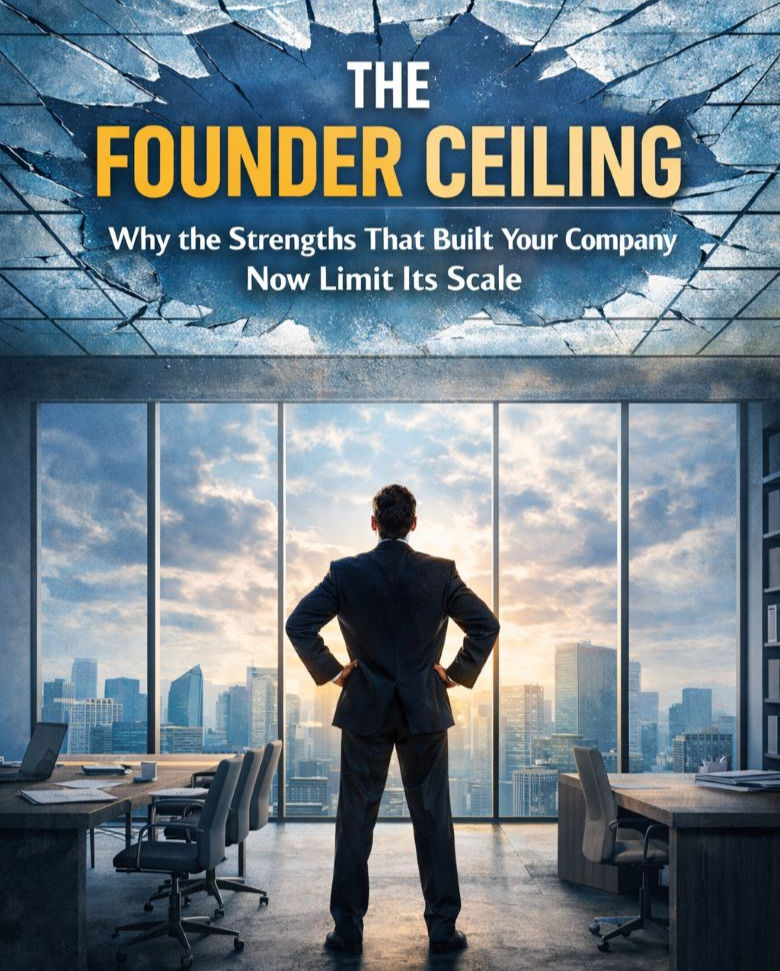
But often the real constraint isn’t operational. It’s personal. Specifically, it’s the identity of the founder. The very traits that got the company off the ground, scrappiness, speed, heroic individual effort, intuitive decision-making, become the hidden ceiling that keeps it from scaling. This is what I call the Founder Ceiling.
The skills that launch are not the skills that scale
Early-stage success rewards intensity and control. The founder knows everything, touches everything, decides everything. They are the culture, the product instinct, the sales engine, and the safety net.
That concentration of power is an advantage at the beginning. It creates coherence and velocity when resources are scarce and time is existential. But as the organization grows, that same concentration becomes a bottleneck.
If every meaningful decision still routes through one person, leaders hesitate, ownership fragments, execution slows without anyone ever saying “stop.”
The founder works harder than ever and yet feels further from the work that matters. Not because they are failing. Because they are succeeding with the wrong operating system.
I recently worked with a founder whose company was growing quickly, yet three expansion initiatives had stalled at once. Each team was waiting for clarity on which market to prioritize. All options were reasonable, so the decision kept being postponed.
Nothing was technically wrong. But execution slowed across the organization while everyone waited for the founder to choose. The company wasn’t stuck because of strategy. It was stuck because no one else could decide.
Many founders privately admit something even harder. They feel strangely trapped inside the very company they built. Most founders don’t have a strategy problem. They have an identity problem.
At this stage, the question is no longer, “What should the company do?” It becomes: “Who must the founder become so the company can make some decisions without them?”
That shift is psychologically harder than any strategic pivot. It asks founders to give up the behaviors that made them exceptional in the first place:
Being the smartest voice in the room
Being the fastest decision-maker
Being the one who always knows
And replace them with less visible, less immediately gratifying capabilities:
Building decision capacity in others
Tolerating slower first drafts from the team
Choosing direction instead of providing answers.
This is not a refinement of the founder identity. It is a release of it.
The danger of becoming an “almost CEO”
Many founders make partial moves. They delegate tasks but not authority. They hire executives but keep the real calls for themselves. They talk about empowerment while quietly maintaining veto power.
From the outside, it looks like evolution. From the inside, the organization feels two conflicting signals, “Step up” and “stay in your lane.”
The result is polite paralysis. Teams stay busy. Initiatives multiply. But the company stops making the few hard, consequential decisions that could change its trajectory. Ambiguity becomes the silent tax on growth.
The danger is rarely a dramatic collapse. More often, the company plateaus quietly while faster, clearer competitors pass it. Strong executives eventually leave because they cannot truly own outcomes. And in many cases, founders aren’t replaced because performance collapses, they are replaced because growth quietly stops.
Today, the ceiling also shows up in how founders build influence
Increasingly, founders discover the ceiling isn’t only inside the company. It shows up in how opportunity reaches them as well.
Many founders still believe opportunity comes from expertise alone. Build a great company. Get results. Then clients, investors, and talent will find you.
But in today’s environment, influence often precedes opportunity. The founders attracting the best deals, talent, and partnerships are those who built audience and trust long before they needed monetization.
They speak not only to business mechanics but to founder reality:
Insecurity
Loneliness at the top
Identity shifts
Failure
Self-doubt
Pressure of success
Because business decisions are emotional before they are strategic. Founders don’t just buy frameworks. They buy relief. Clarity. Confidence. Identity upgrades.
Leaders who understand this don’t operate only as executives. They become platforms of influence. They build gravity. And opportunities begin coming inbound instead of always being chased outbound.
Growth requires subtraction, not addition
The instinct at this inflection point is to add: more process, more meetings, more frameworks, more options. But the breakthrough usually comes from subtraction. One path, not two.One owner, not five stakeholders.One clear call, even if imperfect.
When founders consciously kill the alternative futures, they’ve been keeping alive “just in case,” something shifts. Execution sharpens. Momentum returns. The organization exhales. The company was not waiting for more thinking. It was waiting for a decision.
A useful diagnostic question. If you stepped away for two months, would the company accelerate, stall, or freeze? The answer often reveals where real authority still sits.
From founder to CEO is an identity shift, not a title change
Becoming a CEO is not about acting more corporate or less creative. It is about moving from “I build and drive” to “I design and enable.”
From personal excellence to institutional excellence. The founder’s job was to be indispensable. The CEO’s job is to make themselves progressively unnecessary in the day-to-day, so the company becomes unstoppable.
That transition is where many great companies stall, and a few great ones break through. Not because of better ideas. Because of braver identity shifts. And because the founder was willing to evolve faster than the company’s needs.
The invitation
If you are a founder sensing that your company is no longer limited by talent, capital, or opportunity, but by something harder to name, you may be approaching this ceiling.
The way forward is not to work harder inside your current identity. It is to outgrow it. The Founder Ceiling is not a verdict on your past success. It is an invitation to your next form of leadership. The companies that scale are not led by refined founders.
They are led by former founders who were willing to become someone new before the company forced the change. This is the shift explored in depth in my forthcoming book, The Founder Ceiling, a guide for founders ready to become the CEO their company now requires.
Read more from Shery Saeed
Shery Saeed, Executive Coach & CEO Advisor
Shery Saeed works with founders and CEOs at the moment when success starts to feel heavier instead of easier. Known for her Founder Ceiling framework, she helps leaders evolve their identity, decision-making, and leadership model so their companies can scale beyond founder dependence.
Drawing on decades of transformation work with executives and growth-stage companies, Shery focuses on the human side of scale, where leadership evolution and business performance rise or stall together. Her forthcoming book, The Founder Ceiling, explores why strong companies plateau and how founders can become the CEO their next stage requires.