

The Black Sheep Was Never the Problem
Chris Suchánek is the Founder and Chief Strategy Officer of Firm Media, an award-winning national marketing agency specializing in helping plastic surgery, oral surgery, and med spa practices thrive.

For most of my life, I thought my childhood was normal. When you are raised in an abusive family, you do not know you are living inside dysfunction because dysfunction is all you have ever known. Chaos feels like love. Walking on eggshells feels like respect. Keeping secrets feels like loyalty. A taxed nervous system does not feel like trauma. It simply feels like life.
You do not realize you are surviving because survival is all you have ever experienced. Hypervigilance, people pleasing, perfectionism, and overexplaining do not feel abnormal. They become your personality.
Until one day, you realize they were never your personality at all. They were your nervous system doing exactly what it was designed to do: keep you alive.
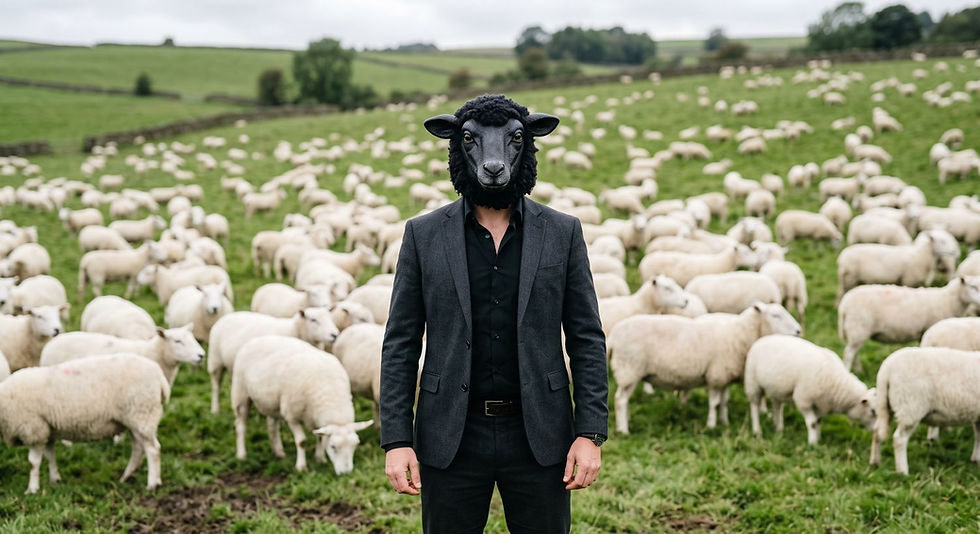
My sister could no longer carry that weight. She folded under the pressure and took her own life. Even then, I could not see what had happened. Our family had spent years assigning her the role of the “crazy one.” She was the black sheep, the difficult one, the unstable one, the problem.
That story protected the rest of us from asking a much harder question: What if she was not the problem? What if the system was?
It was easier to believe she was broken than to admit we were all living inside something deeply unhealthy. Years after losing my sister, the spotlight shifted. The same manipulation, blame, guilt, and character assassination that had once been directed at her was now directed at me. I was being handed the black sheep hat.
For the first time, I saw the pattern clearly. The black sheep is not usually the bad child. The black sheep is the one who refuses to participate in the lie. Healthy families solve problems. Dysfunctional families assign them. Someone must carry the blame so everyone else can avoid looking in the mirror.
Recognizing that truth sent me on a journey of healing. I began learning about complex trauma, not because I wanted to relive my past, but because I wanted to understand why, after building successful businesses and raising a family, I still felt like I was surviving instead of living.
What I discovered changed everything: my childhood had not stayed behind me. It had simply changed jobs.
As I learned more about trauma, I began recognizing parts of myself that I had mistaken for personality traits. Hypervigilance became the ability to anticipate business problems before anyone else. People pleasing became exceptional customer service. Overexplaining looked like communication. Isolation looked like independence. Freezing looked like staying calm under pressure. Self-abandonment looked like sacrifice. Shame became relentless achievement.
For years, other people praised these qualities. So did I. But healing taught me something I never expected. Many of the traits that helped make me successful were not strengths. They were survival skills.
They were not flaws or weaknesses. They were brilliant adaptations created by a child’s nervous system trying to survive an unsafe environment. The problem was not that I developed them. The problem was believing I still needed them.
Hypervigilance was not always intuition. Sometimes it was my nervous system expecting danger. People pleasing was not always kindness. Sometimes it was the fear that saying no would cost me love. Overexplaining was not always transparency. Sometimes it was an attempt to prove I was not the problem before someone else decided I was.
The greatest gift trauma recovery gave me was not discovering how broken I was. It was discovering how resourceful I had been. Every one of those responses existed for one reason: to keep me alive. But the behaviors that protect us as children can imprison us as adults.
That realization changed how I lead. The dynamics we learn in childhood can quietly follow us into the workplace, shaping how we communicate, respond to conflict, and approach accountability. I believe healthy organizations address challenges directly and constructively without assigning blame or creating a villain.
As a leader, I strive to build a culture where accountability exists without humiliation, and people feel empowered, even when the conversation is difficult. That lesson did not come from business school. It came from surviving an abusive family.
Today, I experience something I never thought was possible: freedom. I have the freedom to be 100 percent unapologetically myself, not because everyone accepts me or understands me, but because I no longer need their permission to be who I am.
I think about my sister often. I wonder what her life might have looked like if someone had told her she was not crazy, broken, or the problem. She was carrying a burden that never belonged to her.
I cannot change what happened to her, but I can honor her by refusing to continue the cycle. I can tell the truth, build healthy relationships, create healthy organizations, and refuse to participate in character assassination disguised as love.
If you have ever been called too sensitive, too emotional, too difficult, or the problem, ask yourself one question: Who benefits from you believing that?
The black sheep is not the person who breaks the family. More often than not, the black sheep is the first person courageous enough to stop pretending the family was not already broken.
I once believed the greatest achievement of my life was building successful businesses. It was not. My greatest achievement has been becoming myself. Not the version trauma created or fear protected.
Just me. Unapologetically. Completely. Free.
Read more from Christopher A. Suchánek
Christopher A. Suchánek, Founder, Chief Strategy Officer, and Speaker
Chris Suchánek is the Founder and Chief Strategy Officer of Firm Media, an award-winning national marketing agency specializing in helping plastic surgery, oral surgery, and med spa practices thrive. With over 25 years of experience spanning the entertainment and specialty medical sectors, Chris has worked with iconic brands like Warner Bros., MTV, and EMI Music, earning international acclaim, including a Grammy Award with Brainstorm Artists International.


