The Becoming Audit and Stop Waiting to Find Yourself, Start Creating Yourself
Written by Miss K, Founder & Host of Uncaged Mind
Miss K is the founder and host of Uncaged Mind, a platform for fearless conversations that challenge conventional thinking and question what we are taught to accept. Guided by "Where Curiosity Leads", she is creating a space where no topic is off-limits, no question is too bold, and curiosity refuses to be caged.

We are often told to “find ourselves,” as though somewhere underneath the noise there is a finished version of us waiting to be discovered. But what if identity is not only something we uncover? What if it is also something we build? The Becoming Audit is an invitation to stop treating your future self as a mystery and start paying attention to the choices, experiments, failures and repeated actions that are already creating who you are becoming.
What is the Becoming Audit?
The Becoming Audit started with a question I kept returning to: how much of becoming ourselves actually happens through discovery, and how much happens through participation?
We often talk about identity as though there is one true version of us hidden somewhere inside. We say we need to find ourselves, discover our purpose or figure out who we really are. There can be value in that kind of reflection, but I think it tells only half the story. We also learn who we are by living.
You learn that you are capable by doing something before you feel capable. You discover what matters to you by experiencing what does not. You develop standards after seeing what happens when you abandon them. You find new interests by entering rooms you never thought belonged to you. Sometimes you discover an entirely different version of yourself simply because you finally gave that person something new to respond to. That is what I mean by becoming.
The Becoming Audit is not about inventing a fake, perfect future version of yourself. It is about becoming more intentional about the relationship between who you are today and who your current choices are creating.
Instead of endlessly asking, “Who am I?”, it introduces another question, “Who am I becoming?” Then, importantly, “What am I doing to participate in that?”
1. Meet them first: Create your highest self clearly
Before you can intentionally become someone, it helps to know who you are actually trying to become.
When I talk about your “highest self,” I don’t mean imagining a flawless person who wakes up at 5 a.m., never procrastinates, always feels confident and somehow has every area of life perfectly organised. That kind of ideal can quickly become another impossible standard. Your highest self is better understood through qualities.
How does this person respond when something does not go according to plan? What standards do they have? What do they tolerate and what do they no longer tolerate? How do they speak to themselves? How do they handle money, relationships, ambition, rejection, uncertainty and rest? What kind of friend are they? What kind of work do they want to create? What do they do when nobody is watching?
The clearer that person becomes, the more useful the idea becomes in real life. This matters because old patterns rarely announce themselves as old patterns. They usually arrive disguised as comfort. “Do it tomorrow.” “Don’t say anything.” “You aren’t ready.” “Stay where you already know how things work.”
In those moments, having a clear picture of the person you are becoming gives you another reference point. Instead of only asking what feels easiest today, you can ask what the person you are trying to become would practise here.
Create your highest self so clearly that you have someone to become when your old patterns ask you to stay the same.
2. Put it to the test: You cannot think your way into knowing yourself
There is only so much you can learn about yourself through introspection. At some point, you have to test the theory.
Try something. Fail at it. Become unexpectedly good at something else. Change direction. Enter a room where you feel completely inexperienced. Have a conversation you normally would avoid. Take an opportunity before you have managed to convince yourself that you are ready.
We sometimes wait for certainty before acting because we assume we should know exactly who we are before making decisions. But many parts of identity become visible only after action.
You may think you dislike leadership until someone gives you responsibility for something you genuinely care about. You may think you are not creative because you have only experienced creativity in forms that do not interest you. You may believe you are shy until you enter an environment where you finally feel like you belong.
Even failure gives you information that thinking alone cannot provide.
This is something I have learned through my own journey as well. Some of the things that have taught me the most about myself came from saying yes before I had a complete picture of where that yes would lead. Not everything worked. Not everything needed to.
Because the point of trying is not always succeeding. Sometimes the point is finding out. You cannot learn who you are by only doing what you already know.
3. Nothing is wasted: Treat experience as evidence
One of the easiest ways to become afraid of experimentation is to believe every decision has to work.
If success is the only outcome we consider valuable, every wrong turn starts looking like wasted time. I don’t see it that way.
A decision can be wrong for your future and still teach you something useful about it. A relationship can end and clarify what you need from the next one. A career path can disappoint you and reveal the kind of work that actually energises you. A project can fail and show you a skill you need to develop. Even achieving something you thought you wanted can teach you that wanting it and enjoying the reality of it are two different things.
Experience leaves evidence. Every win, mistake and wrong turn gives you information about what fits you, what does not, what matters more than you realised and what deserves another attempt.
The important part is actually collecting that evidence. Without reflection, we can repeat the same experience without learning very much from it. We call ourselves unlucky, blame ourselves entirely or rush immediately into the next thing without asking what the previous experience revealed.
A Becoming Audit changes the question from “Did this work?” to “What did this teach me?”
Sometimes the answer will be that you need to try again differently. Sometimes it will be that you need more practice. Sometimes the lesson will simply be that this path is not yours.
Knowing what is not for you is still knowledge.
4. Comfort can’t choose for you: Familiar does not always mean right
Comfort is not the enemy.
We need familiarity, stability and rest. A life lived in constant discomfort would not automatically be a meaningful one. The problem begins when comfort becomes the person making all of our decisions.
Human beings naturally gravitate towards what we know. Even an unsatisfying situation can feel strangely safe when it is predictable. A familiar identity can be difficult to leave because we already understand the rules of being that person.
Growth often interrupts that familiarity. Maybe an opportunity appears that requires you to become more visible. Maybe a relationship requires stronger boundaries. Maybe you realise that the career you have spent years preparing for no longer excites you. Maybe your ambitions become larger than the environment around you understands.
The familiar option will often ask less of you. That does not automatically make the difficult option correct. We should not romanticise discomfort or make reckless decisions simply to prove that we are growing.
But once something genuinely shows you who you could become, fear should not be the only voice allowed to vote.
There is a difference between choosing something because it is right for you and choosing it because you already know how to survive there.
Part of becoming is learning to recognise that difference.
5. Leave evidence: Make one choice your future self would make
A future identity becomes useful only when it enters the present.
It is easy to imagine a more disciplined, confident, courageous or self-respecting version of ourselves. It is much harder to make the small choices that would give that person somewhere to begin.
This is where becoming becomes practical. If the person you want to become has stronger boundaries, there needs to be a moment when you actually say no.
If they take their work seriously, there needs to be a day when you work even though nobody is checking. If they trust themselves, there needs to be a decision you stop outsourcing to everyone else’s opinion.
If they take care of their health, manage money differently, communicate more honestly or protect their time, eventually one of those ideas has to become behaviour.
The action does not need to be dramatic. In fact, dramatic decisions can sometimes distract us from the ordinary repetition that changes us much more.
Think of each aligned choice as evidence. Every time you behave in accordance with the person you say you want to become, you leave yourself a small piece of proof: this is something I can do. This is a standard I can keep. This is how I respond now.
One action will not create an identity. Repeated actions begin to. That is why I think one of the most useful questions in a Becoming Audit is incredibly simple: what is one choice I can make today that the person I am becoming would make?
Then make it.
6. Becoming is participation
This is the idea underneath everything else.
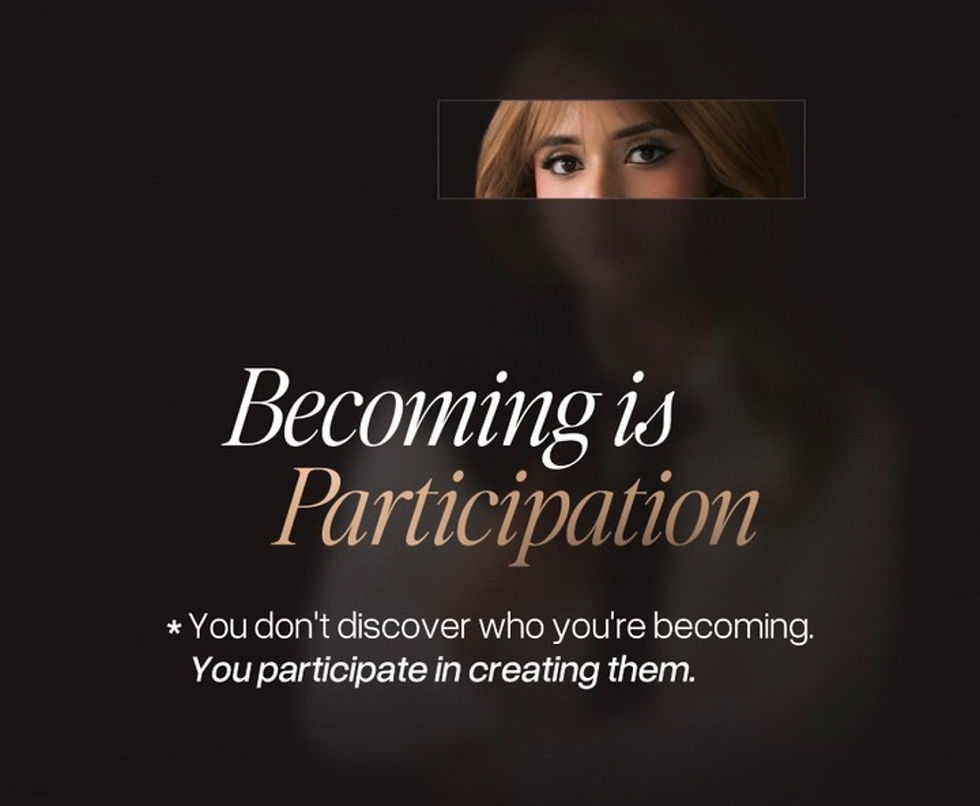
You do not simply discover who you are becoming. You participate in creating them. Of course, we do not control everything that shapes us. Our childhood, circumstances, culture, relationships, opportunities, losses and environments all influence who we become. Some people have significantly more freedom and resources to change their circumstances than others. Any serious conversation about personal growth has to acknowledge that.
But within the areas where we do have agency, participation matters. We participate through what we practise. Through what we tolerate. Through the environments we repeatedly enter. Through what we walk away from. Through what we attempt after failure. Through the standards we keep when they become inconvenient. Through the stories about ourselves that we continue repeating and the ones we finally decide have expired.
This is why I have never been completely satisfied with the instruction to “find yourself.”
Finding sounds passive, almost as though the finished person already exists somewhere and our only responsibility is to locate them.
Becoming is more alive than that. You will discover parts of yourself, certainly. But you will also create parts of yourself through experiences you have not had yet.
The person you become five years from now may have interests you cannot currently imagine, confidence you have not earned yet, opinions you have not encountered enough evidence to form and abilities you have never been placed in a situation to test.
You cannot completely know that person yet. You can participate in meeting them.
How to do your own Becoming Audit
You don’t need an elaborate journal, a perfect morning routine or hours of free time to do a Becoming Audit. You need enough honesty to look at the direction of your life rather than only the destination you hope to reach.
Start by describing the person you are becoming as clearly as you can. Focus less on what they own or have achieved and more on how they live. Think about their standards, habits, relationships, mindset, boundaries and the way they respond when life becomes difficult. Then compare that picture with the way you are currently living, without turning the difference into a reason to attack yourself.
Look at what you have tried recently and what those experiences taught you. Pay attention to the things that worked, but spend equal time with the things that did not. Ask what each experience revealed about what fits you, what drains you and what you might approach differently next time.
Then look for familiarity. Where are you repeatedly choosing what is known simply because it asks less of you? Again, this does not mean every comfortable part of your life needs disrupting. The question is whether comfort is protecting something valuable or preventing something necessary.
Finally, choose one piece of evidence to leave today. Not ten resolutions for the next six months. One decision. One conversation. One boundary. One attempt. One hour of work. One application. One honest no or courageous yes that is consistent with the person you say you want to become.
Then repeat the audit later. Because the answers should change as you do.
Stop waiting to find yourself
There is something comforting about the idea that one day we will finally “figure ourselves out.” We will know exactly who we are, what we want and where we are going, and all the uncertainty will disappear.
I am not sure that day exists. We are constantly encountering new experiences, new people, new information and new versions of ourselves. The person who answers these questions today may answer them differently several years from now.
That does not mean you failed to find yourself the first time. It means you kept living.
Maybe the goal is not to arrive at one final version of yourself. Maybe it is to become increasingly conscious of the role you play in creating the next one.
Meet them first. Put yourself to the test. Let nothing be wasted. Do not let comfort make every decision. Leave evidence through what you repeatedly do. Remember that becoming is participation.
Stop waiting to find yourself. Start creating yourself.
Continue the Becoming Audit
The Becoming Audit is a conversation I plan to keep returning to because becoming does not happen once. As our lives change, the questions worth asking change with them.
It also reflects the larger curiosity behind my work and Uncaged Mind. I explore a wide range of ideas, people, experiences and questions, particularly the things we often live with, believe or accept without stopping long enough to examine them. The subjects may change, but the curiosity remains.
If you take one thing from this Becoming Audit, let it be this: do not wait until you feel like the person you want to become before you start living like them.
Give that person some evidence to work with. Then see who you become.
Visit my website for more info!
Read more from Miss K
Miss K, Founder & Host of Uncaged Mind
Miss K is the founder and host of Uncaged Mind, a platform built to challenge conventional thinking through fearless, curiosity-led conversations. When questioning is often replaced by simply accepting, she is promoting critical thinking and bringing voices from vastly different fields into conversations that dare to go deeper. Beyond the microphone, Miss K stands for something deeply personal, encouraging women to own their voices and question the narratives handed to them. Through Uncaged Mind, she is building a space where curiosity is power, bold thinking is celebrated, and no meaningful question is off-limits.