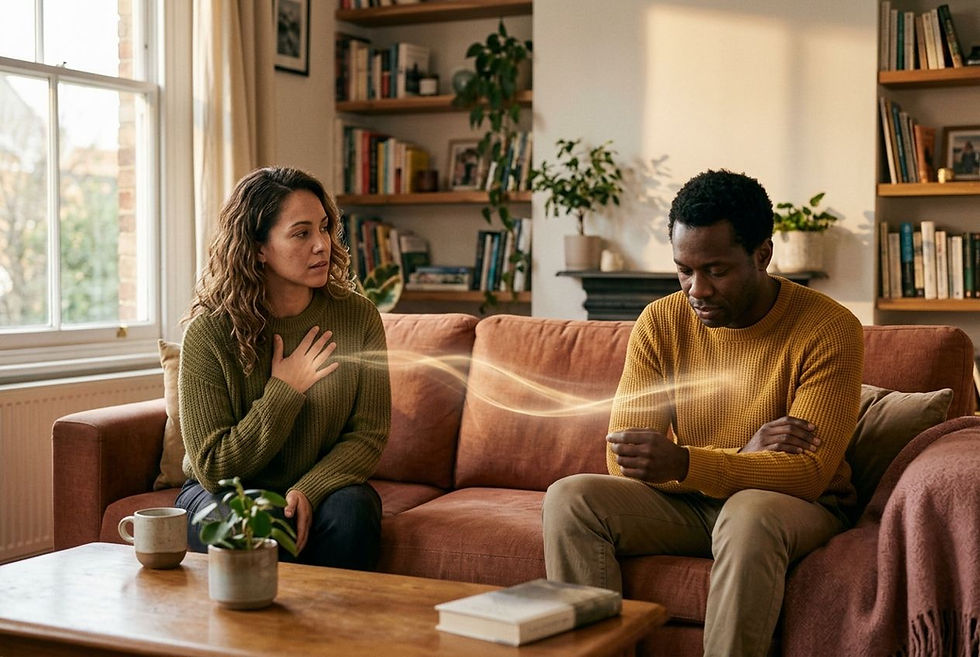
The Algorithm Doesn’t Care and 5 Steps to Reconnecting With Loved Ones Kidnapped by Social Media
Written by Justin Matley, Professional Coach
Justin Matley is a professional development coach and consultant who has spent over two award-winning decades working with individuals, Fortune 500 companies, and everyone in between in multiple roles. Through Matley Coaching, he helps individuals and organizations strengthen communication, improve time management, and develop practical strategies for personal and professional growth.

It seems to be a familiar 21st-century adage: “I have an uncle who…,” followed by something involving politics, social media, and a bubble that has caused family friction, perhaps estrangement. Yes, I have an uncle who went down the Facebook rabbit hole and never really came out. Yes, we still love each other.
Thankfully, yes, we still can connect during the holiday season and enjoy each other’s limited company. But it’s just… different. It’s more careful. It’s a little like a (friendly) poker game, where you’re keeping your cards close to the vest but still sneak in some banter between hands.
It’s not just my uncle. My mother went down that rabbit hole too and became political in ways she never was before. The algorithm bubble that formed extended into real life. Now she wasn’t just lapping up misinformation or getting wound up by clickbait; she started attending events with “like-minded” people. These were aggrieved groups who shared legitimate frustrations, inflamed and exaggerated by their shared digital bubbles.
My relationship with my mother has a longer history of careful love. This piece won’t go deeply into that history; there will be a day. It involves a loving but complicated upbringing with a familiar recipe. Once I got into adulthood, that recipe marinated for years until a mutual reset button was established, along with some ground rules. But regardless, seeing this digital, then real-world, devolution manifest was equally sad and unsurprising. She is easily manipulated and sometimes too trusting. She is bright and street-smart, but doesn’t regularly learn about the people and the world around her. She, like many of us, experiences loneliness, so is often desperate for community. The social media burrowing happened rapidly, and she sought personal connection with other burrowers soon thereafter.
To be clear: I see, and even sometimes relate to, the feelings of loneliness or frustration that magnetically draw people to these fates. I am not without mental and emotional struggle. Along with nearly 400 million others worldwide, I’ve experienced profound depression and crippling anxiety. But I also disagree with and disavow the prisons the algorithms have sent them to. The user may not feel that way. In fact, they genuinely view these places as safe havens: places where they can spew animosities or prejudices that, theoretically, aren’t “politically correct” in today’s society. While I may argue there’s good reason these biases shouldn’t be acceptable, our algorithms instruct us on our own version of reality. The combination of deep, often real feelings, a highly addictive “social” environment, and the relative cloak of anonymity that these platforms create is the recipe that has no trouble ripping families at the seams.
So, the question is: can we get back together? Is there a future where we can truly reconnect on a fundamentally human level? We have to start with this simple fact: social media isn’t going away. In fact, not only is it here to stay, but the manipulative political, corporate, and advertising behaviors are likely going to get worse. Maybe there will be a day when advertisers finally send some of us running, as TiVo and later DVR did with commercials, giving us a reliable way to opt out of certain elements. But there’s no getting away from the dopamine hook of social media without cutting it off at the source. That can be incredibly difficult for many of us, particularly those who actually like social media for its original intent: connecting with old friends and chuckling at cute cat videos.
I think there’s a way out, and it may take time. It’ll certainly take some baby steps. Here are 5 steps to meet our loved ones and reconnect as humans:
1. Make the first move
It is convenient to decide they are wholly in the wrong and that it is up to them to come to you. In many respects, this is a smart and self-preservationist approach. In dealing with genuine addicts, it recognizes that they need to come to a place where they truly want change. For the victims of an addict, it empowers them to find their own path, unmoored from the addict’s unpredictable whims and careless choices. This is responsible in many respects, but the social media environment creates an unavoidable variable: we’re (mostly all) sharing in its machinations. It’s just that we all can steer in different directions, largely based on a few semiconscious clicks that set us on our path. In that sense, we’re all in this mess together, manipulated by outside factors and, in many cases, influenced by generational ignorance of the medium. Choosing to be the bigger person by reaching out and simply saying, “Hey, I’ve been thinking of you,” takes guts, to be sure. It can feel pointless. But we aren’t giving up on our values. We are still accepting a lack of control over their decision-making, but we are taking control of our priorities and how we show our love without negatively affecting our psyche. This gives you the opportunity to set the tone, setting, and boundaries.
2. Find neutrality
Both in where you connect and what you’re going to talk about. Be ready to control the conversation. By extending the outreach, you’ve shown your intent, so it’s best to follow this up by setting the narrative. Small talk can be brutal, but it can establish a tone. Asking about things like children, sports, work, or even general health can establish that you care about what they care about and that it need not be a precursor to communication. This may be difficult. Their decisions of late may aggravate or offend you. But by opening the door and setting the tone, you establish the jurisdiction of the dialogue and your own integrity in the process.
3. Physical activity creates a distraction
There’s something about movement that, well, keeps things moving. If your family member is healthy enough to get around, consider a walk. If they’re even more robust, shoot hoops or play a round of golf, if you can tolerate them for a few hours (maybe keep it to nine holes or the driving range). It allows for a natural distraction, perfect for establishing space for a break in the action. It adds oxygen to the conversation, which gives things some levity. It allows for a place for your eyes to go now and then, away from an awkward stare, and a place for your reactions to filter through if you find frustration bubbling up. Even modest physical activity releases endorphins that can improve the mood and create positive energy, and simply sharing in an activity you both enjoy, even if it is just a walk, creates a safe setting where connection can thrive.
4. Withhold judgment
The fact that you’re embarking on this reconnection already tells us that judgment has been thrown around. That’s normal. We can’t simply disregard our values or how we feel about the world, particularly when it involves a loved one, someone we probably had on a pedestal at one point in our lives. But we can acknowledge disappointment in how things have unfolded and disagreement with some of their thoughts without going into a personal diatribe that can come across as belittlement. Generally speaking, people enter these places of detachment because of real, legitimate feelings, and social media creates an environment that allows for a sense of anonymity that hijacks the conscience. The resulting “bravery” of thought loses important context, expression, and personal values. We must regain those subtleties to establish common ground again. There’s no way to do this if we go in guns blazing.
5. Set expectations low
The chance of the entire experiment blowing up is not zero percent. The chance of a shared epiphany resulting in attending Thanksgiving dinner again isn’t one hundred percent. More often than not, the first shot across the bow can have mixed results, elicit complicated feelings, and perhaps feel like one big shrug. But it matters. Just seeing each other, hearing your voices together, sharing a chuckle or memory… this is what makes human relationships human. Don’t think you’re going to solve anything in the first meeting. Frankly, you may never solve anything. But you can establish a wobbly new normal that acknowledges each of your boundaries: areas of commonality that you can talk about without spontaneously combusting. A spot on the couch together where you can be present. These are wins, and you should take them where you can.
Without a doubt, we find ourselves in complicated times, and our brains haven’t developed enough to grapple with them naturally. It’s up to each of us to expedite the process, to find a path out and back to eye contact, a handshake, a hug. I hope these five steps put you on a path to take a leap, no matter how uncomfortable it feels. Our connections matter. Sure, some are unsalvageable. There are occasions that have enveloped our souls. Where we’ve done everything we can, said everything to be said. But in the land of the algorithm, a new monster has emerged, one that nobody asked for, that no one actively sought out. In the beginning, that first click was no fault of one’s own.
Read more from Justin Matley
Justin Matley, Professional Coach
Justin Matley is a professional development and communication coach and consultant and runs Matley Coaching, focused on effective communication, time management, and planning for individuals and businesses. He has spent over two award-winning decades working across media, production, advertising, and news industries, and a decade teaching in higher education. Justin is deeply committed to community and the ability of people and organizations to find balance, resonate authentically, and connect empathetically in a world rapidly making it more difficult to do so. He coaches individuals and consults with businesses across the country remotely and from his studio in Connecticut.