The 5 Elements of Your Success – A Step-by-Step Guide
Updated: Feb 5
Craig Cooke is a 5x Inc. 5000 CEO and Founder. He is an award-winning, bestselling Author of Business Kung Fu and a sought after success mentor.. Craig combines mindset, mastery and energetics with his Five Elements of Success framework to inspire and empower people to accellerate business growth and personal success.

Success isn’t just about talent or tactics, it’s about energy, how you mobilize it, direct it, and rebalance it when life and business apply pressure. In Business Kung Fu, I introduced the “Five Elements of Success,” a modern success framework inspired by the Chinese concept of wuxing, often translated as the Five Phases or the Five Elements, an interdependent, cyclical framework used for understanding patterns, relationships, and balance.
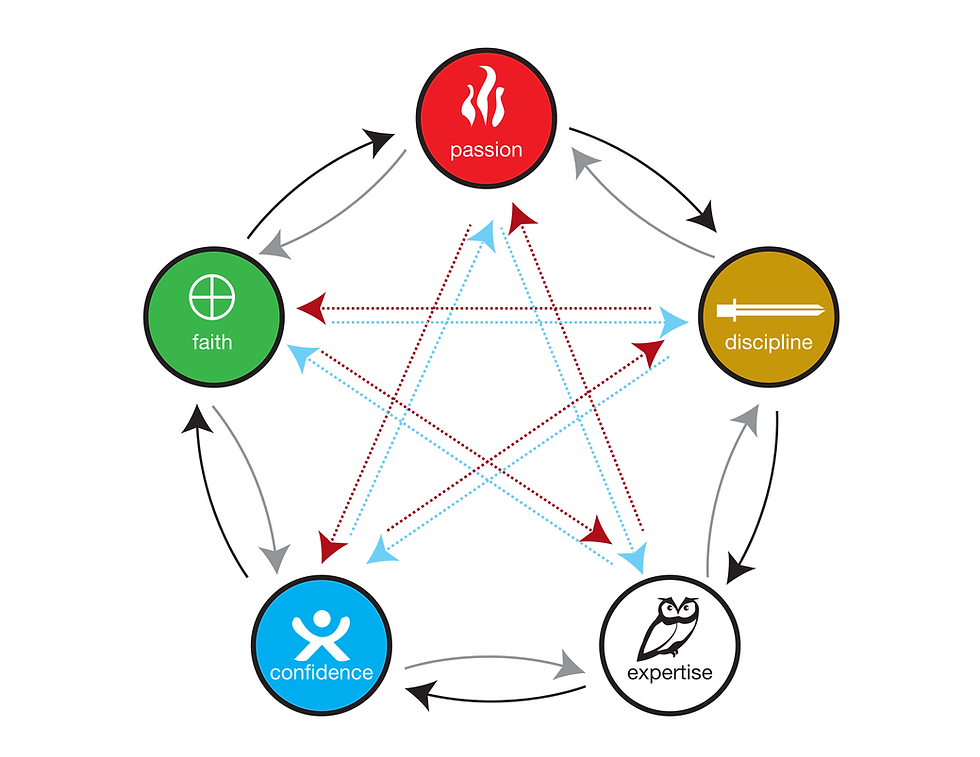
In this article, you’ll get a practical, step-by-step guide to applying the Five Elements as a diagnostic and execution tool so you can identify where you’re thriving, where you’re stuck, and what to do next.
Are you ready to embark on a new journey of success? Then I invite you to continue reading.
How to use this guide in 10 minutes
Before you read the five elements, do a quick self-audit. Rate yourself on each element listed below from 1–10 based on your current reality (not your aspiration). Just be intuitive about it. Then, read on to gain further understanding.
Passion (energy + meaning)
Discipline (structure + consistency)
Expertise (skill + refinement)
Confidence (decisiveness + execution)
Faith (resilience + trust through uncertainty)
The five elements of success
Here’s the model:
Passion: the spark that ignites and fuels your journey
Discipline: the structure that builds and holds your momentum
Expertise: the refinement and mastery of your unique skills
Confidence: the power to act on your mastery
Faith: the trust that carries you through uncertainty
Passion: The spark that ignites and fuels your journey
When you're aligned with your passion, something remarkable happens, you wake up energized. You’re excited to get up and go to work. While working, you enter what I call deep “Rhythm States,” which are flow states. This is where time disappears, and action feels effortless. It is not forced but rather completely natural. Typical psychology describes flow as an optimal experience arising from intense involvement in an enjoyable activity. However, passion is more than excitement. It’s the energetic driver that ignites and fuels discipline. It gives your work meaning. It aligns your spirit with your craft.
The two faces of imbalance: Excessive passion and deficient passion
Excessive passion: When passion runs too hot, it becomes chaotic. You say yes to everything. You chase shiny objects. You overcommit, creating motion without meaningful progress. This leads to negative emotions that trigger reactive behaviors, such as anxiety, scattered focus, feeling lost, or experiencing “busy” seasons with shallow wins. This leads to a feeling that you do not know where you are going, creating more anxiety and potentially even panic.
Deficient passion: When passion is depleted, you drift. There’s no north star, only a feeling of obligation. This also leads to a feeling of being lost. Common symptoms that surface are low motivation, a disconnection or total lack of purpose, decision fatigue, and avoidance. Ultimately, this can also lead to feelings of anxiety.
How to rebalance passion
Define the “why” in one sentence. If you can’t explain why this work matters, you’ll eventually outsource your motivation to caffeine and urgency. If you can’t find your “why,” then be introspective. Explore your existence. Find what brings you joy and fulfillment.
Create an “energy boundary.” Pick one thing you will stop doing for 30 days that drains you, something that blocks your focus and prevents progress on the things that matter to you.
Engineer one rhythm trigger. Use clear goals, protected time, and reduced interruptions. If you lead a team, consider how the work environment can foster flow. Look at your environment. Is it conducive to energy flowing freely, or is it cluttered and obstructive? What can you change in your environment from a multisensory experience to trigger a higher rhythm state?
Discipline: The structure that turns intention into results
Passion initiates, discipline converts. This is where you transform inspiration into a reliable execution rhythm. Discipline is not to be confused with rigidity. It’s governance, creating methods that keep you moving forward when motivation fluctuates. When it’s working, discipline looks like the following:
You have a realistic daily and weekly rhythm.
Your priorities show up on your calendar.
You execute consistently, even when you’re not “in the mood.”
You show up, you’re productive, and you’re effective.
The two faces of imbalance: Excessive discipline and deficient discipline
Excessive discipline: Yes, there are times when you can employ too much discipline. It often shows when you become mechanical, and creativity drops. You may confuse intensity with effectiveness. You start to ignore your own self-care, which then leads to feeling and exhibiting symptoms of burnout.
Deficient discipline: You start and stop. You renegotiate commitments with yourself daily. You start to operate in reactive mode. There is a lack of effectiveness in your work. Your productivity diminishes, and there may be times when you don’t even show up. Signs of apathy and laziness are displayed. It may sound harsh, but it is what it is.
How to build discipline without burning out
Make habits obvious, easy, and satisfying. Reduce friction in your work and day. Define small wins and achieve those on a regular basis. Use those wins as stepping stones to build upon. Take time to examine your work. Are you passionate about it? Are you committed to achieving what you set out to do? Work towards successfully implementing the three levels of discipline that I define in Business Kung Fu:
Showing up
Being productive
Being effective (producing value with your work)
Expertise: The refinement of your unique skills
Expertise is where you stop being merely competent and start becoming undeniably valuable. In business terms, this is your capability moat, the skill stack that differentiates you. Think of it this way, when you fulfill your potential of expertise, you build mastery of your craft, which leads to the attainment of wisdom. This wisdom is the understanding of how you can produce the maximum value in the marketplace for your products and services.
The two faces of imbalance: Excessive expertise and deficient expertise
Excessive expertise: It may sound odd, but yes, there can be an excess condition of expertise. There is a pattern that can be identified with this state of imbalance. It displays itself as perfectionism, over-iterating, and waiting for the perfect moment. Every day starts to feel the same. You’ve grown bored with your craft. Your work lacks novelty, challenge, or meaning. Your skills, once a competitive advantage, haven’t evolved with the market. This is the trap of expertise, believing mastery is a final destination, instead of an ever-evolving path needing continuous micro-adjustments. Left unchecked, this creates apathy, stagnation, and eventually, irrelevance.
Deficient expertise: The pattern of apathy looks similar to an excess condition, but the cause is different. You’ve developed solid skills, but not mastery. You’re good but not great. This is the plateau stage. You’ve hit a brick wall. Progress feels slow. Frustration builds. You feel stuck. You even question your path or your potential.
How to remain a master of your craft
Commit to the breakthrough. Mastery lives on the other side of the wall. Push through the boring reps. Invest in mentorship. Do the work others stop doing. Research how you can evolve your skills. What are the newest emerging trends in your industry? Research and discover a new approach. Experiment. Most people quit when the work gets dull. The master doubles down.
Confidence: The power to act on your mastery
Confidence is execution energy. It’s your willingness to place bets on decisions, on conversations, on moves that create leverage, and most importantly, on yourself. Your confidence enables you to execute behaviors necessary to produce outcomes. It builds trust with your team and customers. It inspires people to follow you. Your confidence is radiant and shines like the sun, attracting the right people and opportunities to your light.
The two faces of imbalance: Excessive confidence and deficient confidence
Excessive confidence: This is when confidence becomes self-centered. It’s all about you. You don’t credit your team, and you ignore feedback. You stop listening to others because you believe you’ve got all the answers. You even take reckless risks. This kind of arrogance blinds you. You don’t realize what you don’t know, and you stop growing. Eventually, life humbles you.
Deficient confidence: This is the opposite extreme, a life led by fear. Fear of failure. Fear of judgment. Fear of not being “enough.” This typically shows up as procrastination, hesitation, and negative self-talk. Unfortunately, this can lead to missed opportunities before they ever have a chance to bloom. You tell yourself, “Who do you think you are?” “You’re not good enough.” “You can’t pull this off.” This is one of the most dangerous enemies of success, internal sabotage.
How to radiate real confidence and shine like the sun
Understand your value. Know the value you bring to the room, to any situation. Utilize positive affirmations. Study personal development. When balanced, confidence becomes grace in action. You execute without force. You lead without ego. You speak with clarity. You listen without defensiveness. Balanced confidence is magnetic. It doesn’t shout, it shines. It doesn’t convince, it invites.
Faith: The trust that carries you through uncertainty
Faith is the stabilizer when outcomes aren’t immediate, when you’re doing the work but the scoreboard hasn’t moved yet. This isn’t passive positivity. Faith is strategic resilience, the ability to keep going, learn, and re-engage without collapsing into doubt or cynicism. Faith is not wishful thinking. It’s not blind hope. It’s not naïve optimism. Faith is the power to move forward when logic, evidence, and emotion all say you shouldn’t. It is the element that carries you through the unknown. It’s what keeps the warrior standing when the battle seems lost.
I define two levels of faith. They are:
Faith in self: This is where it begins. The belief that you are capable. The conviction that you can overcome. That you can build something from nothing. That you can rise again.
Faith in something greater than yourself: This is where you trust in a higher power, a divine intelligence. A certainty that you have a team in the spirit world that loves, guides, and supports you. An understanding that there is a universal rhythm that conspires for your success.
The two faces of imbalance: Excessive faith and deficient faith
Excessive faith: You think positively. You set intentions. You trust the universe will provide, but you don’t act. You’re meditating, journaling, vision boarding, yet avoiding what needs to be done. There’s no movement. No momentum. Does this sound familiar? Often, people question, “Why isn’t this law of attraction stuff working?” You may even fall into the trap of relying on hope, which is not a strategy.
Deficient faith: This is the darkest state. Faith is gone. Hope is lost. You’ve hit the bottom. You are seconds away from quitting. This is the most dangerous place to be. This is where you can give up, and despite all your time and effort, walk away from the opportunities that are within reach but that you just can’t see through the fog of despair.
How to retain a healthy balance of faith
Like a single candle in a pitch-black cave, one tiny flame of belief can begin to light the way. With the element of faith, keep in mind that you need a healthy balance. This means believing with certainty but also remaining grounded and practical in the world. A healthy and practical way of balancing your faith includes the following habits:
Look for signs and symbols
Clear your mind and listen for guidance
Hear the inner voice to guide you forward
Employ a meditation practice
Conduct daily affirmations to co-create the reality you desire
Take action on any insights you derive from seeing and listening
Even a flicker of faith can ignite the fire of transformation. Reach for one reason to believe again. Find one truth, one ally, one insight, and follow it. Remember, the warrior spirit endures through faith. And once you overcome, faith reignites passion. The cycle begins again, stronger, wiser, and more aligned than before.
Maintaining the balance with the 5 elements of success
Even when you have successfully balanced each of the elements, life has a funny way of knocking you out of balance. This occurs through unexpected events, usually through interactions with people, places, and things in a variety of environments. The trick is, "How quickly can you get back to balance and maintain that balance over time?" The best way is to employ practices that engage the entire being, mind, body, and spirit. The practice that has had the biggest, most profound impact on me is qigong.
If you’d like a guided path to apply the Five Elements through an embodied practice framework, my program Qigong for Business Professionals integrates energetic regulation, performance mindset, and the Five Elements model. And if you want the full strategic foundation behind the model, you can explore Business Kung Fu, which details how to navigate the chaos of the professional world using this approach.
If you’re ready to identify which element is currently constraining your growth and build a personalized rebalance plan, I invite you to reach out for one-on-one guidance and support. Start here, contact Craig Cooke.
Read more from Craig Cooke
Craig Cooke, Mentor, Author, Speaker & Conscious Entrepreneur
Craig Cooke embodies success. He founded a digital marketing agency in 1996 with $1,300 and grew it towards a successful exit to a world-class strategic buyer. He is also a Doctor of Chinese Energetic Medicine (medical qigong) and an award-winning Author of the national bestselling book, "Business Kung Fu." Craig serves as a "Success Sifu," inspiring and empowering people, helping them reach what he calls their "divine potential." You can find Craig working with people online and in person through group and individual engagements.