

Research Compares Gay Dads and Straight Parents
Written by Bryan McColgan, Physician Journalist
Dr. Bryan McColgan is an international authority on IVF and surrogacy for gay men. He is the founder of the Gay Dad Reporter, the world’s first online platform dedicated to news about surrogacy and rainbow families, with a focus on gay men.

The journal Family Process published the article, “European Gay Fathers via Surrogacy: Parenting, Social Support, Anti-Gay Microaggressions, and Child Behavior Problems.” The article was written by researchers from the University of Pavia in Italy, which I initially thought would be problematic given how the Italian government has made surrogacy performed anywhere in the world illegal, as well as enacted a number of other anti-LGBTQ+ family policies.
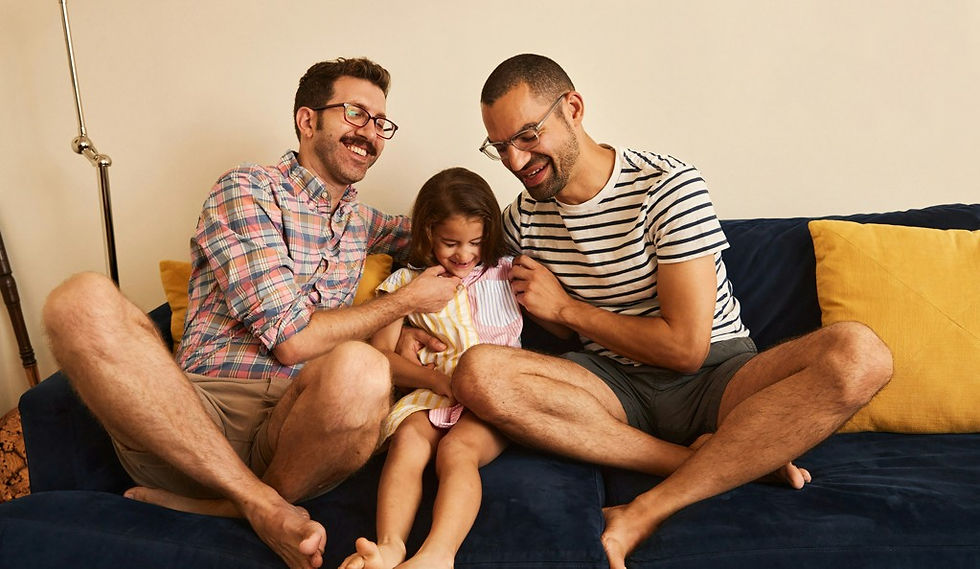
However, the authors are not fueling the flames of the Italian government’s prejudice, but rather aiming to bring rationale and scientific evidence to the forefront of the discussion, as they write in this article’s introduction:
“We hoped to produce evidence that might dispel prejudice and discrimination against gay fathers via surrogacy among social policymakers, as well as to provide useful, empirically based insights for clinicians interacting with gay father families.”
So, with this scientific and enlightened perspective, what did the authors aim to study? How did they go about it? Was the study well designed? What were the results and limitations of the study? What are the conclusions?
Not to bury the lead, but the results were pretty fantastic for gay dads, who essentially outperformed straight parents in every aspect of parenting, child well-being, relationships, and family dynamics.
Introduction
The article does a good job of setting the landscape of surrogacy for gay men in Europe. It’s a complex patchwork of regulations that vary among countries and often force men to build their families internationally, creating emotional and economic challenges.
In terms of previous research, the article does a good job of summarizing and comparing previous studies in the U.S., Australia, Israel, and Italy that showed children in families of gay men develop similarly to children raised in mother-father families.
The current study aimed to examine a number of different behavioral areas in order to get a complete picture of family health and dynamics.
Health of the children through evaluation of their internalizing (i.e., anxiety, depression, social withdrawal) and externalizing (i.e., aggression, rule-breaking) problems.
Parenting styles, including analysis of the degree to which parents were either authoritative (i.e., firm but fair), authoritarian (i.e., strict), or permissive (i.e., lackadaisical).
Coparenting approach to the division of parenting labor (i.e., “Who does what?”) and satisfaction with that division.
Couple relationship happiness.
Stigmatization and microaggressions experienced by the gay couples because of their sexual orientation and family composition.
Social support through family, friends, and chosen family.
The relationships between these different areas and their impact on each other.
The authors hypothesized that there would be no significant differences between the groups in terms of the health of the children, but they did anticipate that family interactions would affect child behavior more than family composition. They also hypothesized that gay parents would be negatively affected by stigma and microaggressions.
Methods
The study population included 67 gay fathers (one from each family) and 67 heterosexual parents (one from each family, 62 of whom were mothers). The parent who identified as the primary caregiver completed the questionnaires. Where parents shared parenting responsibilities equally and spent equal time with the child, they were asked to flip a coin to determine who would complete the questionnaires.
At the start of the study, there were some significant differences between the parents:
Gay fathers were older.
Gay fathers were more highly educated.
Gay fathers had higher yearly incomes.
Gay fathers lived primarily in France and Spain, while straight parents lived more in Switzerland and Luxembourg. (In total, 11 European countries were represented across both groups.)
Importantly, the study used well-validated, widely used questionnaires and other instruments to objectively measure the children’s health, parenting styles, coparenting responsibilities, relationship satisfaction, stigma, and social support. This allows the results to have higher external validity and broader applicability to gay parents, given the reproducible and objective nature of the design.
Research compares gay dads and straight parents
Not to be too biased, but the results were fantastic for gay fathers. There are a number of great tables in the paper that provide all the detailed results and analyses.
In summary, gay fathers performed better in all areas:
Gay fathers reported fewer externalizing problems and fewer internalizing problems in their children relative to straight parents.
Gay fathers reported greater positive coparenting, more equal sharing of childcare tasks, and greater satisfaction with task sharing compared to straight parents.
Gay fathers showed greater authoritative parenting, lower permissive parenting, and greater couple relationship satisfaction than straight parents.
So, gay fathers win (at least in this particular study), but why they won, and the limitations of the study, are critical components of the article’s discussion section.
Discussion
The authors elaborate on some possible explanations for why gay fathers outperformed their straight counterparts.
The children of gay fathers are so incredibly wanted, and I believe this desire and love are so strong that they will have positive generational impacts and make the world a better place. The authors do a great job of describing this as well:
“Whereas some children born to heterosexual parents are conceived by accident, children of gay male parents via surrogacy are always planned, wanted, and the result of a long, complex, expensive journey marked by sustained effort and sometimes many challenges (linked to fathers’ families of origin, friends, and colleagues). The surrogacy journey also requires gay fathers to spend significant time with the surrogacy agency, surrogate, surrogate’s husband/partner, psychologists, physicians, case workers, and attorneys. Thus, it is reasonable to assume that gay parents who pursue this pathway to parenthood are extremely motivated to have children, financially successful, and capable of bringing complex plans to fruition.”
Gay fathers may have stronger and more stable relationships given the arduous task they face as a couple in having a child through surrogacy.
Given the significant differences in education and yearly income between the groups, gay fathers may benefit from a more favorable financial environment, which has been shown to be associated with fewer child behavior problems.
Gay fathers (and lesbian mothers) may be less likely to conform to traditional gender roles and more likely to be voluntarily involved in child caregiving and to coparent more equitably.
The study’s limitations are important to discuss, as there are some aspects that could have affected the results and can be considered for future research:
The geographical representation across Europe was not controlled between the groups, so other cultural or social elements could have impacted the results.
The socioeconomic advantage of the gay fathers is another limitation, but the authors admit that this is likely an unavoidable limitation for this type of research. Because of the high cost of surrogacy, it is not possible to find a large sample of gay fathers via surrogacy whose education levels and incomes match those of straight parents.
The straight primary caregivers in the present study were typically mothers, so the “parenting” results for straight couples are more accurately described as “mothering” results. However, this is representative of the current social climate, so it still feels broadly applicable.
The study did not include straight couples who used surrogacy, but the authors acknowledge that this is not an “apples-to-apples” comparison. Straight couples view surrogacy as a “last resort,” full of feelings of fertility shame and failure, while gay couples have only positive associations with the process given the nature of their reproductive limitations.
As with all scientific research, the sample sizes could always be larger in order to provide even more confidence in the results, but the authors confirm that the size of the study population did allow for large and medium effects or differences to be measured by the statistical modeling.
Conclusions
Interestingly, the authors disproved part of their own hypothesis in that they anticipated that the gay parents would perform the same as the straight ones. Given that they performed significantly better across all metrics, the results completely refute concerns about the psychological adjustment of children raised by gay fathers. They also suggest that prohibitions against surrogacy for gay males seem entirely based on prejudice, with no basis in social science research.
It should not be overlooked that, while gay fathers and their children performed exceptionally well, they were negatively impacted by stigma and microaggressions. Therefore, social changes still need to evolve to make the world truly healthy for all rainbow families.
However, this research is an incredible step in the direction of truth, and I hope it will contribute to regulations and policies that allow gay men to continue to have children in Europe and all over the world.
Read more from Bryan McColgan
Bryan McColgan, Physician Journalist
Dr. Bryan McColgan is a Stanford and Columbia University-trained physician who is currently on his first journey to fatherhood through surrogacy. Navigating IVF and surrogacy in the United States from his current home in Sweden led Bryan to start the Gay Dad Reporter, the leading online platform dedicated to assisted reproduction for gay intended fathers. His mission is ethical surrogacy for gay intended dads everywhere.







