Polly Angel Interview on How Meeting Your Inner Team Can Change the Way You See Yourself
Polly Angel is a Rapid Transformational Therapy practitioner, IFS and Somatic Trauma-Informed Coach, and the founder of The Angel Path. She is the creator of Meet Your Inner Team, a movement changing the way adults understand themselves and helping children find themselves before they lose their way.
Polly Angel, Founder of The Angel Path
Can you tell us about The Angel Path and what inspired you to create Meet Your Inner Team?
I created The Angel Path to guide people back to their own wellness. Nobody can do the work for you. It has to come from within. But having a guide makes all the difference, and that's what I want to be. Someone who takes your hand and leads you gently, with empathy, in the right direction. Hence the name.
Discovering Internal Family Systems changed my life and the way I treat myself. In my therapy room, I watched women have the same breakthrough. The voice driving them or keeping them small wasn't the truth. It was a part of them that had learned its job in childhood. And almost every time, they asked, "Why didn't anyone tell me this when I was younger?"
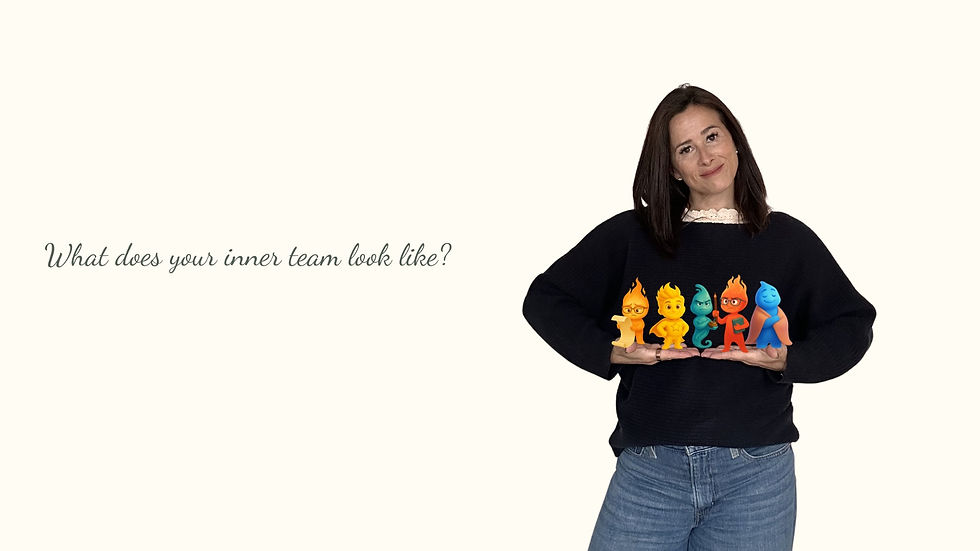
I wanted to share it with everyone, but IFS can feel complicated at first. So I found a way to make it fun, visual and easy to grasp, for anyone from a five-year-old to a grandparent. That became Meet Your Inner Team: a card deck, a workbook and a children's storybook.
At its heart, it helps us be more compassionate towards ourselves. And that's a huge leap towards mental wellness.
What helped you recognise that your own people-pleasing patterns were connected to beliefs formed much earlier in life?
I didn't realise my people-pleasing was something I could change. I thought it was simply who I was, not a behaviour I'd learned to stay noticed, loved and appreciated.
I was proud of it. In my family, I was the Peacekeeper, the go-between. People talked to me rather than to each other, and I always tried to make things better. I see now that this let others avoid things that needed dealing with. I never stopped to ask what it was costing me.
My hypnotherapy training changed that. Learning about beliefs and the roles we take on, I could suddenly see the patterns. Then, in my own session, came a moment I'll never forget. I understood that I had decided my purpose was to look after my mother. And I'd made that decision before I was even born, while I was still in the womb.
No wonder that part worked so hard. It wasn't a flaw. It was a loyal part still doing a job it took on before I had words. So I thanked it and gave it a new one. I still care deeply about others. I just no longer abandon myself to do it.
How do Rapid Transformational Therapy, Internal Family Systems, and somatic practices work together in your approach to helping women change long-standing patterns?
I think of them as three ways into the same house.
Rapid Transformational Therapy, which I trained in through Marisa Peer's method, uses hypnosis to find the early experience where a belief like "I'm not enough" first took hold. Internal Family Systems gives us the map, so we can meet the part carrying that belief and help it find a healthier role.
What I love about parts work is that we don't always need to go back to the event that caused the hurt. We can work with the part that has been protecting you, without reliving what happened. So for anyone worried about being retraumatised, IFS offers a gentler way in.
And somatic work brings the body along, because we hold so much of our history physically. One client went back to her chiropractor after a session with me, and he asked her what on earth had happened. The pain in her back had gone. Another client had lived with arthritis and could only get down the stairs sideways. After a big release in hypnotherapy, she now walks down facing forwards, one foot on each step, without pain.
Together they follow my approach: Root Cause. Rebalance. Renew.
Why do behaviours like perfectionism and people-pleasing often continue into adulthood, even when we recognise they're holding us back?
Because they worked. At some point, usually in childhood, being perfect or keeping everyone happy kept us safe. Nobody ever told that part we grew up, so it carries on, decades later.
They're also deeply practised. Do something for thirty or forty years and it becomes automatic in your body. Changing those well-worn pathways takes effort. With hypnotherapy it can happen surprisingly quickly, but you still choose the new version of you every day.
And many of us feel attached to these traits because we believe they're who we are. Changing how you behave doesn't change who you are. It changes how you experience life.
Here's an image I love. Picture one of the hardest moments of your life. Now imagine walking back into that scene and finding the lesson waiting for you, like a little parcel tied with a bow. You pick up the gift and carry it into your future. And you leave the scene and the old feelings behind.
Nobody is broken. We are all just running job descriptions written by children who were doing their very best to keep us safe.
What have you learned from bringing Meet Your Inner Team into schools about how children understand their emotions?
It's early days for school trials, but I've shown the cards to all sorts of age groups, even younger than they're designed for. From five upwards, children relate to them incredibly quickly. They love the characters and the colours, and they spot their brother, sister and parents straight away. We don't always give children enough credit for the wisdom they hold.
The biggest shift is that a feeling becomes a part, not who they are. "My Angry One came out" is very different from "I'm a naughty boy." That lowers shame almost straight away. And it's psychoeducation, not therapy: a shared language teachers and parents can use too.
It also gives children a choice. The thing I hear most from women in my therapy room is that they never felt they had one. If there was hardship, they just had to live with it. Children who know their inner team learn that they do have a choice. Which helpers to take to school. Which voice gets to be loudest. And how to bring their team back into balance.
How can someone begin to recognise when their inner Worrier or Perfectionist is trying to protect them?
Start by noticing the moment it arrives. Protectors have a signature. The Worrier often shows up as a racing mind full of "what ifs", usually late at night. The Perfectionist might be rewriting an email for the fourth time.
When you catch it, close your eyes for a moment and notice where it sits in your body. A tight chest, perhaps, or a knot in your stomach. Then name it. "That's my Worrier." Noticing and naming creates a little space between you and the feeling.
Then get curious. One question I find especially useful is this: what would happen to me if this part wasn't here any more? Most people feel an immediate sense of loss, or lack, or exposure. That's the clue. It tells you the part has been protecting you, using a strategy it learned long ago.
Finally, thank it. A part that feels appreciated rather than attacked can finally begin to relax.
What is one practical way parents can help children understand difficult emotions without making them feel something is wrong with them?
Start with a story. That's why I wrote An ExtraOrdinary Adventure. It shows children that they have a whole team of characters inside them, each with a part to play. As they follow the story, they naturally become more compassionate towards every part of themselves.
Then bring the language home. Change "you are" to "a part of you". Instead of "you're being so naughty", try "you seem to have a very angry part today. What does your Angry One want you to know?" The child is no longer the problem. Instead of getting cross with them for having a feeling, we invite them to be curious about it.
And model it yourself. "I snapped just then. That was my Angry One. I'm tired, I'm sorry, and I'm going to take a breath." Children learn far more from how we treat ourselves than from anything we tell them.
If households across the country used this language, I truly believe we'd raise a generation with real emotional literacy, able to express themselves without blame or shame.
You often say, "There is nothing wrong with you. You are simply out of balance." What does finding that balance look like in everyday life?
I often picture a DJ's mixing desk. Put one of your characters on each slider. The parts you use all the time are pushed right to the top. The ones you wish got more of a look-in sit right at the bottom. The result is a jagged zigzag. That's what being out of balance looks like.
Balance is gently sliding the hardworking parts down a notch and nudging the quieter ones up. Every characteristic is good in small doses. Too much of anything, even a good thing, is never healthy.
In everyday life, it might be noticing your Striver pushing you to answer emails at 10pm, thanking it, and closing the laptop anyway. Catching your Peacekeeper about to say yes, and saying "let me get back to you" instead. Recognising that the pull towards the biscuit tin is your Soother, and asking what you really need.
You're in charge of the mixing desk. You'll lose the balance and find it again many times a day. The difference is that you notice, and meet yourself with curiosity instead of criticism.
If you could change one thing about how we teach emotional intelligence to the next generation, what would it be?
Teach it early, and teach it to the grown-ups at the same time.
Children are so imaginative. When they understand their inner team, they use it in incredible ways. One eight-year-old I know turns to her Wise Guide when she's stuck in class, and takes her Angry One to splash in her sparkly pond when things get too much. She's eight, and she already knows how to look after herself.
But it can't be another lesson delivered to children. They learn emotional intelligence by watching us. When the adults at home and at school share the same simple language, a child gets consistency, and consistency is deeply regulating.
Of course they'll still face challenges. That's life. But when hard times come, perhaps they'll have the tools to manage themselves a little better, or at least know where to start the work.
Imagine a generation who never had to wait until adulthood to understand themselves.