

NYC TLC Insurance Requirements and 7 Steps After a Rideshare Crash
A rideshare crash in New York City can unfold quickly. The driver may leave before you can record the TLC plate or insurance details. NYC TLC insurance requirements point you toward the policy that may respond after a rideshare or livery crash, but you must verify the coverage tied to the specific vehicle and collision date. Once you are safe, preserve the ride receipt because app records can change.

The Taxi and Limousine Commission (TLC) implemented updated vehicle insurance requirements effective March 1, 2026. The changes reduce the required amount of personal injury protection coverage (pursuant to Local Law 90 of 2025).
1. Get to safety and seek medical care
Address immediate danger first
Move away from traffic when you can safely do so. If anyone might be hurt, call 911 and follow emergency personnel's instructions. Never postpone emergency care to take photographs or collect a driver's information.
Create a medical record of your symptoms
Seek a medical evaluation promptly, even if discomfort seems mild. Neck pain, back pain, concussion symptoms, and injuries to muscles or ligaments may become noticeable later. The Centers for Disease Control and Prevention advises monitoring for concussion symptoms after a head injury. Describe the collision and your symptoms accurately to the clinician.
Keep discharge papers, prescriptions, referral instructions, and appointment records. Insurers may review these records to determine whether an injury is connected to the crash.
2. Report the collision through the proper channels
Contact police when injuries or significant damage are involved
Request the incident number from responding police. A collision report may identify drivers, owners, vehicles, plates, and witnesses. It can also record apparent injuries, although legal responsibility is determined separately.
Under New York DMV guidance, drivers generally must file an MV-104 after a crash that causes injury or death, or damage above $1,000 to one person's property. The filing deadline for a qualifying crash is generally 10 days.
Notify the rideshare platform
Report the collision through Uber or Lyft and save the confirmation. Provide the date, approximate time, pickup location, destination, and reported injuries. Do not guess about speed or fault.
An app report does not replace a driver's required accident report. A recorded insurance statement or broad medical authorization also goes beyond a basic incident report, so understand what is being requested before agreeing.
3. Preserve the ride receipt and app records
A ride receipt can connect a passenger to a vehicle and help establish whether a trip was active at the time of impact. Take screenshots of the receipt and driver profile, including the vehicle description, plate, route, pickup and drop-off points, app messages, and incident report confirmation.
Export or email the receipt when possible, and keep a backup outside your phone. Preserve cancellation notices, fare adjustments, and later support messages. Do not crop out dates, times, sender details, or surrounding context. If someone else booked the ride, ask them to preserve the complete record.
4. Photograph the TLC identifiers and crash scene
Photograph the plates and markings
If you can do so safely and without delaying treatment, photograph each vehicle identifier. Take close-up images of the TLC plate and registration plate, along with wider images showing which vehicle carries them.
Record the vehicle number, affiliated base name, driver's TLC license, and exterior markings when available. An Uber or Lyft logo alone does not identify the insurer or policy.
Document the physical scene
Photograph the vehicle's position, visible damage, traffic signals, lane markings, debris, and weather conditions. Note nearby buildings with cameras, and ask witnesses for permission to record their contact information.
5. Track lost income and crash-related expenses
Create a dedicated folder for crash-related financial records. Keep receipts for medical copayments, prescriptions, transportation to appointments, damaged property, and replacement services such as paid household help.
Document missed work with payroll records or employer confirmation. Self-employed people can retain invoices, contracts, calendar entries, bank records, and messages about canceled work.
A short symptom and appointment log can connect dates with practical limitations. Record what happened without predicting a permanent outcome, and distinguish amounts paid from amounts billed.
6. Pin down the policy under the NYC TLC insurance requirements
Why a TLC vehicle uses commercial coverage
TLC insurance is commercial, or group coverage maintained for a vehicle licensed to transport passengers for hire in New York City. It differs from an ordinary personal auto policy because the vehicle operates in a regulated for-hire market.
Liability coverage addresses harm for which an insured is legally responsible. No-fault benefits pay eligible injury expenses regardless of fault, subject to applicable rules and policy terms. App involvement alone does not identify the policy attached to the vehicle, its owner, or its affiliated base.
What the 2026 minimums require
Under TLC rules effective March 1, 2026, required no-fault personal injury protection (PIP) decreased from $200,000 to $100,000 per person. Licensed vehicles with eight or fewer passenger seats continue to require at least $100,000 in bodily injury liability coverage per person and $300,000 per accident under existing law. The New York City Taxi and Limousine Commission publishes the applicable vehicle insurance requirements.
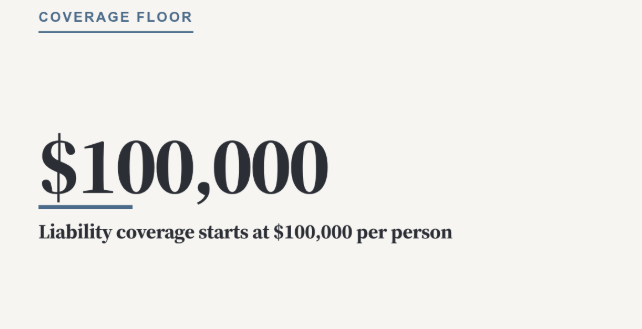
The 2026 rules updated the minimum PIP coverage while maintaining existing liability minimums for TLC-licensed vehicles with eight or fewer passenger seats.
Ordinary New York private-car minimums are $25,000 per person and $50,000 per accident for nonfatal bodily injury, plus $10,000 for property damage, with separate death limits. TLC minimums don't set an individual policy's actual limits, and larger passenger vehicles may have different requirements.
Verify the vehicle's coverage
Find the vehicle record using its TLC plate or vehicle license number.
Review the TLC Licensee Snapshot for listed insurer and policy information.
Compare the coverage effective dates with the collision date.
Ask the insurer to verify coverage in writing.
An FH-1 certificate documents insurance filed with TLC, but the filing alone does not prove that the policy remained in force on the collision date. Confirm the effective dates and obtain the insurer's coverage position before relying on a database entry or certificate.
7. Calendar no-fault and public-entity deadlines
The lawsuit deadline may not be the first deadline that matters.
Separate benefit notices from lawsuit deadlines
New York Department of Financial Services guidance generally requires written notice of an accident for no-fault benefits within 30 days. Limited exceptions require clear, reasonable justification. Medical bills and wage-loss materials have separate submission rules, so request the correct forms from the appropriate insurer.
New York courts' limitations guidance generally gives people three years to file ordinary personal injury actions. Shorter periods may apply to particular defendants or claims, and individual circumstances can affect the calculation.
Understand the public-entity issue
A collision involving a city vehicle or public employee may trigger a separate notice requirement. Claims involving a defective public roadway or public authority can also follow specialized procedures. New York municipal claim rules generally require notice within 90 days for covered claims, but the requirements do not apply uniformly to every agency or authority.
Identify the entity promptly and confirm who must receive formal notice. The following periods are general New York timeframes, not a deadline calculation for an individual case.
General New York reporting and filing timeframes:
Potential requirement | General timing | Immediate action |
Driver's DMV accident report | Within 10 days of a qualifying crash | Submit the MV-104 |
No-fault accident notice | Generally 30 days after the accident | Identify the insurer and give written notice |
Municipal notice of claim | Generally 90 days after the claim arises | Confirm the entity and delivery procedure |
Ordinary personal injury lawsuit | Generally three years | Confirm the applicable filing period |
When the usual information is missing
The driver or TLC details are unavailable
Use the ride receipt and police incident number to narrow the search. Include the trip time, pickup location, destination, vehicle description, and any partial plate number. Camera systems may overwrite footage quickly, so request preservation promptly through the owner or an appropriate legal process. Uber, Lyft, and TLC may require formal procedures before releasing private records.
The record suggests that coverage lapsed
A listed lapse does not necessarily mean that no source of recovery exists. Check for replacement coverage, confirm cancellation dates, and investigate any available uninsured-motorist protection. The Motor Vehicle Accident Indemnification Corporation may be relevant in some cases, but eligibility and notice requirements depend on factors such as residency, insurance status, vehicle identification, and other available coverage.
Several parties may share responsibility
The driver, vehicle owner, another motorist, employer, base, contractor, or public entity may have different roles. App use alone does not establish the rideshare company's responsibility. Preserve identifiers for every vehicle, and don't sign a release before understanding the collision, available coverage, and the rights the agreement would require you to surrender.
Protect the record while the details are fresh
Medical attention and prompt reporting create an initial record. Preserving trip details and vehicle identifiers supports later policy checks, while organized financial records document the collision's practical effects. Acting promptly helps protect evidence, identify the correct vehicle and insurer, and preserve options while the relevant information remains available.







